
This post was originally published on Substack. That platform does not align with my values so I have re-published it here. If you have subscribed to my Substack, please do subscribe to here instead.
I would not be in my line of work if I did not love being around water. I grew up, was raised, and lived most of my life on the banks of the Humber. Whether it was the open expanses of the bank and cliffs between Barton and South Ferriby, or the concrete defences around the Hull tidal barrier, I have marvelled and been inspired by the mighty tides and the big open skies of the Estuary. These were places I would sit, reflect, and let my imagination wonder.
Until recently, the only time I have lived away from the Humber was three years spent in Coventry. This city, a La Corbusien nightmare of concrete and ringroad, sits close to the point in the UK that is furthest away from any coast. Having buried its river, the Sherbourne, under the concrete the post-war planners loved so much, it is entirely cut off from any form of waterscape altogether. When I worked there, the ‘Jerde Masterplan’ had an ambition to install water features along the old route of the river but this is a long way from the daylighting of buried rivers that has been successful elsewhere.

Needless to say, I did not enjoy my time in Coventry. I do not want to bash it, it has lots going for it, but I personally was not inspired or enriched by it. I did not find any spaces where I could sit and imagine. It was not the city for me. A large part of this, I think, was the lack of a waterscape and I felt homesick and longed to be under those open skies of the Humber once again the whole time.
It was not easy then to prepare myself for the move to York. It was move an hour’s drive inland, away from the estuary and the sea. I did not want to feel disconnected and homesick again. Thankfully, York did not suffer secondary devastation by well-intentioned yet misguided town planners whilst recovering from the Blitz and retains much of its Medieval charm (I once heard pre-war Coventry described as “York on steroids”). The River Ouse flows through its centre and I now live just a short walk away. Lunchtime and after-work meanders along its banks have become a near daily ritual, watching the boats, the rowers, and birds diving for fish and trying to guess where they’ll pop up again.
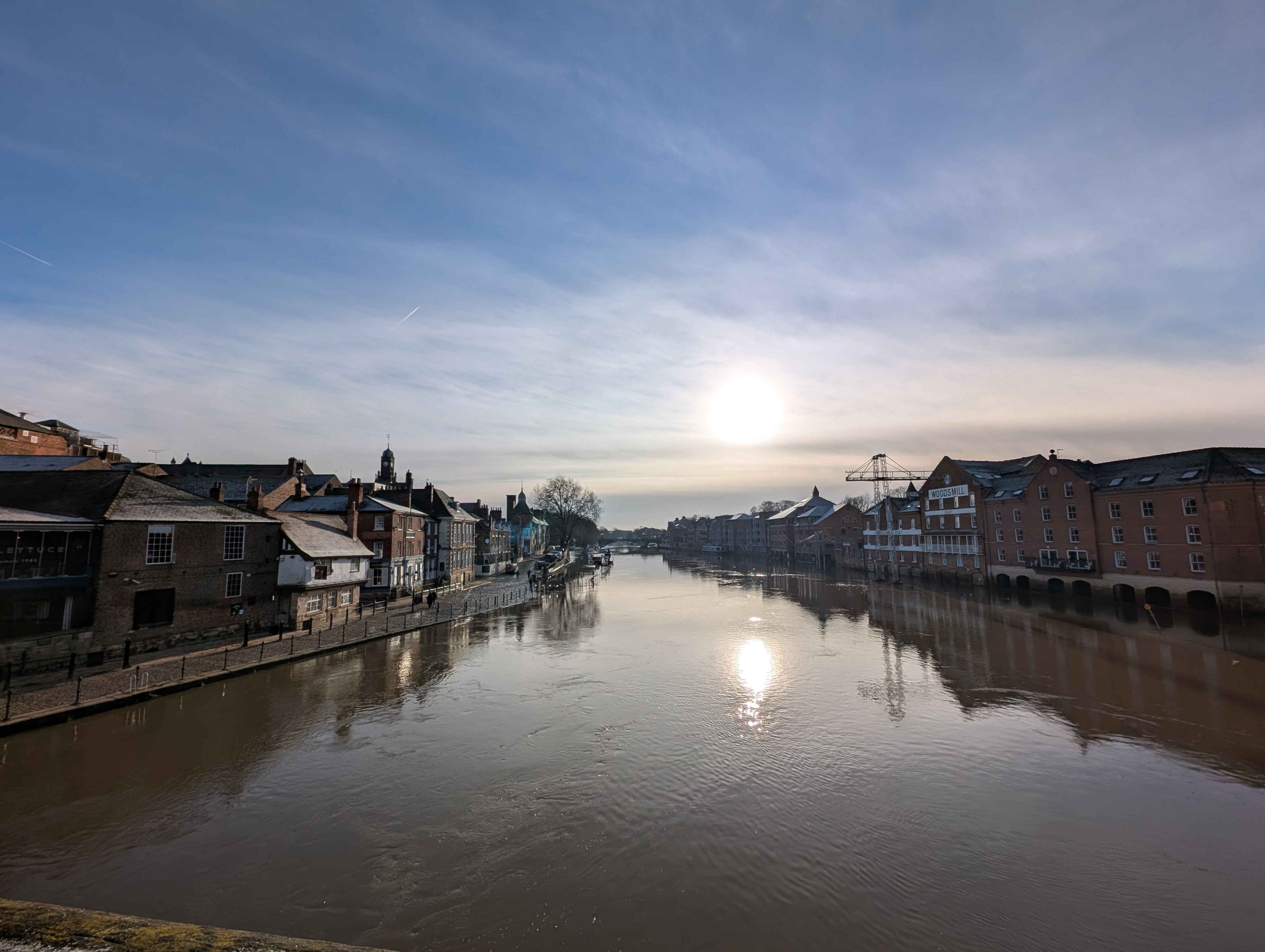
What I really love about the river is how dynamic it is and the liminal spaces at its edges. The river level can rise and drop quickly and since we moved here a few months ago it has spilled over its human-defined edges on handful of occasions. These are my favourite times and places. As I write, one of my favourite walks is diverted by the flood of the river. Not enough to cause harm, just minor nuisance, but it reminds me of its power and creates ambiguity over where belongs to us and where belongs to it.

It prompts my imagination. The water is much higher than usual and higher than I would visualise when it is ‘in bank’. The Ouse can flood to an extent that it causes real damage and misery and woe to those people unfortunate to be impacted by it. It is hard to visualise how it would look and the volume of water that would be needed for it to happen. You can see the evidence in the barriers on houses and businesses. In other cities, you see it on flood markers (I haven’t spotted any in York yet). And, when I see the water spilled over onto footpaths and the layer of fine silt left behind from the river when it was higher the day before, it sparks my mind to consider the hazards.
Here at the river edge, I find something similar to that I find on the banks of the Humber. It is different, yet in a metaphorical, spiritual, and a very literal hydrological sense, they are connected. It is a place I can sit, reflect, and imagine. I am excited for the ideas I will have here.
Failure of Imagination in Flooding (1)
In July 2021, devastating flooding impacted northern Europe, including Belgium, Germany, and the Netherlands. The floods caused over 10 billion Euros worth of damage and caused extensive damage to properties and communities over large areas. Tragically, nearly 200 people lost their lives.
This is despite the flooding being well forecast by the European Flood Awareness System (EFAS), which provided warnings 3 to 4 days in advance, seemingly giving organisations and individuals enough time to prepare. Even if they could keep their homes and businesses safe, they should have had time to keep themselves safe.
Professor Hannah Cloke of the University of Reading, who specialises in flooding, wrote an article for The Conversation following the flooding examining the reasons for why warnings were not as effective as expected. Cloke was involved in setting up EFAS, so was well positioned to comment. I think you might expect her to pass the buck, to say the science was right and it was not the fault of the forecasters that those warnings were not heeded. But she doesn’t.
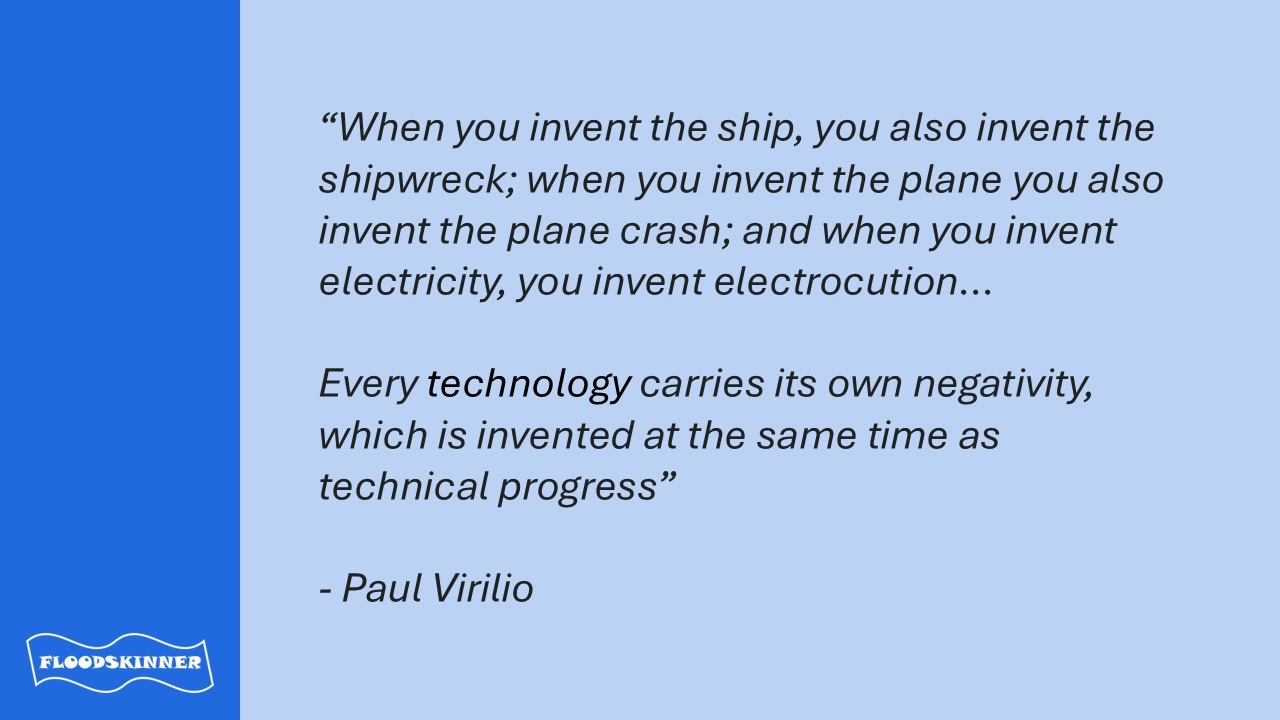
The philosopher Paul Virilio wrote about technology: “When you invent the ship, you also invent the shipwreck…“. As scientists, when we create anything we need to imagine what could go wrong and own that. It is not enough to put together an early warning system, however world leading, accurate, and timely, if no one acts on it.
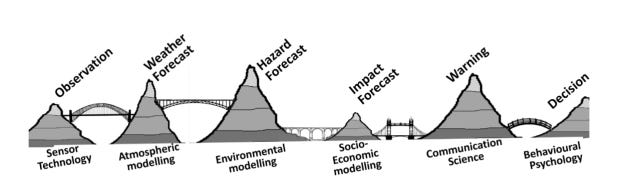
Golding et al (2019) described how early warning systems are made up of steps together in a chain. At each step, value is built as a mountain, between each step the value is lost in the ‘valleys of death’. Bridges of communication, understanding, and knowledge transfer ensure that value is retained and passed forward. The only value of an early warning system emerges when people respond to it appropriately.
Cloke described in her article how the failure laid in the way that warnings were produced, disseminated, and interpreted. The EFAS relies on public agencies responding in the right way to their warnings – as happened in some places but not others – as they are not available to the public. Professor Linda Speight, University of Oxford, who also specialises in flooding, described the difficulty of issuing warnings with the right message, especially when working with numerous different groups and organisations – a one-size fits all approach does not work for effective warning.
Both Cloke and Speight conclude that flood warnings are only effective if people understand the potential impacts on them. Speight described the benefits of impact-based forecasting, for example: “river levels will rise rapidly causing widespread flooding. Damage to roads and property is expected”. Cloke summarised the job of a flood warning (and science more widely) as “helping people see the invisible” – that is helping people imagine those potential impacts in response to the warning so they are compelled to take action. To Cloke, this failure in imagination was the missing bridge in the early warning chain, between warning and decision, where that value, tragically and literally, fell into the valley of death.
Books for George
We lost my father-in-law, George, a year ago between Christmas and New Year. He was a good man, into his eighties, who had spent much of his career in the British Civil Service, including the Ministry of Agriculture, Farming and Fisheries. He had many interesting stories to tell, including how he ended up at Wembley for the 1966 World Cup Final with free tickets as none of his colleagues believed England would reach that far!
George’s passion was for books. He was always reading, was never without a book in his hand, and when asked what he would like for presents we were sent a list of books. He very reluctantly halved the size of his library when he and my mother-in-law, Beverley, downsized and moved to the seaside for their retirement. Beverley still found new books he had acquired hidden in cupboards and drawers.
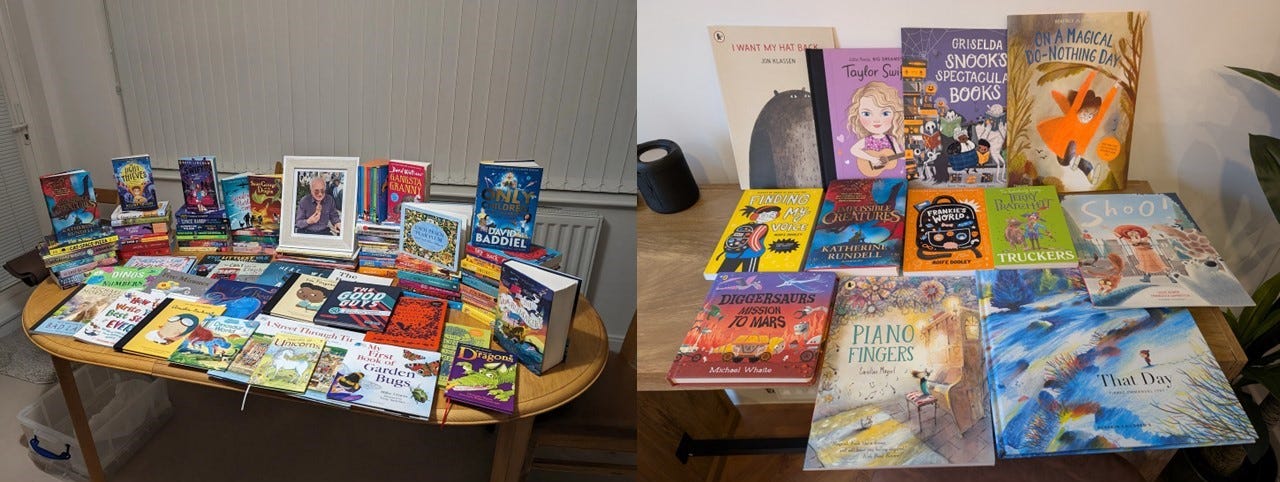
This is how we wanted to remember him, so instead of flowers at his funeral we asked people to buy a children’s book that meant something to them. We arranged with the primary school he attended (many years ago) to donate them to their library. We were blown away by people’s generosity and we were able to donate over 100 beautiful books!
We continued it again this year but on a smaller scale. With my wife’s family staying with us over Christmas, we visited a local bookshop and each bought a few books to donate to a primary school in York. I chose some books with a neurodiversity theme because I’d have liked to have read these when I was a kid. We plan on making this an annual tradition. George would have loved sharing his joy of reading with the school kids.
Playing with LEGO® at Work!
In the last year I have been developing workshops inspired by the LEGO® SERIOUS PLAY® method. The method was originally developed and licensed by LEGO and designed to help teams strategise within a corporate setting. They describe it as “an experiential process designed for use in guided workshops with adults to prompt dialogue and encourage reflection, as well as develop problem-solving skills and use of the imagination”. A few years ago, LEGO opened up the licence on the method and now you can find many providers offering services and training based on it.
Since being made open, the applications of the method have also spiralled, for example it is widely used now for education and therapy. The method seemed perfect for my mission (see the January 2025 newsletter for more on that) so I invested in 15 starter kits and a copy of The LSP Method by Michael Fearne. You can do training to be a ‘trained facilitator’ but there is no training accredited by LEGO. If you have experience in teaching or facilitation, the method should be quite easy to pick up.
I’m still learning and I recently got the opportunity to run a session with my colleagues in my day job. We are a dispersed team and only get to meet face-to-face a few times a year. When we meet, we try and find useful activities to do that are tactile, experiential, and something we just would not be able to do over a Teams call. The LEGO SERIOUS PLAY method-inspired session allowed us to think differently about the challenges we face in our programme and how we can work as a team to overcome them.
Whilst this is not how I intend to apply the method in my own work (more on that here), it really did demonstrate the value of the method. Once people get over the novelty of ‘playing with Lego’ at work, it really does help teams get into that different mindset, opening up and driving more in-depth discussions. As for the details of what was discussed, I am afraid that stays internal to our team.
Gaming Environments
Gaming Environments contains all the news I have found relating to the nexus of gaming and the environment. This news is also published on the Games for Geoscience website each month and can be found here.
Games for Geoscience 2025 at the European Geoscience Union (EGU) General Assembly is looking to be another strong and exciting session! Thank you to all our contributors who submitted 21 abstracts to the session. The convenor team is now working behind the scenes to assign oral and poster presentations to the submissions and the schedule will be posted on March 14 2025.
The infamous Geoscience Games Night will also be returning to EGU in 2025! The date, time, and location will be confirmed on March 14 2025. Anyone attending EGU is free to bring and host a game or just turn up to play. If you are bringing a game, please contact the convenors so they can add it to the list of confirmed games.
The current issue of Consilience, the “online journal exploring the spaces where the science and the arts meet” is out. Issue 19 is themed about Insects and can be read here. Submissions for Issue 21 open on 31st March 2025 with the theme Chaos.
Environmental Sustainability at York’s environmental games meeting is returning for 2025. Play for the Planet 2 will be held at the University of York, April 25 2025. The deadline to submit contributions has been extended to February 7 2025, the deadline to register is March 14 2025, and you can do those things here.
The University of Salford has two funded PhD opportunities available at the Manchester Games Centre. One will look at Games Design for Post-Climate Futures and other at Games as Ecological Processes. Deadline to apply is February 28 2025 for an October 2025 start. Find out more here.
The 6th Workshop on Tabletop Games, FDG 2025, is taking place April 15-18 2025 in Vienna and Graz, Austria. The workshop aims “to address the gap between research and practice, looking at the ways in which academics can apply their tools to the discussion of analog games“. There is a call for papers open until February 7 2025. You can find out more here.
The National Resilience Centre, Scotland, has launched a new game aimed at primary schools called Are your prepared?. The game is designed to help people talk to children about preparing for natural hazards and staying safe. See the video below to learn more.
Map the Wild is a 2-player board game where players must collect wild plants. It has been designed by Swacardz and Forgotten Games. Whilst not an educational game, it is themed around the wild edible plants of India, so looks perfect for tangential learning and starting conversations. The game is currently available for pre-order in India here.
A new toolkit has been published for “imagining, designing and teaching regenerative futures“. The Creative Methods Toolkit is for educators to give them new approaches to inspire and engage their learners. It was produced by 124 authors as part of the COST Action SHiFT – Social sciences and humanities for social transformation and climate change. Find out more and download the toolkit here.
LongLeaf Valley is a mobile game created by Trees Please Games. In the game players restore forests and create new habitats as they build their own wildlife reserve. As players earn tree tokens in game, the developers support the real world planting of tree. To date, the developers claim the players of game have supported the planting of over 2 million trees! Learn more here.
A guest blog by Nico King, Executive Creative Director for Chaos Theory Games for Games for Change discusses Designing Eco-Games: Lessons from 10-Years of Development. This blog post is a real tour de force and is packed with handy tips for professional games designers and geoscientists making their own games. Read it here.
Playing for the Planet are celebrating 5 years and are exploring the programme’s past, present, and future in an editorial series. Part 2 looks at how the game industry is working to reduce the impacts of their supply chain. Read it here.
Playing for the Planet have also launched their 2025 Green Game Jam. The theme this year is ‘nature’. Game studios can participate by developing a themed game, adding action pledges to an existing game, or donating a portion of revenue to green charities. The deadline to sign up is on January 31, so will have passed, but it is worth keeping an eye on anyway! The pack is here.
The journal Education Sciences has a special issue on Extended Reality. Amongst many of the interesting articles is one led by Games for Geoscience contributor Laura Hobbs, covering the use of Minecraft for teaching sustainable development, engineering, and environmental science. Read the special issue here.
The Games Development Conference (GDC) have released their 13th annual State of the Games Industry report. The report highlights how the games industry has been impacted by climate change, with 16% of developers saying they have been affected by natural disasters, including floods, storms, extreme heat, and wildfires. The report can be downloaded here.
Uppsala University Press has published a free edited volume on Transformative Role-Playing Games Design, edited by Lynne Bowman, Elektra Diakolambrianou, and Simon Brind. Download it here.
About this Newsletter
I am Chris Skinner, a science communicator, STEM professional, and ADHDer. I am on a mission empowering people to unlock their full potential by transforming imagination into a powerful, actionable skill. This newsletter tracks my journey. I would like you to join me, so please subscribe. The newsletter also includes a copy of Gaming Environments, the monthly news relating to the nexus of gaming and the environment that I collate for the Games for Geoscience website. This newsletter is free and I do not offer a paid tier. If you would like to say thank you and/or help me in my mission please buy me a coffee using the link below.
Views expressed in this newsletter are mine and do not represent those of my employer. Content and links are provided for informational purposes and do not constitute endorsements. I am not responsible for the content of external sites, which may have changed since this newsletter was produced.
 GeoSkinner
Pingback: Gaming Environments Newsletter – February 2025 – Games for Geoscience
Pingback: Gaming Environments Newsletter – March 2024 – Games for Geoscience