Author Archives: FloodSkinner

Unknown's avatar

About FloodSkinner

I am a geoscience researcher, educator, and content creator specialising in water, computer models, and games.

The science behind imagination - strengthening your skills

The Science Behind Imagination: Strengthening Your Skills

It is commonly considered that imagination is something some people have and others are born lacking. That it is something that artists, poets, and storytellers are blessed with whilst the rest of us philistines have not been bestowed our fair share. I do not believe this to be true. Instead, I believe we all have an imagination, or what Albert Read would call an imagination muscle, that can be exercised and strengthened.

In fact, my belief is backed up by research. A 2022 paper by Dr Andrea Blomkvist, a researcher in philosophy of cognitive science at the Centre for the Study of Perceptual Experience, University of Glasgow, showed empirical evidence that our imaginations demonstrate the hallmarks of two key qualities of a skill:

1. It can be improved through practice.

2. It can be controlled.

A key piece of evidence given by Blomkvist for imagination being improved by practice comes from mental rotation tasks. People are shown a test object and a number of images that could correspond to the test object having been rotated. They are asked to mentally rotate, i.e. to visualise, the test object and answer which of the images is correct. As participants practiced the visualising, they got better and faster at completing the task.

We control our imaginations by constraining them to reality. An example used by Blomkvist is imagining moving a bedframe up a staircase. To imagine this usefully, you have to imagine the bed and the staircase as the right sizes and also not being able to change shape or size or even vanish altogether. Our imaginations can visualise them doing those things but we can control it to help us achieve our goal. In exercises with children of different ages where they were asked to plan for imagined events, it was found that older children were better able to constrain their imaginations to reality.

There is much in this paper about imagining that reminds me of modelling and dealing with assumptions and uncertainty. Imagination is described as always involving simulation. When we simulate, either numerically or imaginably, we make assumptions, we have biases, and we miss potentially important information. Modellers can develop their imaginations to better understand the limits of their outputs and better communicate where they, and are not, useful.

How will you develop you imagination and your control of it?

This post was originally published in the January 2025 issue of The Imagination Engine. You can get first access to these articles by subscribing to the posts using the box below.

Views expressed in this newsletter are mine and do not represent those of my employer. Content and links are provided for informational purposes and do not constitute endorsements. I am not responsible for the content of external sites, which may have changed since this newsletter was produced.

Logo - The Imagination Engine in a golden ring on a blue background.

The Imagination Engine – February 2025

This post was originally published on Substack. That platform does not align with my values so I have re-published it here. If you have subscribed to my Substack, please do subscribe to here instead.

I would not be in my line of work if I did not love being around water. I grew up, was raised, and lived most of my life on the banks of the Humber. Whether it was the open expanses of the bank and cliffs between Barton and South Ferriby, or the concrete defences around the Hull tidal barrier, I have marvelled and been inspired by the mighty tides and the big open skies of the Estuary. These were places I would sit, reflect, and let my imagination wonder.

Until recently, the only time I have lived away from the Humber was three years spent in Coventry. This city, a La Corbusien nightmare of concrete and ringroad, sits close to the point in the UK that is furthest away from any coast. Having buried its river, the Sherbourne, under the concrete the post-war planners loved so much, it is entirely cut off from any form of waterscape altogether. When I worked there, the ‘Jerde Masterplan’ had an ambition to install water features along the old route of the river but this is a long way from the daylighting of buried rivers that has been successful elsewhere.

An artists' aerial view of Coventry after proposed redevelopment. The roofs and streets are covered in trees and plants and it looks very green. An inset shows a closer look at a trail of ponds where a river used to flow.

Needless to say, I did not enjoy my time in Coventry. I do not want to bash it, it has lots going for it, but I personally was not inspired or enriched by it. I did not find any spaces where I could sit and imagine. It was not the city for me. A large part of this, I think, was the lack of a waterscape and I felt homesick and longed to be under those open skies of the Humber once again the whole time.

It was not easy then to prepare myself for the move to York. It was move an hour’s drive inland, away from the estuary and the sea. I did not want to feel disconnected and homesick again. Thankfully, York did not suffer secondary devastation by well-intentioned yet misguided town planners whilst recovering from the Blitz and retains much of its Medieval charm (I once heard pre-war Coventry described as “York on steroids”). The River Ouse flows through its centre and I now live just a short walk away. Lunchtime and after-work meanders along its banks have become a near daily ritual, watching the boats, the rowers, and birds diving for fish and trying to guess where they’ll pop up again.

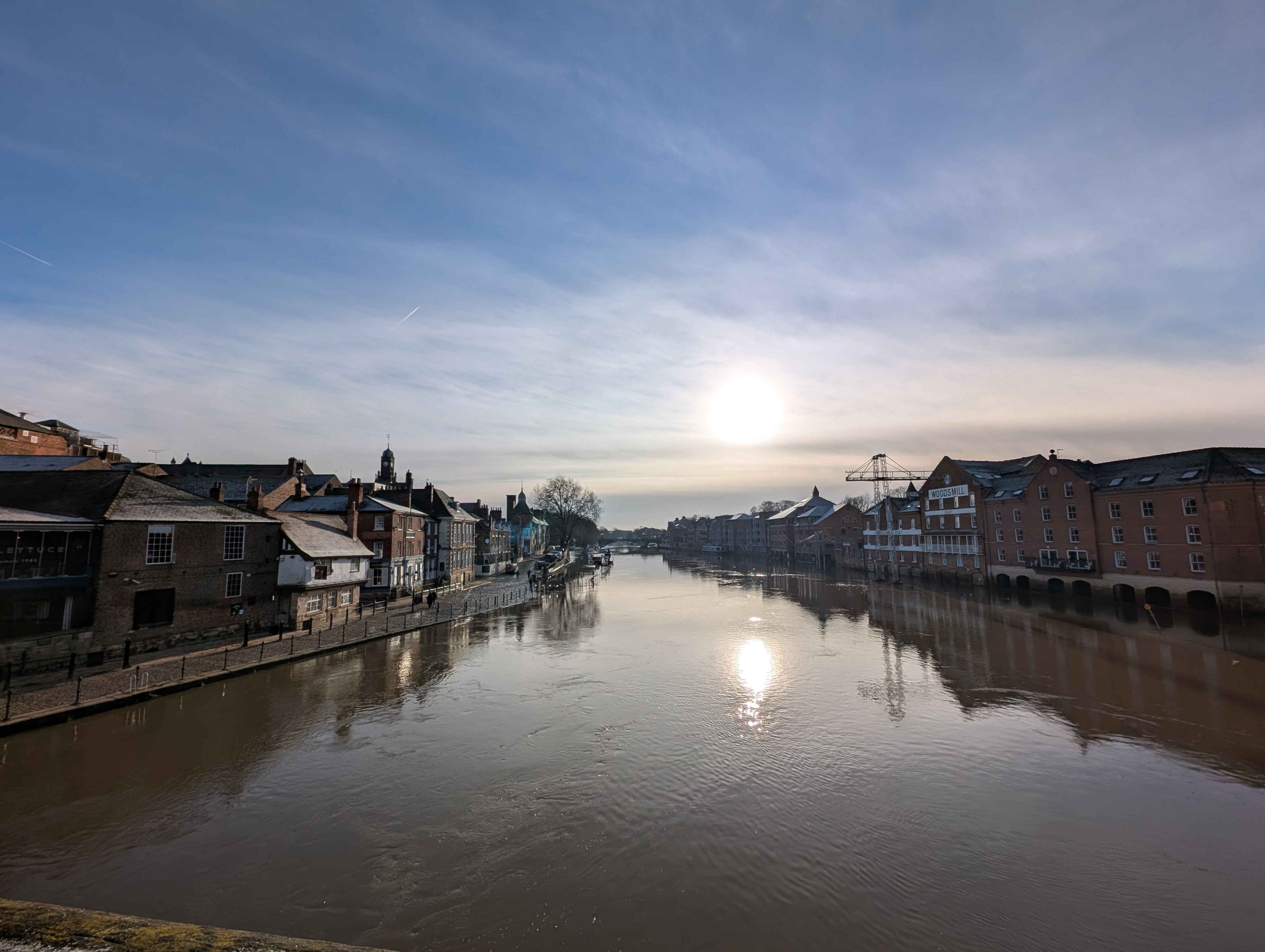
A view of the river Ouse taken from a bridge half way over its span. Buildings stand close to either side of the river. The sun is low in the blue sky, with whispy clouds, and reflects in the flat water surface.

What I really love about the river is how dynamic it is and the liminal spaces at its edges. The river level can rise and drop quickly and since we moved here a few months ago it has spilled over its human-defined edges on handful of occasions. These are my favourite times and places. As I write, one of my favourite walks is diverted by the flood of the river. Not enough to cause harm, just minor nuisance, but it reminds me of its power and creates ambiguity over where belongs to us and where belongs to it.

View of the river from the ground as it floods a footpath right up to the feet of a public bench.

It prompts my imagination. The water is much higher than usual and higher than I would visualise when it is ‘in bank’. The Ouse can flood to an extent that it causes real damage and misery and woe to those people unfortunate to be impacted by it. It is hard to visualise how it would look and the volume of water that would be needed for it to happen. You can see the evidence in the barriers on houses and businesses. In other cities, you see it on flood markers (I haven’t spotted any in York yet). And, when I see the water spilled over onto footpaths and the layer of fine silt left behind from the river when it was higher the day before, it sparks my mind to consider the hazards.

Here at the river edge, I find something similar to that I find on the banks of the Humber. It is different, yet in a metaphorical, spiritual, and a very literal hydrological sense, they are connected. It is a place I can sit, reflect, and imagine. I am excited for the ideas I will have here.

Failure of Imagination in Flooding (1)

In July 2021, devastating flooding impacted northern Europe, including Belgium, Germany, and the Netherlands. The floods caused over 10 billion Euros worth of damage and caused extensive damage to properties and communities over large areas. Tragically, nearly 200 people lost their lives.

This is despite the flooding being well forecast by the European Flood Awareness System (EFAS), which provided warnings 3 to 4 days in advance, seemingly giving organisations and individuals enough time to prepare. Even if they could keep their homes and businesses safe, they should have had time to keep themselves safe.

Professor Hannah Cloke of the University of Reading, who specialises in flooding, wrote an article for The Conversation following the flooding examining the reasons for why warnings were not as effective as expected. Cloke was involved in setting up EFAS, so was well positioned to comment. I think you might expect her to pass the buck, to say the science was right and it was not the fault of the forecasters that those warnings were not heeded. But she doesn’t.

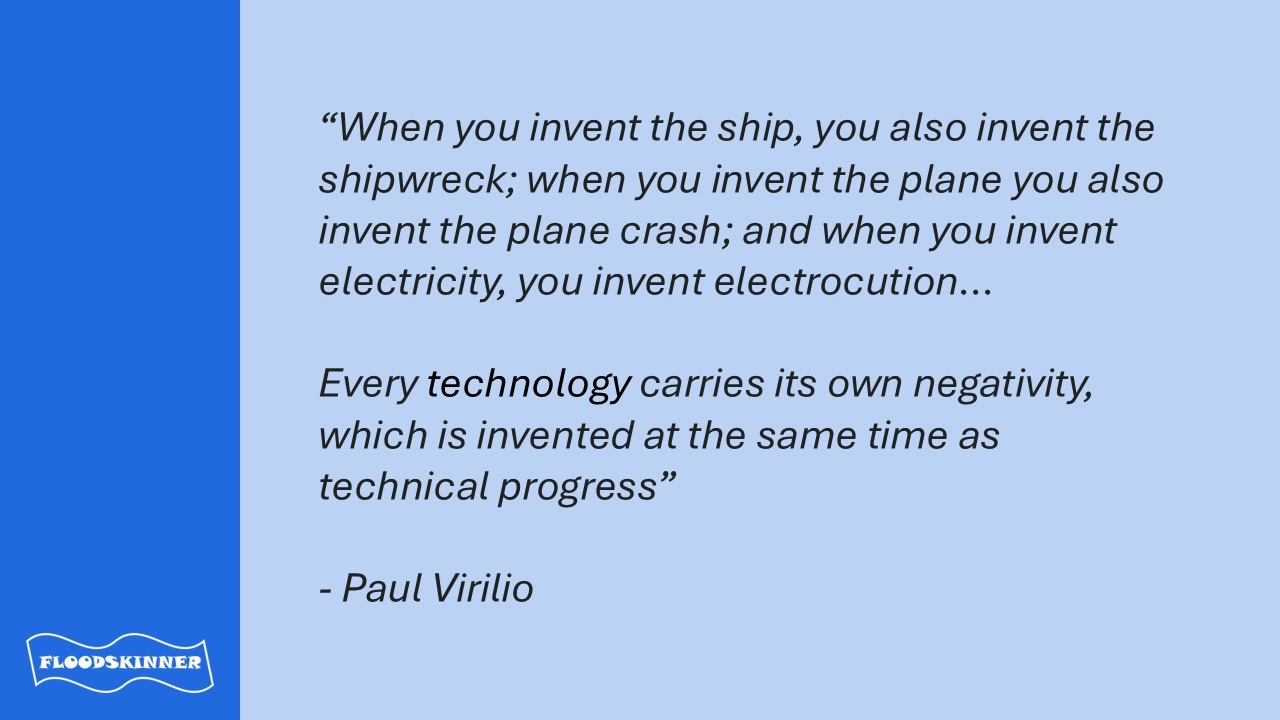
Quote: “When you invent the ship, you also invent the shipwreck; when you invent the plane you also invent the plane crash; and when you invent electricity, you invent electrocution...Every technology carries its own negativity, which is invented at the same time as technical progress." Paul Virilio

The philosopher Paul Virilio wrote about technology: “When you invent the ship, you also invent the shipwreck…“. As scientists, when we create anything we need to imagine what could go wrong and own that. It is not enough to put together an early warning system, however world leading, accurate, and timely, if no one acts on it.

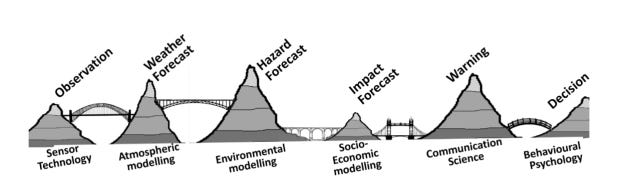
Six mountains right to left, joined by bridges. Each is labelled, from left to right, Observation (sensor technology), weather forecast (atmospheric modelling), hazard forecast (environmental modelling), impact forecast (socio-economic modelling), warning (communication science), decision (behavioural psychology).

Golding et al (2019) described how early warning systems are made up of steps together in a chain. At each step, value is built as a mountain, between each step the value is lost in the ‘valleys of death’. Bridges of communication, understanding, and knowledge transfer ensure that value is retained and passed forward. The only value of an early warning system emerges when people respond to it appropriately.

Cloke described in her article how the failure laid in the way that warnings were produced, disseminated, and interpreted. The EFAS relies on public agencies responding in the right way to their warnings – as happened in some places but not others – as they are not available to the public. Professor Linda Speight, University of Oxford, who also specialises in flooding, described the difficulty of issuing warnings with the right message, especially when working with numerous different groups and organisations – a one-size fits all approach does not work for effective warning.

Both Cloke and Speight conclude that flood warnings are only effective if people understand the potential impacts on them. Speight described the benefits of impact-based forecasting, for example: “river levels will rise rapidly causing widespread flooding. Damage to roads and property is expected”. Cloke summarised the job of a flood warning (and science more widely) as “helping people see the invisible” – that is helping people imagine those potential impacts in response to the warning so they are compelled to take action. To Cloke, this failure in imagination was the missing bridge in the early warning chain, between warning and decision, where that value, tragically and literally, fell into the valley of death.

Books for George

We lost my father-in-law, George, a year ago between Christmas and New Year. He was a good man, into his eighties, who had spent much of his career in the British Civil Service, including the Ministry of Agriculture, Farming and Fisheries. He had many interesting stories to tell, including how he ended up at Wembley for the 1966 World Cup Final with free tickets as none of his colleagues believed England would reach that far!

George’s passion was for books. He was always reading, was never without a book in his hand, and when asked what he would like for presents we were sent a list of books. He very reluctantly halved the size of his library when he and my mother-in-law, Beverley, downsized and moved to the seaside for their retirement. Beverley still found new books he had acquired hidden in cupboards and drawers.

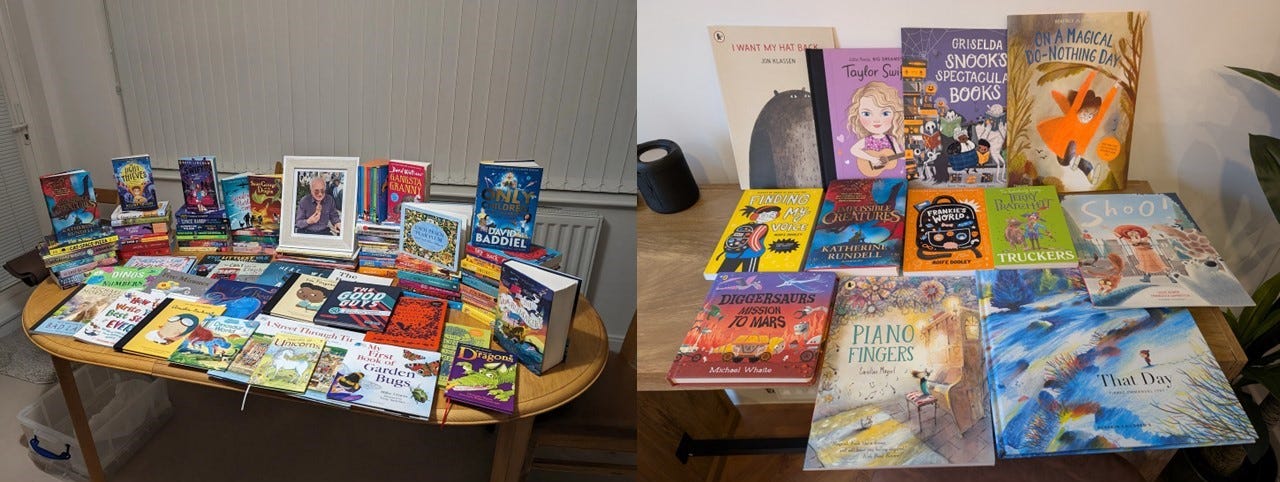
Two pictures. Left is a dining table covered in colourful children's books and a photo of a man eating an ice cream. Right is a smaller table covered in children's books.

This is how we wanted to remember him, so instead of flowers at his funeral we asked people to buy a children’s book that meant something to them. We arranged with the primary school he attended (many years ago) to donate them to their library. We were blown away by people’s generosity and we were able to donate over 100 beautiful books!

We continued it again this year but on a smaller scale. With my wife’s family staying with us over Christmas, we visited a local bookshop and each bought a few books to donate to a primary school in York. I chose some books with a neurodiversity theme because I’d have liked to have read these when I was a kid. We plan on making this an annual tradition. George would have loved sharing his joy of reading with the school kids.

Playing with LEGO® at Work!

In the last year I have been developing workshops inspired by the LEGO® SERIOUS PLAY® method. The method was originally developed and licensed by LEGO and designed to help teams strategise within a corporate setting. They describe it as “an experiential process designed for use in guided workshops with adults to prompt dialogue and encourage reflection, as well as develop problem-solving skills and use of the imagination”. A few years ago, LEGO opened up the licence on the method and now you can find many providers offering services and training based on it.

Since being made open, the applications of the method have also spiralled, for example it is widely used now for education and therapy. The method seemed perfect for my mission (see the January 2025 newsletter for more on that) so I invested in 15 starter kits and a copy of The LSP Method by Michael Fearne. You can do training to be a ‘trained facilitator’ but there is no training accredited by LEGO. If you have experience in teaching or facilitation, the method should be quite easy to pick up.

I’m still learning and I recently got the opportunity to run a session with my colleagues in my day job. We are a dispersed team and only get to meet face-to-face a few times a year. When we meet, we try and find useful activities to do that are tactile, experiential, and something we just would not be able to do over a Teams call. The LEGO SERIOUS PLAY method-inspired session allowed us to think differently about the challenges we face in our programme and how we can work as a team to overcome them.

Whilst this is not how I intend to apply the method in my own work (more on that here), it really did demonstrate the value of the method. Once people get over the novelty of ‘playing with Lego’ at work, it really does help teams get into that different mindset, opening up and driving more in-depth discussions. As for the details of what was discussed, I am afraid that stays internal to our team.


Gaming Environments

Gaming Environments contains all the news I have found relating to the nexus of gaming and the environment. This news is also published on the Games for Geoscience website each month and can be found here.

Games for Geoscience

Games for Geoscience 2025 at the European Geoscience Union (EGU) General Assembly is looking to be another strong and exciting session! Thank you to all our contributors who submitted 21 abstracts to the session. The convenor team is now working behind the scenes to assign oral and poster presentations to the submissions and the schedule will be posted on March 14 2025.

The infamous Geoscience Games Night will also be returning to EGU in 2025! The date, time, and location will be confirmed on March 14 2025. Anyone attending EGU is free to bring and host a game or just turn up to play. If you are bringing a game, please contact the convenors so they can add it to the list of confirmed games.

The current issue of Consilience, the “online journal exploring the spaces where the science and the arts meet” is out. Issue 19 is themed about Insects and can be read here. Submissions for Issue 21 open on 31st March 2025 with the theme Chaos.

Environmental Sustainability at York’s environmental games meeting is returning for 2025. Play for the Planet 2 will be held at the University of York, April 25 2025. The deadline to submit contributions has been extended to February 7 2025, the deadline to register is March 14 2025, and you can do those things here.

The University of Salford has two funded PhD opportunities available at the Manchester Games Centre. One will look at Games Design for Post-Climate Futures and other at Games as Ecological Processes. Deadline to apply is February 28 2025 for an October 2025 start. Find out more here.

The 6th Workshop on Tabletop Games, FDG 2025, is taking place April 15-18 2025 in Vienna and Graz, Austria. The workshop aims “to address the gap between research and practice, looking at the ways in which academics can apply their tools to the discussion of analog games“. There is a call for papers open until February 7 2025. You can find out more here.

The National Resilience Centre, Scotland, has launched a new game aimed at primary schools called Are your prepared?. The game is designed to help people talk to children about preparing for natural hazards and staying safe. See the video below to learn more.

Map the Wild is a 2-player board game where players must collect wild plants. It has been designed by Swacardz and Forgotten Games. Whilst not an educational game, it is themed around the wild edible plants of India, so looks perfect for tangential learning and starting conversations. The game is currently available for pre-order in India here.

A new toolkit has been published for “imagining, designing and teaching regenerative futures“. The Creative Methods Toolkit is for educators to give them new approaches to inspire and engage their learners. It was produced by 124 authors as part of the COST Action SHiFT – Social sciences and humanities for social transformation and climate change. Find out more and download the toolkit here.

LongLeaf Valley is a mobile game created by Trees Please Games. In the game players restore forests and create new habitats as they build their own wildlife reserve. As players earn tree tokens in game, the developers support the real world planting of tree. To date, the developers claim the players of game have supported the planting of over 2 million trees! Learn more here.

A guest blog by Nico King, Executive Creative Director for Chaos Theory Games for Games for Change discusses Designing Eco-Games: Lessons from 10-Years of Development. This blog post is a real tour de force and is packed with handy tips for professional games designers and geoscientists making their own games. Read it here.

Playing for the Planet are celebrating 5 years and are exploring the programme’s past, present, and future in an editorial series. Part 2 looks at how the game industry is working to reduce the impacts of their supply chain. Read it here.

Playing for the Planet have also launched their 2025 Green Game Jam. The theme this year is ‘nature’. Game studios can participate by developing a themed game, adding action pledges to an existing game, or donating a portion of revenue to green charities. The deadline to sign up is on January 31, so will have passed, but it is worth keeping an eye on anyway! The pack is here.

The journal Education Sciences has a special issue on Extended Reality. Amongst many of the interesting articles is one led by Games for Geoscience contributor Laura Hobbs, covering the use of Minecraft for teaching sustainable development, engineering, and environmental science. Read the special issue here.

The Games Development Conference (GDC) have released their 13th annual State of the Games Industry report. The report highlights how the games industry has been impacted by climate change, with 16% of developers saying they have been affected by natural disasters, including floods, storms, extreme heat, and wildfires. The report can be downloaded here.

Uppsala University Press has published a free edited volume on Transformative Role-Playing Games Design, edited by Lynne Bowman, Elektra Diakolambrianou, and Simon Brind. Download it here.


About this Newsletter

I am Chris Skinner, a science communicator, STEM professional, and ADHDer. I am on a mission empowering people to unlock their full potential by transforming imagination into a powerful, actionable skill. This newsletter tracks my journey. I would like you to join me, so please subscribe. The newsletter also includes a copy of Gaming Environments, the monthly news relating to the nexus of gaming and the environment that I collate for the Games for Geoscience website. This newsletter is free and I do not offer a paid tier. If you would like to say thank you and/or help me in my mission please buy me a coffee using the link below.
Buy Chris a Coffee

Views expressed in this newsletter are mine and do not represent those of my employer. Content and links are provided for informational purposes and do not constitute endorsements. I am not responsible for the content of external sites, which may have changed since this newsletter was produced.

All my links

Logo - The Imagination Engine in a golden ring on a blue background.

The Imagination Engine – January 2025

This post was originally published on Substack. That platform does not align with my values so I have re-published it here as it was. If you has subscribed to my Substack please move your subscription to here.

Happy new year! A personally turbulent 2024 is out of the way and honestly, I am very much looking forward to a more settled 2025. With all that happened last year, not least our move to York, I did not make as much progress on my personal goals as I would have liked. Things like this newsletter and the FloodSkinner YouTube channel were neglected as I focussed on just getting through, and prioritising the day job.

Now settled into our new home, in a new city, and it being a new year, it is naturally a time to look forward. If last year taught me anything, it is how important it is to focus on what is important to you and to carve out time for that. Being ADHD, my focus can be easily pulled away and I can find myself committing to things that were exciting at the time but become a distraction down the line. Long-term planning is also something that does not come naturally to me.

So, 2025 is going to be a year where I try and turn this around. I want to be more purposeful, more strategic, and to lay the foundations for where I actually want to get to. I have done a lot of self-reflection, searching for my, what Simon Sinek would call, ‘why’ – what is important to me, what do I enjoy, who do I want to be. In short, I’ve been considering my ‘mission’ that will keep me on track:

Empowering people to unlock their full potential by transforming imagination into a powerful, actionable skill.”

In this first quarter of 2025, I will be using this mission to develop a business plan that I will publish in April. It will lay out the ways I intend to achieve this mission and the services I can provide. It will also help me to determine which projects I can commit to and which I must regrettably turn down.

I am very excited to have developed this mission and am looking forward to moving forward into 2025 with renewed purpose. I hope you will join me by subscribing to the newsletter.

Chris (aka FloodSkinner).

All my links

Buy Chris a coffee


Imagination as a Skill.

You will have noticed from my mission that I consider imagination to not be something some people have and others are born lacking. It is not something that artists, poets, and storytellers are blessed with whilst the rest of us philistines have not been bestowed our fair share. Instead, we all have an imagination, or as Albert Read would call an imagination muscle, that can be exercised and strengthened.

In fact, my belief is back up by research. A 2022 paper by Dr Andrea Blomkvist, a researcher in philosophy of cognitive science at the Centre for the Study of Perceptual Experience, University of Glasgow, showed empirical evidence that our imaginations demonstrate the hallmarks of two key qualities of a skill:

1. It can be improved through practice.

2. It can be controlled.

A key piece of evidence given by Blomkvist for imagination being improved by practice comes from mental rotation tasks. People are shown a test object and a number of images that could correspond to the test object having been rotated. They are asked to mentally rotate, i.e. to visualise, the test object and answer which of the images is correct. As participants practiced the visualising, they got better and faster at completing the task.

We control our imaginations by constraining them to reality. An example used by Blomkvist is imagining moving a bedframe up a staircase. To imagine this usefully, you have to imagine the bed and the staircase as the right sizes and also not being able to change shape or size or even vanish altogether. Our imaginations can visualise them doing those things but we can control it to help us achieve our goal. In exercises with children of different ages where they were asked to plan for imagined events, it was found that older children were better able to constrain their imaginations to reality.

There is much in this paper about imagining that reminds me of modelling and dealing with assumptions and uncertainty. Imagination is described as always involving simulation. When we simulate, either numerically or imaginably, we make assumptions, we have biases, and we miss potentially important information. Modellers can develop their imaginations to better understand the limits of their outputs and better communicate where they, and are not, useful.


Accountability.

It has been a couple of years now since I realised I was ADHD and it has been a journey of self-discovery. To be honest, it has been really hard to get over that grieving process many people in my position report as having – this is the mourning of the person you imagine you could have been had you known earlier. What more might have I achieved if I understand how my brain works, knew how to work with it, and had the support I needed rather than accepting the lie that I just lazy?

As I mentioned above, I struggle with making and sticking to long-term plans. This is a punch in the stomach for me as one of my ambitions since I was young was to write a book, very much a long-term project. I have many discarded plans and projects where I started a book project and either lost interested, lost confidence, or simply outright forgot about it. It has been an ambition that thus far has alluded me and I think it will continue to do so unless I find ways to work with my ADHD brain.

My mission above for ‘FloodSkinner’, and the business plan, will also be a long-term project and I know I have to work with my brain in order to be successful. On my ADHD journey, I have found Jessica McCabe and her ‘How to ADHD’ YouTube channel extremely useful, and with perfect timing she recently posted a video about how to use accountability to achieve long-term goals.

This newsletter will be part of my accountability system. I am committing, to myself and to you, to continue to produce this newsletter each month. I will include updates on progress and pieces of research relevant to my imagination mission – a few years down the line, maybe there will be enough there to form the core of my long longed-after book.

I have committed to publishing my business plan in April – this is also to keep me accountable. In that business plan I will also include a number of performance indicators, metrics to help me measure progress against my mission. Each year in April, to coincide with the end of the financial year, I will publish an annual report that will report that progress – I hope that publicly committing to this, being open about my intentions and progress, plus my love of a metric, will help me stay focussed and achieve my long-term ambitions.


FloodSkinner YouTube Channel.

My YouTube channel has been going for a couple of years now. If you needed any evidence of my ADHD, then the identity crisis of this channel surely provides this. In those two years, I have changed the name a few times – it started as FloodSkinner’s Model Life, then it was Floodology, then Practical Scicomm, before I gave up on a singular focus and just renamed it FloodSkinner.

The aim of the channel was always to be something I enjoyed, a chance to learn new skills, and to be a repository for the content I make. This has meant that when life gets stressful, it is one of the first things that gets neglected. My last long-form video was uploaded over 8 months ago now and it makes me sad I have not been able to make more.

The good news, I am planning a new short series of long-form videos. Planned as a 3-part series, it will document my experiences of the SeriousGeoGames and Earth Arcade projects I worked on at the University of Hull. I will be stretching my script writing and video making skills to inject more variety and more humour into the videos, as I explore the history of these projects and the learning I can pass on to you.

But, it has not been totally devoid of content. I have managed to sporadically post short form videos, as Shorts on YouTube and as Reels on Instagram. These have included a short series from last years European Geoscience Union General Assembly, a piece on the Foss flood barrier in York, and most recently three more entries in my Distracted Geography series on the Sustainable Development Goals.

To make sure you do not miss the new videos you can subscribe to the channel.

FloodSkinner YouTube


Project Progress.

The annual Games for Geoscience session is coming up this easter at the European Geoscience Union General Assembly. We are still accepting abstracts until midday January 15th, so if you have worked with games for anything relating to geoscience, natural hazards, or the environment come and share it with us! I have written a post on the Games for Geoscience website that contains all the details you need.

Games for Geoscience 2025

Last month we soft-launched Adventures in Model Land. This is a framework inspired by tabletop roleplay games (TTRPG) where we encourage numerical modellers to build imagined worlds that follow the same rules as their models. This exercise is firstly a fun thing to do and share but will also help them think more creatively about the limits and assumptions in their models. From my example short story about a CAESAR-Lisflood model land you can see how alien these worlds can be. We are looking for people to give the framework a try and to report on their created model lands. Find out more on the Adventures in Model Land page on my website.

Adventures in Model Land


Gaming Environments

Gaming Environments contains all the news I have found relating to the nexus of gaming and the environment. This news is also published on the Games for Geoscience website each month and can be found here.

The deadline to submit your abstracts for the 2025 Games for Geoscience session is rapidly approaching. You have until midday January 15th – find out all the details in our blog here.

Research led by Dr Francesca de Rosa of the Centre for Advanced Preparedness and Threat Response Simulation considers Transdisciplinarity in Serious Gaming Design for Improved Crisis Preparedness. It discusses the development and piloting of a Command, Control, Coordination and Communication (C3C) game and can be read in the International Journal of Serious Games here.

Christmas may have been and gone but it also now just less than a year away! So, this great article by Dr Linda Dunlop and Prasad Sandbhor, University of York, on how to have difficult climate conversations is still timely and relevant. They discuss the unique power of games to breakdown barriers and create a safe space for conversations, recommending five games perfect for raising the topic of climate action. Read it on The Conversation here.

More from Environmental Sustainability at York now, with the return of the Playing for the Planet conference on April 25th at the University of York. The meeting aims to “link research and practice in environmental gaming”. If you’d like to give a Research Blast presentation, you have until 12pm GMT January 17th to submit an abstract. Find out more and book tickets here.

Speaker and game award submissions for the world’s premier games for social good meeting, Games for Change Festival 2025, are now open. The festival will be held in New York and online in the summer (date TBC) with the deadline for speaker submissions on January 24th – submit here. You can also submit games for the showcase and awards, including Best in Environmental Impact, here.

Take Action Global and Games for Change have teamed up to create the Climate Action Day Virtual Arcade. The arcade features ten independent videogames created by school students, to be played by other students, and to share environmental messages and promote positive actions. View the game listings and find all the links here.


About this Newsletter

I am Chris Skinner, a science communicator, STEM professional, and ADHDer. I am on a mission empowering people to unlock their full potential by transforming imagination into a powerful, actionable skill. This newsletter tracks my journey. I would like you to join me, so please subscribe. The newsletter also includes a copy of Gaming Environments, the monthly news relating to the nexus of gaming and the environment that I collate for the Games for Geoscience website. This newsletter is free and I do not offer a paid tier. If you would like to say thank you and/or help me in my mission please buy me a coffee using the link below.

Buy Chris a Coffee

Views expressed in this newsletter are mine and do not represent those of my employer. Content and links are provided for informational purposes and do not constitute endorsements. I am not responsible for the content of external sites, which may have changed since this newsletter was produced.

All my links

Logo - The Imagination Engine in a golden ring on a blue background.

The Imagination Engine – December 2024

This post was originally posted on Substack. That platform does not align with my values so I have copied it here instead. If you have subscribed to my Substack, please move your subscription to here.

Welcome to the December 2024 FloodSkinner newsletter.

As I look back and reflect on the last year, the one big thing it has taught me is that life can come at your fast. Personally, our family has experienced extreme lows and extreme highs over the last year, even within a day or two of each other. For both good and bad, our lives have been turned upside down.

Significantly, my wife landed her dream job and with it we made a move to beautiful York. We have always dreamed of living in an historic European city, somewhere like the cities we love, Prague and Ljubljana, and I think we have found the closest we’ll get in the UK. I would not have imagined this time last year that we would be here but I love it.

It has been a busy year professionally too. Some of my highlights are:

As part of my role at the Environment Agency:

  • Published our report on the potential and pathways for open methods in operational flood hydrology, produced by JBA Consulting. Read it here.
  • Published reports covering a major survey of UK hydrologists I led. Read them here.
  • Completed my three-year term as a trustee for the British Hydrological Society and co-chair of the Communications and Publications committee.
  • Co-led the Environment Agency’s summer activities at the Science Museum. We led a team of over 120 volunteers who engaged over 80,000 visitors over four weeks. I won a local recognition award, and the team won the EA’s One Team award, for this project.

As FloodSkinner:

  • Travelled to Vienna to convene the Games for Geoscience and Geoscience Games Night sessions at the European Geoscience Union General Assembly. I also contributed to the Elevate your Pitch short course.
  • Presented an invited seminar on the history of SeriousGeoGames for the University of West England’s Science Communication Unit.
  • Presented on Games and Models at the University of York’s Play for the Planet meeting. See my home recording of it below.
  • Developed the Play your PhD workshop, inspired by Lego™ SeriousPlay™, and delivered it to the first cohort of students on the Flood Centre of Doctoral Training, University of Southampton. Find out more about my workshops and how to hire me here.

Being such a busy year, I admittedly have struggled to find the headspace to do some of the voluntary scicomm stuff I love, including making videos for my YouTube channel and delivering this newsletters monthly. You may have noticed it has changed a few times too as I have strived to find the most useful and interesting format.

I am still committed to bringing you the latest news, events, opportunities, and cool stuff from where games and the environment meet. However, I found most of the items on Twitter and as that platform is no longer an enjoyable space to be, I have deleted my accounts. I cannot find the same volume of information via BlueSky or LinkedIn just yet.

At the same time, I am beginning to spin up a few projects that I’d like to share. Consequently, the newsletter will become more of a hybrid of my own news and the Gaming Environments items. This will be distributed via Substack once again, with a shortened Gaming Environments newsletter shared on the Games for Geoscience newsletter.

Chris (aka FloodSkinner)

Adventures in Model Land

I am very, very excited to launch Adventures in Model Land! We use computer models to help us make decisions about the real-world. Models however can never perfectly recreate the real-world, having to make simplifications and compromises to operate and be useful. In this way, they create their own model lands. Erica Thompson’s brilliant book, Escape from Model Land, shows us how we must leave and understand these model lands to make good decisions about the real-world. But what if we could bring these worlds to life, explore them more deeply, and even undertake quests within them?

Adventures in Model Land is inspired by tabletop roleplay games (TTRPGs) to help those who work with computer models breathe life into the model lands they use. Level One, released December 1st, guides you through the world building process. We are looking for volunteers to test this framework by creating and sharing model lands for their own. Check out the draft framework here and contact me if you’d like to help.

In the future, we will launch Level Two to help you create quests for players that take place inside your model land, and Level Three, a guide to hacking existing games to play be the rules of your model land.

Finally, if you are attending the European Geoscience Union’s General Assembly in 2025, you can take part in the Into Model Land short course, based on Level One of the framework. Find out more here.

Adventures in Model Land has been developed by Chris Skinner, Erica Thompson, Liz Lewis, Rolf Hut, and Sam Illingworth.

Adventures in Model Land

New Paper

Work led by Katie Parsons, and co-authored by myself and Alison Lloyd Williams, has recently been published in Geographical Research – Using 360 immersive storytelling to engage communities with flood risk.

This interdisciplinary work brings together my previous work with VR, 360 animation, and immersive storytelling with SeriousGeoGames, Alison’s work using creative interventions to help flood-affected children and young people share their stories, with Katie’s expertise with flood education.

The paper details the work to create the Help Callum and Help Sali immersive flood stories, the co-production of teaching materials with children, young people, and teachers, and the evaluation of their efficacy as a resource. You can read it open access here.


Gaming Environments

Gaming Environments is the newsletter of Games for Geoscience. It brings you the latest news, events, opportunities, and cool stuff from where games meet geoscience and environmental research and action.

Visit Games for Geoscience

News

QUARTETnary by The Silly Scientist is an educational game about geological time. After it was successfully backed in a KickStarter earlier this year, it is now available on general sale. Get your copy here.

The winners of the first ever Playing for the Planet Awards have been announced. The Playing for the Planet alliance aims to help the gaming industry engage with environmental issues and the awards congratulate those who have made a significant contribution. Read about the winners on PocketGamer.biz here.

Issue 18 of Consilience, the journal that explores the spaces where the sciences and the arts meet, is available to read now here. The theme is ‘Consciousness’.

UNESCO and 8one Foundation have published a report on gender dynamics in games and gaming, globally. The Gender Equality Quest in Video Games is available to read now here.

Recent research by the University of Bolton, through the Game Realising Effective and Affective Transformation (GREAT) showed the effectiveness of engaging gamers with climate issues within games. They used in-game QR codes to engage gamers with climate-related surveys and compare clicks with traditional clickable adverts, finding in-game codes drove greater engagement. Read more here.

Events

The call for abstracts for the 2025 General Assembly of the European Geoscience Union is now open. The deadline for abstracts is January 15th 2025, 13:00 CET. You can find more details and browse the sessions here.

The Games for Geoscience session is amongst the programme. If you use games for communicating, sharing, teaching, or researching within a broad theme of geoscience, please do tell us about it. We also welcome work using gaming tech, including virtual and alternative realties (ie, VR and XR). You can submit an abstract here.

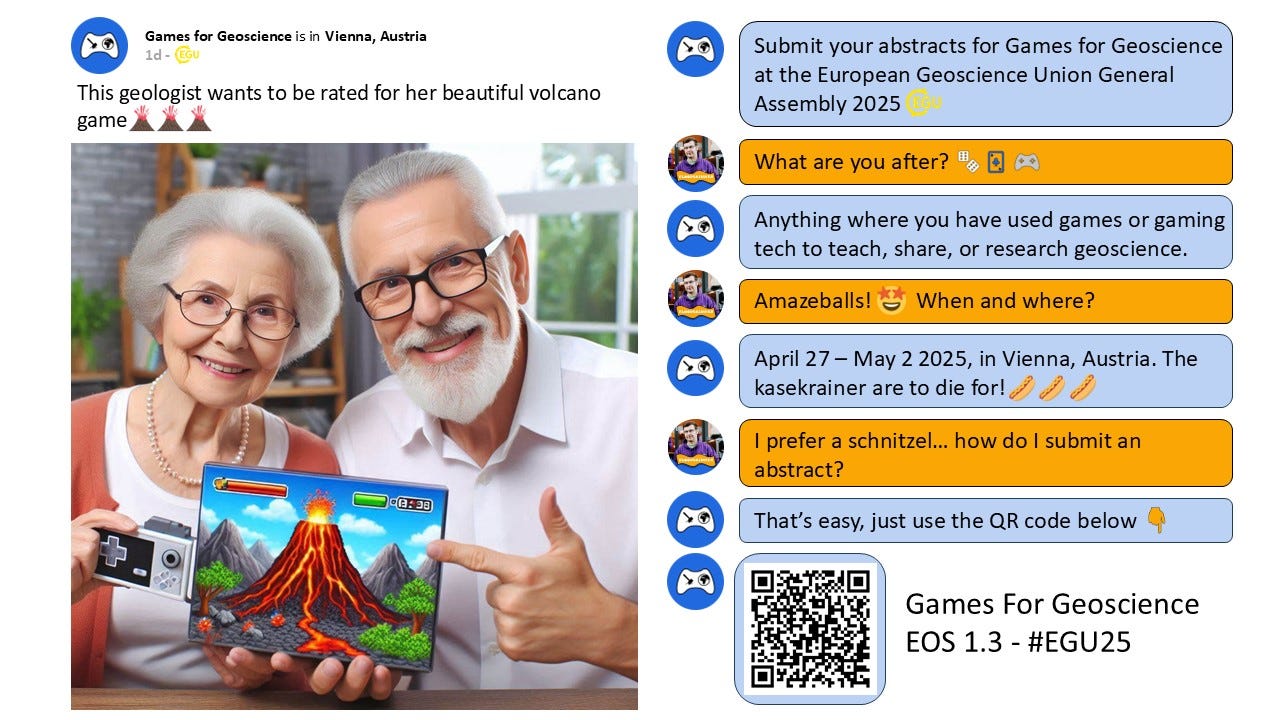
Advert for the Games for Geoscience Session. Details in post.

Opportunities

Do you write sole-play TTRPG? Want your game featured in a new bundle? You can submit them to the Solo but Not Alone bundle here. Submissions close on December 22nd 2024. The bundle will be released on January 9th 2025 for $10, with funds going to Take This, the gaming charity supporting people’s mental health.

Cool Stuff

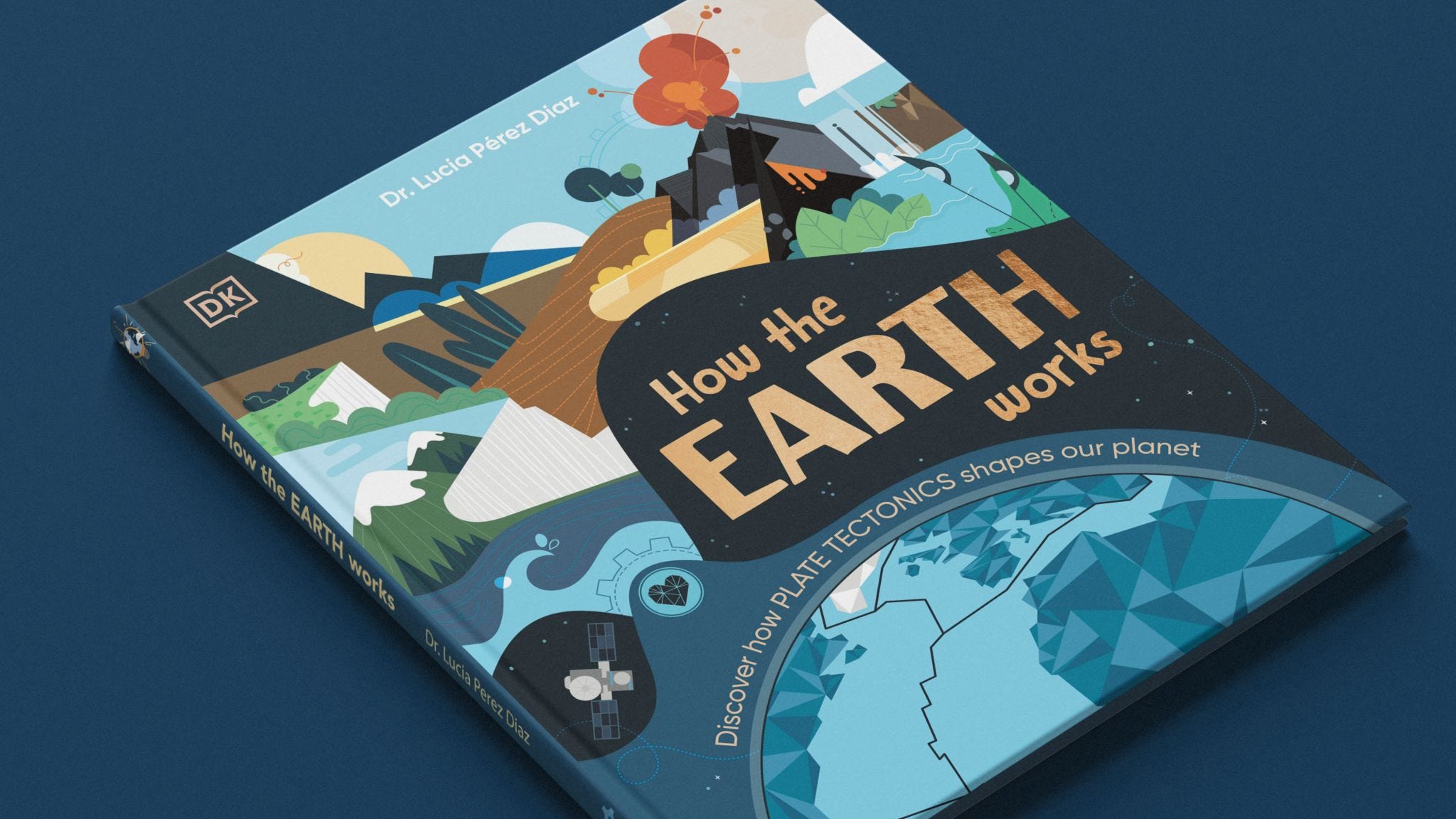
Awesome science artist, Dr Lucia Perez-Diaz is releasing her first science book aimed at children. And it looks gorgeous! How the Earth Works is published by DK Books, and “takes inquisitive 7-9 year olds on a journey of discovery into the inner workings of our planet. You can pre-order it here.

An image of the book How the Earth Works.

About this Newsletter

This is the personal newsletter of Chris Skinner, a science communicator and author under the name FloodSkinner. It includes the Gaming Environments newsletter that is also published on the Games for Geoscience website. It shares News, Events, Opportunities, and Cool Stuff from where games meet geoscience and environmental research and action. It is free and there is no paid tier. If you want to say thank you to Chris, you can ‘buy him a coffee’ using the link below.

Buy Chris a Coffee

Views expressed in this newsletter are mine and do not represent those of my employer. Content and links are provided for informational purposes and do not constitute endorsements. I am not responsible for the content of external sites, which may have changed since this newsletter was produced.
Finishing things makes me feel crap - my experience with ADHD

Finishing things makes me feel crap – My experience with ADHD.

//Views in this post are my own and not indicative of those of my employer or the Science Museum Group.

I am sharing these thoughts with you over my lunch break. I feel tired, broken, and on the verge of tears – focussing on my work has been more of a struggle than it usually is. When I consider my situation objectively, I should feel the opposite way entirely.

For the last few months, pretty much all of 2024 until now, I have been working on a large project at work. In my day job, I am a Senior Hydrologist at the Environment Agency, England’s environmental regulator. The project was to organise the Agency’s activities at the Science Museum that was running for its third year. This year it had moved to a more prominent location, up on the David Sainsbury Technicians Gallery, and could expand. I volunteered to join a project manager team with a couple of others to lead and oversee the project.

Yesterday, August 5th, that work culminated in the activity launching at the Museum. It will run for the month, featuring four separate activity areas and crewed by over 120 amazing volunteers from across the Environment Agency. We have developed the activities, obtained kit, designed our space, and trained the volunteers – it has been a considerable effort by everyone organising. I could not be in the space to set up yesterday, but I was sent a trickle of images by others in our organising team.

It looks great. The volunteers looked happy, confident, and enthusiastic. By all accounts, that first day talking to visitors at the Museum and demonstrating our activities to them was a success. We had done it and the hard work had paid off. We had done a good job – I had done a good job.

Yes, although I am proud of what we have achieved, and what I have achieved as part of it, I feel no joy in it. Logic, and possibly society, tells me I should be like an Olympian winning a gold medal. Smiling, jumping excitedly, waving to the crowd, kissing and biting my medal and overwhelmed by what I have just done. But no – drained, disconnected, and a little depressed is what I am left with.

I know this feeling. I had only a few months ago when I published the report for the UK Hydrology Skills and Satisfaction Survey, another large project I led. There was no joy in finishing that too, just the emptiness. I know this feeling well, it only lasts a day or two, but it does make me sad.

I am self-diagnosed ADHD and have been for a couple of years. It has been a revealing and difficult journey of discovery and understanding about who I am and why I am the way I am. ADHD is characterised by a low production of dopamine – the reward chemical that makes you feel good when you do the right things and reinforces that behaviour – in your brain. Consequently, ADHDers seek the often less good things that give you a quick, easy dopamine bursts. For example, starting new projects does this but when the novelty wears off, not so much. This is first reason why ADHDers, including myself, can be bad at finishing things.

The flipside of the ADHD struggle to focus is hyperfocus. Often unhelpfully described as a ‘superpower’, hyperfocus kicks in when we have something that really takes our interest or there is big pressure to complete it. When I’m in hyperfocus it is best feeling in the world – I love working hard and I love getting stuff done, especially if it is a writing task (I think I’m the only person ever to enjoy writing their thesis). I can achieve an order of magnitude more than others when in hyperfocus and produce quality work in a short space of time. But it is exhausting, and when I’m done I am often tired and migraines kick in. Sometimes, as projects approach their end and deadlines loom, I hyperfocus a lot. When it is over, then comes the crash. I think that avoiding this feeling is the second reason ADHDers are bad at finishing projects.

For the third reason, think of the difference between Type 1 and Type 2 fun. Type 1 are activities that are often short, exciting, and give you instant feedback. Type 2 fun activities require hard work where the process itself is not enjoyable but the pay off at the end is worth it. An example of Type 2 fun would be running a marathon. Type 1 fun appeals to me as it provides me that instant dopamine kick. I get nothing from Type 2 fun, firstly my timeblindness does not help me picture the end goal, and secondly, for whatever reason I don’t get that pay off at the end. There is no sense of achievement for me so I have never learned how to achieve Type 2 fun.

To translate this to a work environment, I love Type 1 work, tasks that are instant, achieved quickly, give me something to firefight or a problem to solve quickly. I struggle with Type 2 work – projects where the end is so long away, I can’t picture it and I also know I won’t get a pay off once it has completed. This has seen me in the past avoid initiating longer-term projects or struggling to really plan them (for example fellowship applications when I was still in academia). I have, and still do, lack confidence in my ability to lead things. Knowing this has helped me immensely in shifting my mindset from thinking I was just lazy and too disorganised to ever achieve what I wanted, to believing I can achieve and lead larger projects if I have the right support in place. For example, in my job I work alongside a project manager who is skilled in all the things I struggle with – they are like magic and let me focus on what I am good at.

My struggles to complete things, or more accurately my avoidance of the flatness I feel when finishing things, also influences my down time. I love games but actually enjoy playing very few of them. The ones I love and spend many hours playing are city-builder and simulation games – Timberborn, Cities:Skylines, Football Manager – a common thread here is that you can’t complete these games, they are open ended, you just keep going, building, and refreshing. I don’t have the motivation to complete or finish games, so these types of games just do not appeal to me.

I’m still on my journey, learning about myself. I am trying to push myself and lead larger projects including the things I want to do. For example, the only thing I ever wanted to do when I was younger was write a book – I am determined I will achieve this and now I know why it has been such a struggle. It does make me sad knowing that even if I was an athlete and won an Olympic Gold the height of my emotions would be “Well, this will look good on the CV”, but I am learning to get that sense of accomplishment in other ways.

Thank you for reading his, it has been cathartic writing it and you have helped lift me out of my doldrums! On to the next project…

Chris