
Tag Archives: Imagination

Are we building imagination that lasts? Geoscience Differently and Imagination Engines.

Imagination Engines and Infrastructures – June 2026

This month my understanding of imagination has been challenged and made me reflect on my past work. Are we investing in ways that sustain its impact or just creating moments? Find out more below.

Welcome to June’s edition of the GeoSkinner newsletter, just in time! It is marking season and the volume of concentrated reading is something my ADHD brain struggles with. Forcing myself to focus, along with the emotional drain and worrying about being unfair to students, has triggered a couple of migraines. But hey, I got here in the end.

Regular readers of my newsletter will appreciate that imagination, and its importance to science, is a common theme. We need well-developed imaginations so we can envisage problems, identify solutions, and collectively find alternative futures that give us the hope that they can become reality.

My interest in, and research on, imagination has been inspired and shaped by my former mentor and all-round science hero, Professor Hannah Cloke OBE. Hannah has been talking about how crucial imagination is to disaster communications for years and recently gave a brilliant keynote The Climate Futures We Dare to Imagine – click the link to watch it on YouTube or read her related thoughts in this article for The Conversation.

In both, Hannah introduces the concept of imagination infrastructure to a flood management context as “the building blocks of society’s shared understanding”. She goes on to describe how a flood warning or a photograph of a flooded street can act as imagination infrastructure.

Last summer, I was equally inspired by the Interrogating Imagination Infrastructure report from Joseph Rowntree Foundation. I used the ideas from the report to help develop my ‘Play your Research’ workshops, encouraging early career scientists to think of their work as imagination infrastructure.  The report describes how the idea emerged to help frame the resources that help communities collectively visualise alternative futures. It also describes how the rapid growth in research using imagination infrastructure has led to the use of many different terms, frames, and directions.
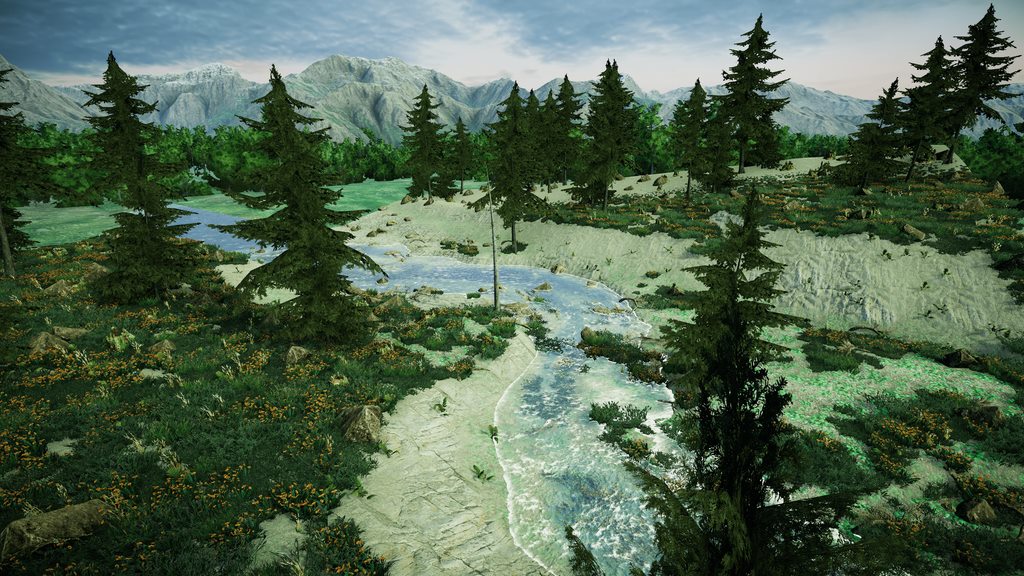
A river valley in computer graphics
Can Flash Flood! be considered imagination infrastructure?

On the one hand, imagination infrastructure is used to describe anything that provides support to people’s imaginations – a warning, a story, a photo, for example. Here, the structural element is applied cognitively. Through showing someone a photo of a familiar yet flooded street, you provide them the cognitive structure to visualise what this might be like on their own street. Thus, the photograph becomes the imagination infrastructure.

However, Interrogating Imagination Infrastructure implores us to think “infrastructurally” about imagination, where infrastructures: are created by and support social practice; can be ‘hard’ (e.g., roads) or ‘soft’ (e.g., movement of information); are shaped by regulations and standards; and, require maintenance. In this understanding, imagination infrastructures are something more than cognitive structures, they are the way they are created.

I find thinking infrastructurally about imagination a useful idea. It calls on us to be deliberate in investment, to continuously support and maintain, and to pay attention to who, and who does not have access. It tells us that building true imagination infrastructure isn’t just building moments, it’s building something that lasts.

Considering this led me to a distinction that I found useful – where the infrastructure exists to build and, importantly, sustain imagination over the long-term, individual resources should instead be considered as imagination engines:

  • The flood warning is an engine – the processes and models that produce and distribute it is the infrastructure.
  • The photo of the flooded street is an engine – the means of capturing, collating, and disseminating such images is the infrastructure.

This distinction might seem arbitrary1, but it provides a useful reflection on practice and its usefulness. My own past work has involved creating lots of imagination engines, for example the Flash Flood! VR experience2.
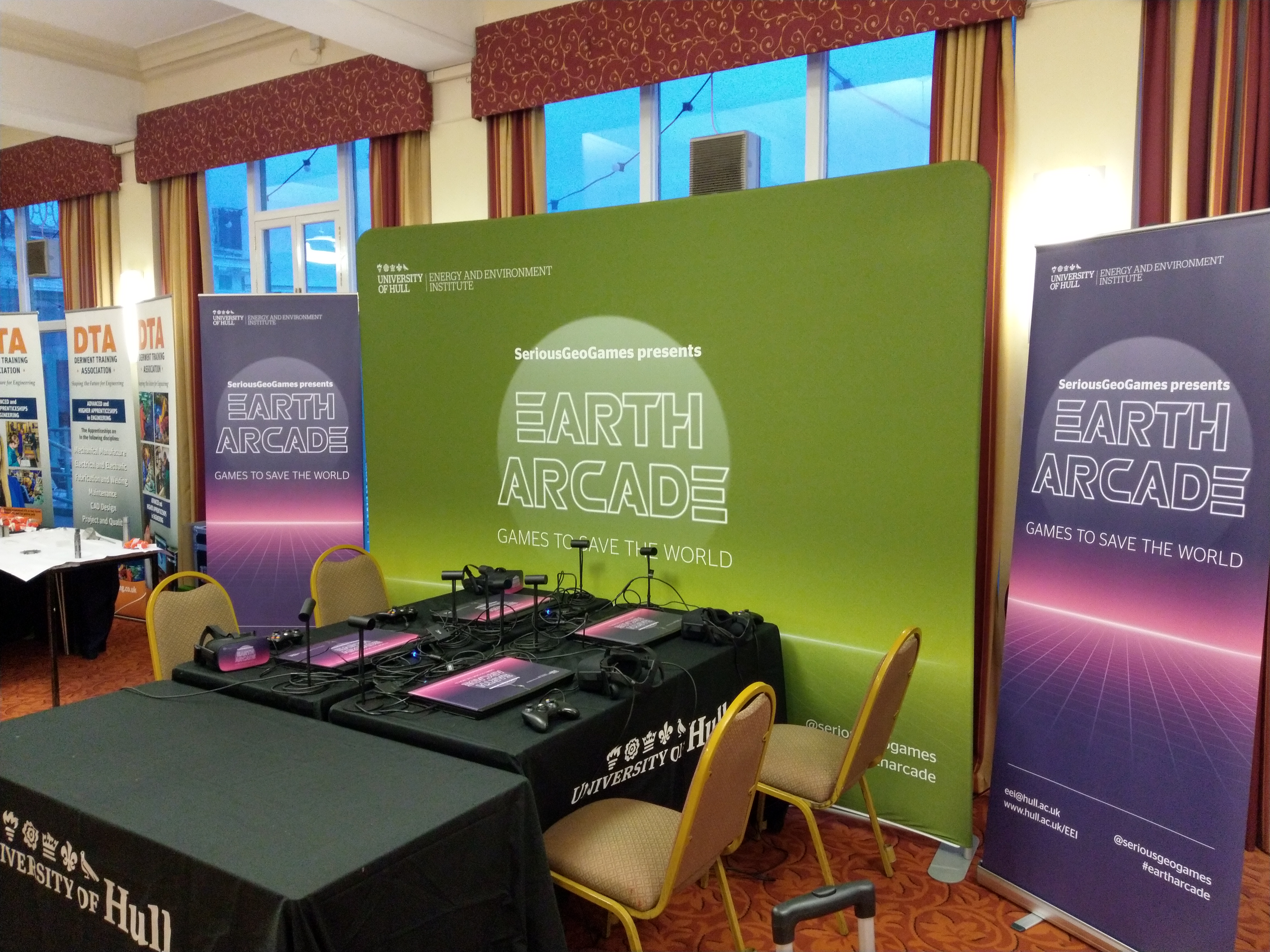
Laptops on a table as part of an event, surrounded by Earth Arcade banners.
If Flash Flood! was an imagination engine was the Earth Arcade imagination infrastructure?

As an activity, Flash Flood! helped people visualise what a flood might look like in a virtual river valley and it made people more interested in learning about flooding – it was an imagination engine. However, it was not supported by imagination infrastructure and that limited its impact. The experience itself has not been used for years and it is likely obsolete for newer VR headsets. To have got the most out of the project, I would need to have put more effort into the infrastructure surrounding it – on reflection, this is what my Earth Arcade project could have been.

This does not mean that imagination engines have no value or are inferior to imagination infrastructure. In fact, they are both vital. The engine is the motor that gets the imagination running, the infrastructure is the open road that sets it free.

I’d love to know:

Are you building imagination engines or infrastructure in your work? Or, do you think the distinction is not helpful? Let me know in the comments below.

1Interrogating Imagination Infrastructure itself warns that the term could become problematic if not applied metaphorically.

2Incidentally, only possible thanks to Hannah’s support, encouragement, and funding via the NERC-FFIR programme.

Dangers & Dwellers is a group roleplaying card game created by Games for Geoscience regulars Emanuelle Intrieri, Samuele Segoni, and Francesco Cardi from the University of Florence (L’Università di Firenze). The action takes place on a fictional island that faces many hazards, including floods, hurricanes, and earthquakes, and players (or teams) assume roles in the island’s governance and take actions to manage the risks. You win if you reach the end of Turn 6 with your island’s happiness, wealth, and population all above 0.
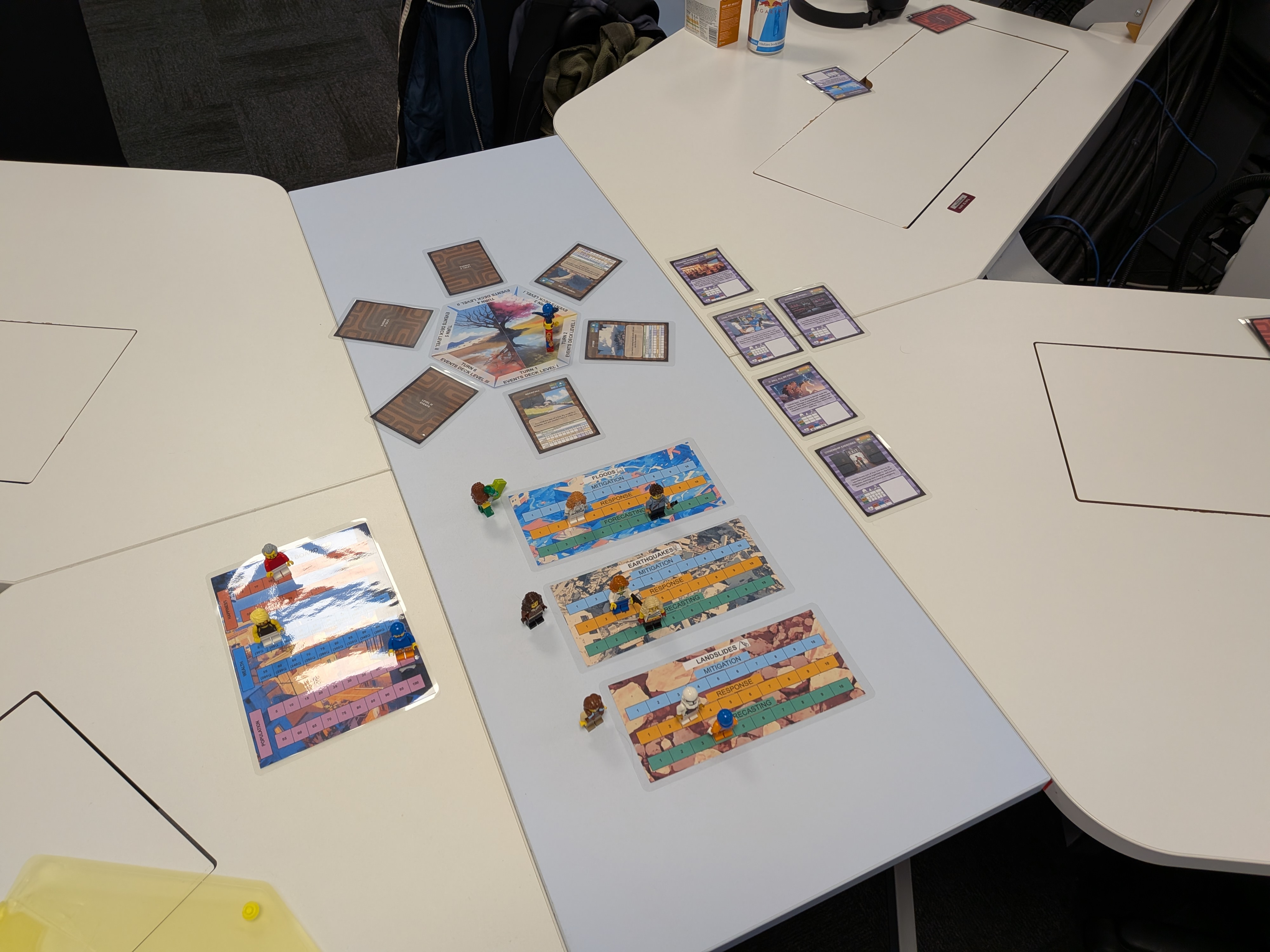
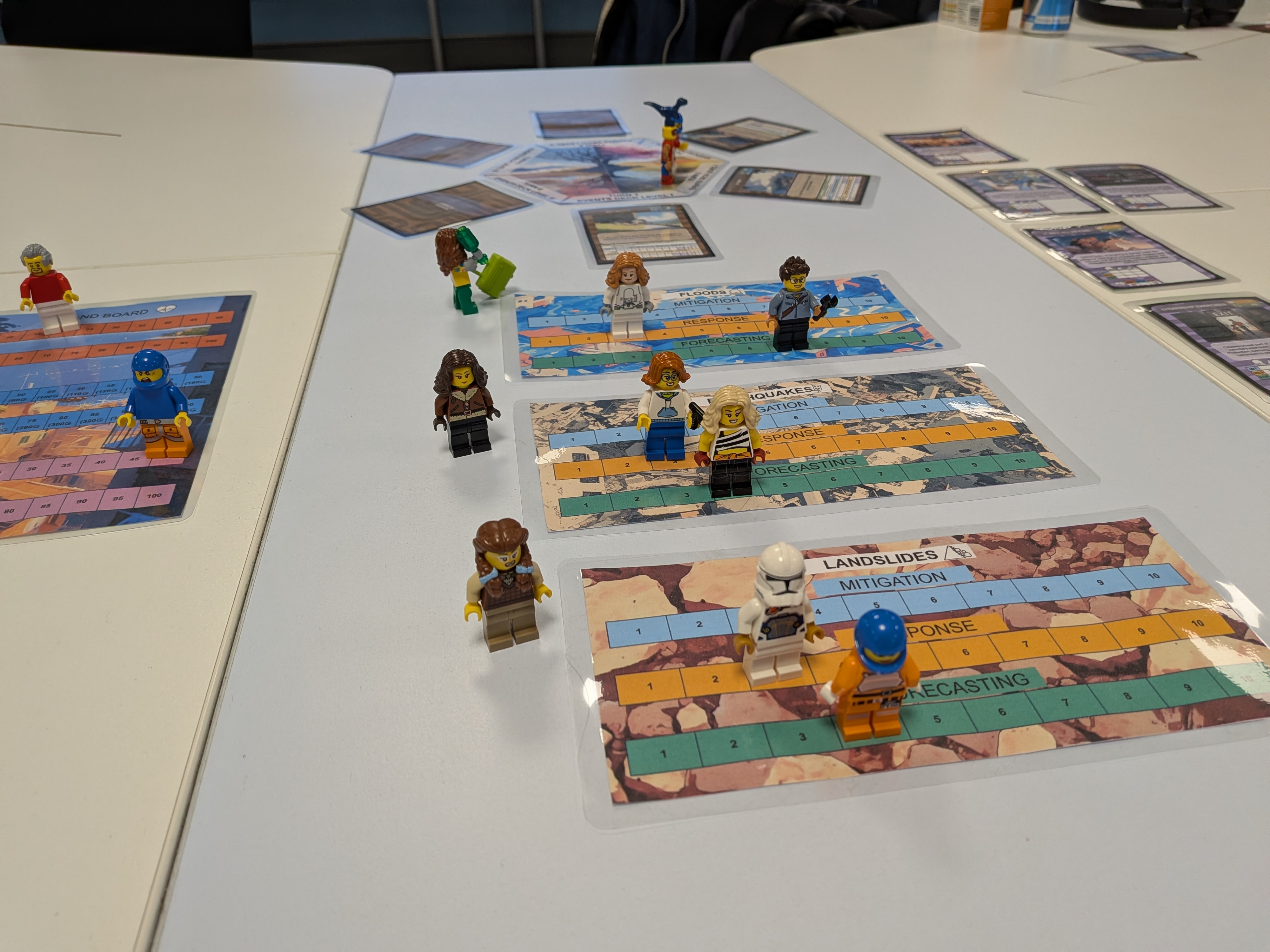
I was sent a print & play version of the game and after a long evening of printing, cutting, and laminating, I played the game with my 2nd-year Environmental Hazards students. In the first attempt, still figuring out how to play, we were out of the game by turn 3, but on our second go we were equipped with better strategies and only lost on the final, big, Level III hazard.

The game was fun to play and benefitted from multiple attempts. It demonstrates the balance of hazard likelihood and impact, different priorities across different groups, and the cumulative impacts of multiple hazards well in a ‘show, don’t tell manner’. Unfortunately, with only two hours I did not get a chance to run a debrief with the students but this was a very enjoyable way to finish the module for the year.  

Do you know a geoscience-themed game I should play?

I have uploaded six new videos to the GeoSkinner 360 channel. This channel is dedicated to only 360 videos, where you change the viewing angle within the video. The six videos were all filmed whilst I was in Edinburgh with our 2-year students and cover several sites that we visited or they used for their projects. Below is a preview of a flood tour I took down the Water of Leith – to get the most of the video, view it using the YouTube App on a mobile device with the highest resolution you can make work.

These videos are part of the imagination infrastructure for my teaching. Students need to design research projects in these sites having never visited them and these videos form just one of the resources available to them to imagine what that would look like.

GeoSkinner’s (mostly) monthly newsletter is for geoscientist students, researchers, educators, and communicators wanting to do things more imaginatively.

With each newsletter, you will find:

  • Geoscience Differently: A big idea about doing geoscience differently
  • Imagination Engines: Examples of inspiring and creative work by others
  • Behind-the-scenes updates from my projects and signposting to useful resources

If you’re interested in geoscience, games, and creativity, you’re in the right place – subscribe below to get the newsletter sent directly to your inbox.

Imagination Engines. Inspiring Interactions - Simon Clark.

Inspiring Interactions – Simon Clark

Simon Clark is one of the most successful science communicators on YouTube. His channel, @SimonClark, currently has over 644,000 subscribers and his videos regularly amass hundreds of thousands of views. Although his channel is now focussed on promoting climate literacy it started 15 years ago as a vlog about his experiences as a state-educated student attending University of Oxford. This was significant because Oxford and Cambridge have traditionally been a space for privately-educated students – even today where less than 7% of students are privately educated they make up 30% of student intake at these universities, and historically this has led to a disproportionate under-representation of state-educated citizens in important roles (e.g., 65% of senior judges are privately-educated). It’s clear that his representation of the state-educated voice in that arena resonated with many people.

What I have found inspiring about Simon is how he has managed re-invent and evolve his channel throughout his career. From that original vlog, through his time doing a PhD at the University of Exeter, to going full-time afterwards, and now focussing on climate literacy. He has adapted and grown with his audience whilst remaining true to himself and the content he wants to make and feels is important. Recently, he has been open about struggling with YouTube’s algorithm and the threat that poses to his livelihood – this led to another re-invention and the incorporation of some physical models into his videos. Simon makes these by hand and they are beautiful and he has been rewarded with millions of views. It’s imagination, it’s craft, and it’s realness – all the things I think people yearn for.

I’m also inspired by Simon as he is living my dream in many ways. He gets to be creative, share knowledge, and inspire people to learn every single day. He has already achieved my ambition and written a book (with an excellent audiobook version read by Simon himself). Like me, he’s a big gaming and Warhammer fan and successfully brings these into his work (seriously, check out his awesome Hawaiian Orks). When I put together videos for my YouTube channel, I looked to Simon’s for ideas – how can I put it together, how do I tell the story, how can I film this? Simon also co-hosted a brilliant podcast How to Make a Science Video with Sophie Ward where they chatted to other science creators. It is so jammed with useful insights and ideas that I highly recommend you listen if you want to make science videos.

I asked Simon some questions about imagination and his work.

Why is imagination important to the work you do?

Imagination is vital to me for two reasons. Firstly, YouTube is such a crowded marketplace that anyone not being imaginative in how they present their work risks being crowded by any number of content creators making things by the book. By making things that no one has ever made before, you stand out in a competitive niche. But more than that, and this is the second reason, it’s deeply fulfilling. I would never dream of referring to myself as an artist, but I think there is a part of me that clamours to express itself via art. Making videos is of course itself an art form, but trying to innovate and ask “what could I do here that’s unique” provides another level of artistic fulfilment.

How do you keep your imagination sharp?

I firmly believe that in order to create art you must consume art, and so I’m almost constantly hunting for new stimuli in the form of videos, podcasts, ideas, films, games, but particularly music. I’m one of those people who absolutely rinses their Spotify subscription. I think being exposed to new ideas in one medium – such as music – makes you question preconceptions and biases you have in other media forms. And doing that is the first step to creating something innovative. Which is the other key component – in order to create… you need to create! So I try to do something creative, whether that’s painting or singing or writing or videomaking, every day.

What are you currently working on that you would like to shout about?

I’m in the very early stages of a mammoth video that’s a sequel of sorts to my tiny Earth video. I can’t say much, but it’s going to be big in scale and involve very small models. And trains.

This post was originally published as part of the Imagination Engines newsletter. To get my content earlier and straight to your email subscribe using the box below:

Views expressed in this newsletter are mine and do not represent those of my employer. Content and links are provided for informational purposes and do not constitute endorsements. I am not responsible for the content of external sites, which may have changed since this newsletter was produced.

Imagination Engines. Inspiring Interactions - Lucia Perez-Diaz.

Inspiring Interactions – Lucia Perez-Diaz

Lucia Perez-Diaz is just simply multi-talented. You could describe her a Geoscientist. She has a PhD from Royal Holloway, has worked as a researcher, has an impressive scientific publication record and practices geoscience professionally. As an Earth Scientist, of the hard rock geology variety, Lucia specialises in understanding the process of plate tectonics, describing herself as a detective using clues and computer models to recreate the way the earth may have been in the long, distant past.

You could describe her as an artist, or even a science-artist. She is also a freelance illustrator and an incredible artist. She has a very distinctive and aesthetically pleasing style that she describes a “fun and whimsical”. Much of what she creates is made using papercut methods and even when her art is digital, whether that’s the beautiful illustrations for the game QUARTETnary or in her book How the Earth Works,  it still carries that hand-crafted style. This is why her work appeals so much, it has a tactile quality, it looks like you  could pick it up and run your fingers along the edges of each cut piece of paper – like a vinyl record, it is a medium that provides a direct connection between the audience and the creator.

Finally, you could also describe her as a writer and storyteller. She called herself a detective and in How the Earth Works she uses this as a device to draw the reader through the book. The book itself is aimed at children to inspire them with geoscience and learn about plate tectonics, but really it is her own story of investigating the deep past of the planet that she is inviting the reader to join her in. Recently, she has also turned her talents to science-journalism, joining the press team for the European Geoscience Union General Assembly, covering the themes of the conference including gender, AI, and ethics.

I asked Lucia a few questions about imagination and what it means to her work:

Why is imagination important to the work you do?

Much of what we do as Earth Scientists relies on imagination. We imagine processes we can’t directly see, and times we can’t travel to. Science, to me, is built on curiosity—and curiosity naturally leads us to create new ideas, to imagine. For me, science, imagination, and creativity are deeply intertwined.

As an artist, imagination plays the obvious role in the creative process, but also in figuring out how to communicate science in ways that resonate with people who may have different perspectives, interests, or relationships with it. It’s about finding new entry points into scientific ideas.

How do you keep your imagination sharp?

One thing I started doing a few years ago that really helps keep me creatively fit is taking on projects that are outside my comfort zone. Last year, for example, I created a series of illustrations featuring eight different characters based on various lipids.

“Take cholesterol and design a character inspired by its molecular structure and characteristics” — it doesn’t get much weirder than that! At times I regretted agreeing to it, but it pushed me to think in new ways, and I was really happy with the final result.

Some of these experiments never make it to social media — sometimes because I’m not allowed to share them, other times because they don’t fit my usual content — but they absolutely help keep my imagination active.

What are you currently working on that you would like to shout about?

Following my first book How the Earth Works, I’ve been developing ideas for new books — which I can’t talk about just yet, but I’m very excited about!

Alongside that, throughout 2024 and 2025, I’ve been working on a print series called Adventures in Time. It explores what it might be like to travel through different geologic periods. Right now, I’m working on a piece inviting travellers to the Paleogene—where you can climb Mount Everest while it’s still easy! (The Himalayas only began forming around 50 million years ago, so Earth’s tallest mountain was just a hill back then.)

This post was originally published as part of the Imagination Engines newsletter. To get my content earlier and straight to your email subscribe using the box below:

Views expressed in this newsletter are mine and do not represent those of my employer. Content and links are provided for informational purposes and do not constitute endorsements. I am not responsible for the content of external sites, which may have changed since this newsletter was produced.

Imagination Engines. Game we played. 13 Beavers.

13 Beavers – A Game We Played

I love a computer game called Timberborn. It’s a city builder game where you manage a colony of anthropomorphised beavers as they build a colony in the ruins of humanity, presumably now extinct. It is gentle, lovely, has a great sense of humour, and is highly addictive.

This is probably why Amy chose the board game 13 Beavers by Format Games as a silly Christmas gift for me. It’s a nice little game aimed at kids but we still had fun. The game has its own lore that tells of 13 legendary beavers who made it to beaver paradise*. These 13 beavers, each with its own theme such as a ninja, a robot, and a cowbeaver, form the artwork of the cards in the game – numbered 1 to 13, you move by correctly guessing whether the next card is higher or lower than the last.

The 13 Beavers game board. Colourful cartoon style, with board squares along a rapid flowing river. A player's hand is using a small fishing rod to catch magnetic fish.

The very simple game play is supplemented by some fun additions, including a magnetic fishing rod and fish that can either give you a bonus or set you back. There is also the opportunity to take a huge shortcut via the ‘tempting tunnel’ if you are able to correctly guess the exact value of the next card – something Amy did the first time we played, crossing the finishing line whilst I was still rooted to the start.

13 Beavers was lots of fun to play – it is funny, fast, and often frustrating (in a good way), whilst also being quite charming. It comes with a colourful board, a deck of attractive cards with the beaver artwork, a magnetic fishing rod and fish, and wooden beaver and dam playing counters. It’s recommended for ages 7+ and for 2-6 players. If you’re looking for a fun game for the family that doesn’t take too long or lead to arguments, this would fit the bill.

The reintroduction of beavers to UK landscapes is a hot topic these days. Beavers can bring great benefits as they create areas of wetland in wooded areas, which in turn increases biodiversity. Areas with beavers have greater resilience to forest fires and by allowing water to pond behind their dams they have potential to contribute to flood risk management too. 13 Beavers is not intended as an educational game but could make a fun hook for younger audiences as part of engagement work involving beaver reintroductions, facilitating conversations.

*I built beaver paradise in Timberborn so I imagine it looks a bit like this.

This post was originally published as part of the Imagination Engines newsletter. To get my content earlier and straight to your email subscribe using the box below:

Views expressed in this newsletter are mine and do not represent those of my employer. Content and links are provided for informational purposes and do not constitute endorsements. I am not responsible for the content of external sites, which may have changed since this newsletter was produced.

Imagination Engines. Book I've Read. The Science of Storytelling by Will Storr

The Science of Storytelling by Will Storr

This is not a new book, having been published in 2019, so I am probably not the first person to tell you this book is great, but… this book is great! The author, Will Storr, takes a scientific approach to storytelling. By this, I mean he has extensively researched what the research literature is telling us about what makes a good, compelling story, drawing on diverse fields but especially psychology. It started as a successful course for aspiring writers but thankfully Storr has made all this learning more easily accessible through The Science of Storytelling.

Its origins as a course are evident throughout the book. It is clear, it is engaging, it is packed with examples that illustrate the points, and it is exceptionally practical and useful. I initially listened to the audiobook, read by Storr himself, and found it entertaining in a way I have not found any other non-fiction book – his knowledge, his passion, and his belief in the message he’s communicating comes through in abundance and just makes you want to keep listening. I especially enjoyed his renditions of the many quotes from literary works throughout.

The true testament to the practicality of The Science of Storytelling is that once I had finished the audiobook I went straight out and bought a physical copy. My intention is to re-read it and make a whole load of notes. Of particular use is the Appendix, titled ‘The Sacred Flaw’, which is a step-by-step method for writing a novel – an ambition I have harboured since my early teens.

What I did not expect was for this book to help me improve my understanding of the nature of models. Talking about understanding characters and their motivations, Storr draws on the Theory of the Mind, which is our ability to understand how people perceive the world in different ways. Storr describes how we all create our own models of reality, which are not truth but controlled hallucinations. The best stories emerge from characters being faced with the wrongness of their model – the lie of it – and are forced to change as its usefulness has diminished. For a clear and extreme example of this happening to a character, think of the Truman Show. How can we ever build a perfect model of reality when even our own perceptions and understanding of that real world are themselves an imperfect model?

The Science of Storytelling is essential reading if you write fiction or harbour any ambition to write fiction. However, even if you do not write fiction but are involved in any form of science communication, I implore you to read this book. You will not regret it and it will help you craft compelling narratives and stories to engage and enthuse people with science and research. It sits well within a growing body of work that draws on fields like psychology and behavioural insights to make communication and storytelling more effective, such as How to Save the World by Katie Patrick.

Finally, if you are modeller read this book. It will help you appreciate the cognitive biases we all have and how these shape our perceptions of reality. In all good stories change happens, the resolution is achieved, when someone is able to escape from their own personal model land. This is a useful metaphor for escaping from our numerical model lands too.

This post was originally published as part of the Imagination Engines newsletter. To get my content earlier and straight to your email subscribe using the box below:

Views expressed in this newsletter are mine and do not represent those of my employer. Content and links are provided for informational purposes and do not constitute endorsements. I am not responsible for the content of external sites, which may have changed since this newsletter was produced.