Category Archives: Personal Reflection

GeoSkinner in yellow

Introducing GeoSkinner

I’ve changed my name! Well, my ‘brand’ and social media handle anyway.

I’ve been ‘FloodSkinner‘ since around 2015 after I change my Twitter handle from ‘CloudSkinner‘. CloudSkinner came about as my PhD was related to clouds and I made the switch as my first post-doc role was related to flooding.

After I left my last academic role and started using FloodSkinner as a catch-all for my personal projects, I considered using a different name. However, logistically it was challenging and my Twitter account had >4,000 followers at that point. I decided against it.

A few years down the line and I am increasingly unhappy with FloodSkinner as a name, or a brand, or whatever it is. It does not accurately capture my range of interests and the things I create and work on.

An example – just 8 out of my 23 YouTube videos on my main channel are about flooding. Just 4 of my 30 Shorts have a flooding theme.

Ultimately, I’ve just had the feeling that the name was inhibiting the growth of my content.

The new brand I am using is GeoSkinner – I am a geographer and a geoscientist, so Geo was the natural choice. I feel it is a much better fit and pretty much all my videos and Shorts feel relevant to the name.

To make the change, I’ve had to: update my logo; change handles on the LinkedIn page, BlueSky, LinkTree, Ko-Fi, and Discord; purchase a new website domain and add it to my website; and update profile pictures all over the place. My Instagram and Threads stay as GeoGamesMaster as GeoSkinner was already taken there.

One things I haven’t done yet is extract my FloodSkinner email account from the places I’ve used it and transfer over to a GeoSkinner one – this is being a bit tricky.

The final thing I’ve done is update my YouTube channels, including rebranding the existing main and Extra Life channels as GeoSkinner.

My 360 videos have never done well on the main channel, they get views but people stop watching very quickly – I guess if you’re pushed a 360 video you are not expecting, you won’t stay long. I’ve started a GeoSkinner 360 channel and moved my existing 360 videos onto it. I also took the chance to collate and upload my previous 360 content onto this one channel.

I feel very happy about the change and hope it makes a positive difference. In the three days before I switched domains this website had 24 views and 81 in the three days after. Now it’s time to make some higher quality content!

Imagination Engines. Crafting Connections - Science Communication in a Digital Age

Crafting Connections: Science Communication in a Digital Age

I listen to the radio to help me focus on work. The station I often choose is called Absolute 80s and essentially plays the same ‘Best of the 80s’ CD collection on shuffle every day as far as I can tell. During the adverts, a narrator beckons me to join “Real Dating for Real People”. No thank you, I am a happily married man, I reply, and besides, if I was looking I’d be looking for a dating agency just for an imaginary girlfriend. The station’s ident, I think now voiced by Julian Barratt, then tells me “Absolute 80s, where real music matters” before they play the theme from Ghostbusters.

I’ve always found the way advertisers use language fascinating. For example, around about when Michael Gove unhelpfully spouted “People have had enough of experts” ushering in the erosion of trust in evidence-based approaches, toothpaste commercials transitioned from phrases like “scientifically formulated” and “chosen by experts” to “pro-experts”, and eventually to “professionally formulated”. The term professional seemingly became more palatable than scientific and expert – I tried using this on my online profiles, labelling myself as a ‘professional researcher’ rather than as a scientist.

It would seem today that ‘real’ is an favoured buzzword for advertisers. They are usually well informed about the zeitgeist and they are tapping into a genuine desire for experiences that are genuine, authentic, and human. The digital world has transformed the way we live – and artificial/abominable intelligence (AI) is transforming it again – yet this yearning for connection, for authenticity, for realness, will always win through. But in our digital and AI dominated world, what is ‘real’?

Objects are real.

In The Revenge of Analog by David Sax, he described this as “digital is the peak of convenience, analog is the peak of experience.” Sax places this in the context of the renaissance of vinyl records, sales of which have increased year on year for the last 18 years – he highlights a preference for the richer sound quality and being able to hold, and own, an object – a tangible, tactile thing. There is also a connection here – the music is played live, the very vibrations carving the grooves into a master that is then used to press the records, whose grooves return the original vibrations into music. Thus, a record has an echo of the liveness of the performance. You can run your fingers over the surface of a record, feel the grooves on your skin, and be connected with its creator. Contrast that to a CD or digital file. They are just data transformed multiple times and estranged from their creators.

In the realm of games, there has also been a resurgence for analogue, with the market for board games set to grow from $21bn in 2023 to $41bn in 2029. This isn’t at the expense of digital games either, whose market value far exceeds this and also continues to grow.

There is a strong desire for people to make and build. I love Warhammer – I do not play that often but I like to build and paint their model kits. Despite competition from digital gaming, and predictions 3D printing will kill their business model, parent company Games Workshop are posting year-on-year increases in sales and profits. The doomsayers wanting to write the companies eulogy fail to understand the enduring desire for the tactile – to feel and make things with your own hands and the joy that gives you. Some people call it the Ikea Effect. To me it’s obvious, for example, you cannot replicate the feeling of building a model airplane kit by building a digital model, or even printing out solid components of resin. The experiences are entirely different.

Craft is real.

Recently as I was wasting time in the evening by browsing YouTube I was reminded of the simple pleasure of seeing someone who is very good at their job being very good at their job. I watched Sarah Natochenny, the voice actor for Ash Ketchum on the Pokemon cartoon, being asked to improvise voices for characters she has only just seen. I love watching her facial expressions as she processes, imagines, then embodies the character, giving them not just a voice but a whole personality and back story. She has a craft, she is good at it, and its delightful to see her expressing that craft and me then thinking ‘wow, there’s no way I could do that’.

We will always be delighted by talented people showing off their talent and seeing something incredible being done for real. Even though Harry Palmer will always be my favourite spy, I do enjoy the Bond films. A huge part of their appeal is the action and the real stunts. When you see the Hornet X car do a mid-air corkscrew across a river in The Man with the Golden Gun it is because someone actually did that – it was planned on a computer and there is special FX trickery but ultimately, someone got in that car and drove it up the ramp. This was a rule for Bond films – the action was as authentic as possible. This was regrettably forgotten in the resultingly awful, CGI-riddled Die Another Day, something which will have been noted on Bond’s B107.

Both together are super-real.

The first Wallace & Gromit film, A Grand Day Out, was released, rather terrifyingly, in 1989. It used a painstakingly detailed process of stop motion animation and clay models to bring characters to life and tell the story. Each clay model is sculpted and manipulated by hand – a thing, an object, produced and controlled by someone good at their craft. At Christmas 2024, the latest instalment of the story, Vengeance Most Fowl, became the BBC’s most viewed scripted show since 2002 at a time when TV viewership is declining. Although now augmented with model digital effects, the heart of its production, and its lasting appeal, is that craft and the things it creates.

I don’t want you to mistake this as a false-nostalgia fuelled rant against the use computer animations and CGI. I love those too and my favourite shows as a kid included the vanguard of these, Reboot and Insektors. The point I am trying to make is that there is a still a space for hand-crafted shows and films to cut through –  Recently, the restored 1983 pilot of the original Thomas the Tank Engine show, made using real models of trains and landscapes, has been viewed over 1.6m in the last month of YouTube.

Realness in Science Communication.

Good science communication connects people to science and in particular to the scientists involved. People want to see the ‘realness’ of science, experiencing it in a genuine and authentic way. They want to know the stories of real scientists behind it.

My specialism in science communication has been game-based approaches at festival-style events. The sort of place where you get given a small 3x3m space, a trestle table, and present some form of tabletop activity. I’m probably best known for virtual reality activities in this spaces, such as Flash Flood! and Humber in a Box. There was an appeal for VR in the pre-pandemic era, which I was purposely tapping into but my bet would be this is nowhere near as strong now as it was back then as the novelty has worn off. However, other activities like the EmRiver mini-flume and AR Interactive Sandbox have a timeless popularity owing to their tactile, hands-on approach. If I was doing similar work these days, I’d be focussing on my physical demo work and storytelling, for example Earth Arcade: The Forest.

Science is a craft. It is not easy and it needs years of training, mentorship, and practice to master. We often forget this. Like any craft, people want to see scientists being good at science. In our efforts to make science sharable and understandable we should not lose sight of also needing to amaze people into saying ‘wow, there’s no way I could that’. This may seem counter-intuitive because part of the role of a science communicator is to inspire people to be scientists, but I think this is where inspiration comes from – if I was younger and was better at doing voices, I might instead watch Sarah’s video and say ‘wow, that’s so awesome I want to be able to do that’.

Science communication becomes really special when someone is able to bring together their craft for science and another craft. Sam Illingworth is a scientist and poet and a science-poet. Rolf Hut is scientist and a maker and a science MacGyver. Iris Van Zelst is a scientist and games developer and science-games developer. There is a growing movement of scientists expressing their crafts and research through science-art, including these examples from former colleagues at the University of Hull I had the pleasure of writing about.

As AI becomes more embedded in real-life, as every YouTube thumbnail or LinkedIn ‘thought leader’ relies on increasingly samey AI generated visual slop, and as online writing becomes ever more generic and unimaginative, people will increasing seek a connection to the authentic, the genuine, the real. It might not seem so now, but the desire for tactile objects and demonstrable craft will surge in the future. Science communicators, hold your nerve.

Creating a book donation tradition in memory of loved ones.

Creating a Book Donation Tradition in Memory of Loved Ones

We lost my father-in-law, George, a year ago between Christmas and New Year. He was a good man, into his eighties, who had spent much of his career in the British Civil Service, including the Ministry of Agriculture, Farming and Fisheries.  He had many interesting stories to tell, including how he ended up at Wembley for the 1966 World Cup Final with free tickets as none of his colleagues believed England would reach that far!

George’s passion was for books. He was always reading, was never without a book in his hand, and when asked what he would like for presents we were sent a list of books. He very reluctantly halved the size of his library when he an my mother-in-law, Beverley, downsized and moved to the seaside for their retirement. Beverley still found books hidden in cupboards and drawers.

Left: A table full of books and a photo of George. Right: a smaller pile of books on a table.

This is how we wanted to remember him, so instead of flowers at his funeral we asked people to buy a a children’s book that meant something to them. We arranged with the Primary school he attended to donate them to their library. We were blown away by people’s generosity and we were able to donate over 100 beautiful books!

We continued it again this year but on a smaller scale. With my wife’s family staying with us over Christmas, we visited a local bookshop and each bought a couple of books to donate to a Primary school local to us. I chose some books about neurodiversity because I’d have liked to have read these when I was a kid. We plan on making this an annual tradition. George would have loved sharing his joy of reading with the school kids.

What book would you choose to give to your younger self?

This post originally appeared in the Imagination Engines newsletter. To read this content a few weeks earlier, subscribe to the newsletter below.

Meanders on the Ouse

Meanders on the Ouse

I would not be in my line of work if I did not love being around water. I grew up, was raised, and lived most of my life on the banks of the Humber. Whether it was the open expanses of the bank and cliffs between Barton and South Ferriby, or the concrete defences around the Hull tidal barrier, I have marvelled and been inspired by the mighty tides and the big open skies of the Estuary. These were places I would sit, reflect, and let my imagination wonder.

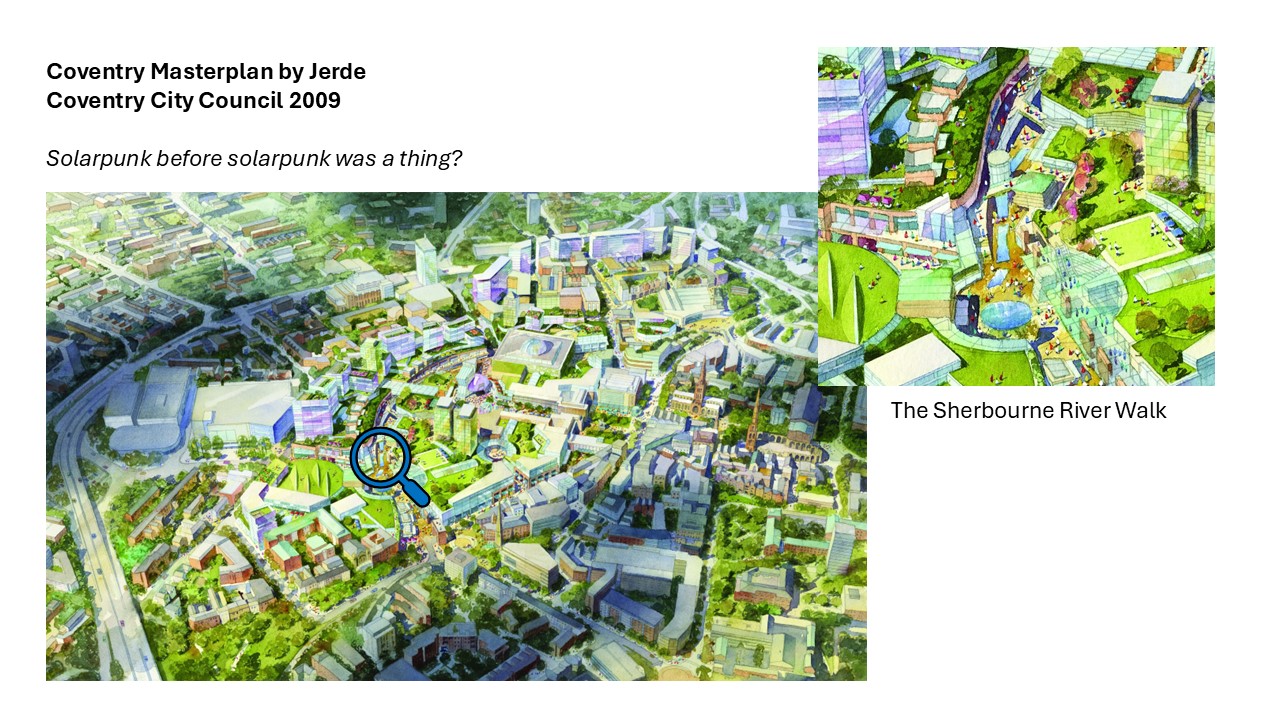
Until recently, the only time I have lived away from the Humber was three years spent in Coventry. This city, a La Corbusien nightmare of concrete and ringroad, sits close to the point in the UK that is furthest away from any coast. Having buried its river, the Sherbourne, under the concrete the post-war planners loved so much, it is entirely cut off from any form of waterscape altogether. When I worked there, the ‘Jerde Masterplan’ had an ambition to install water features along the old route of the river but this a long way from the daylighting of buried rivers that has been successful elsewhere.

An artist's impression of an aerial view of a redeveloped Coventry. There are lots of trees and green roofs. An inset shows a series of ponds in a street, retracing the route of the buried river.

Needless to say, I did not enjoy my time in Coventry. I do not want to bash it, it has lots going for it, but I personally was not inspired or enriched by it. I did not find any spaces where I could sit and imagine. It was not the city for me. A large part of this, I think, was the lack of a waterscape and I felt homesick and longed to be under those open skies of the Humber once again the whole time.

It was not easy then to prepare myself for the move to York. It was move an hour’s drive inland, away from the estuary and the sea. I did not want to feel disconnected and homesick again. Thankfully, York was not devastated by well-intentioned yet misguided town planners whilst recovering from the Blitz and retains much of its Medieval charm (I once heard pre-war Coventry described as “York on steroids”). The River Ouse flows through its centre and I now live just a short walk away. Lunchtime and after-work meanders along its banks have become a near daily ritual, watching the boats, the rowers, and birds diving for fish and trying to guess where they’ll pop up again.

A view of the Ouse in York. The low sun reflects in the wide river. Buildings flank both banks.

What I really love about the river is how dynamic it is and the liminal spaces at its edges. The river level can rise and drop quickly and since we moved here a few months ago it has spilled over its human-defined edges on handful of occasions. These are my favourite times and places. As I write, one of my favourite walks is diverted by the flood of the river. Not enough to cause harm, just minor nuisance, but it reminds me of its power and creates ambiguity over where belongs to us and where belongs to it.

A close-up photo of the river ouse spilling over its banks, with shallow water lapping the feet of a bench.

It prompts my imagination. The water is much higher than usual and higher than I would visualise when it is ‘in bank’. The Ouse can flood to an extent that it causes real damage and misery and woe to those people unfortunate to be impacted by it. It is hard to visualise how it would look and the volume of water that would be needed for it to happen. You can see the evidence in the barriers on houses and businesses. You see it on flood markers (although I haven’t spotted any yet). And, when I see the water spilled over onto footpaths and the layer of fine silt left behind from the river when it was higher the day before, it sparks my mind to consider the hazards.

Here at the river edge, I find something similar to that I find on the banks of the Humber. It different, yet in a metaphorical, spiritual, and a very literal hydrological sense, they are connected. It is a place I can sit, reflect, and imagine. I am excited for the ideas I will have here.

Where are the spaces that spark your imagination?

This post originally appeared in the Imagination Engines newsletter. To read this content a few weeks earlier, subscribe to the newsletter below.