April 30th 2025 was officially the eight edition of the (unofficial) European Geoscience Union Games Day! Where does the time go, eh? In this post I take a look back at the origins of the Games Day and the story so far.
For the uninitiated, the General Assembly of the European Geoscience Union, often just referred to as EGU, is Europe’s largest gathering of geoscientists. Each year, around 21,000 of them converge in Vienna to share science and schnitzel. For the last seven years, Wednesdays have been what I have dubbed the Games Day, featuring our science sharing session – Games for Geoscience – and our social event – the Geoscience Games Night.
It all began when Sam Illingworth and Rolf Hut approached me in 2017 about convening a gaming session as part of the education and outreach programme. The following year we held the first ever Games for Geoscience session, thankfully with enough abstracts for both a session of talks and a session of posters.
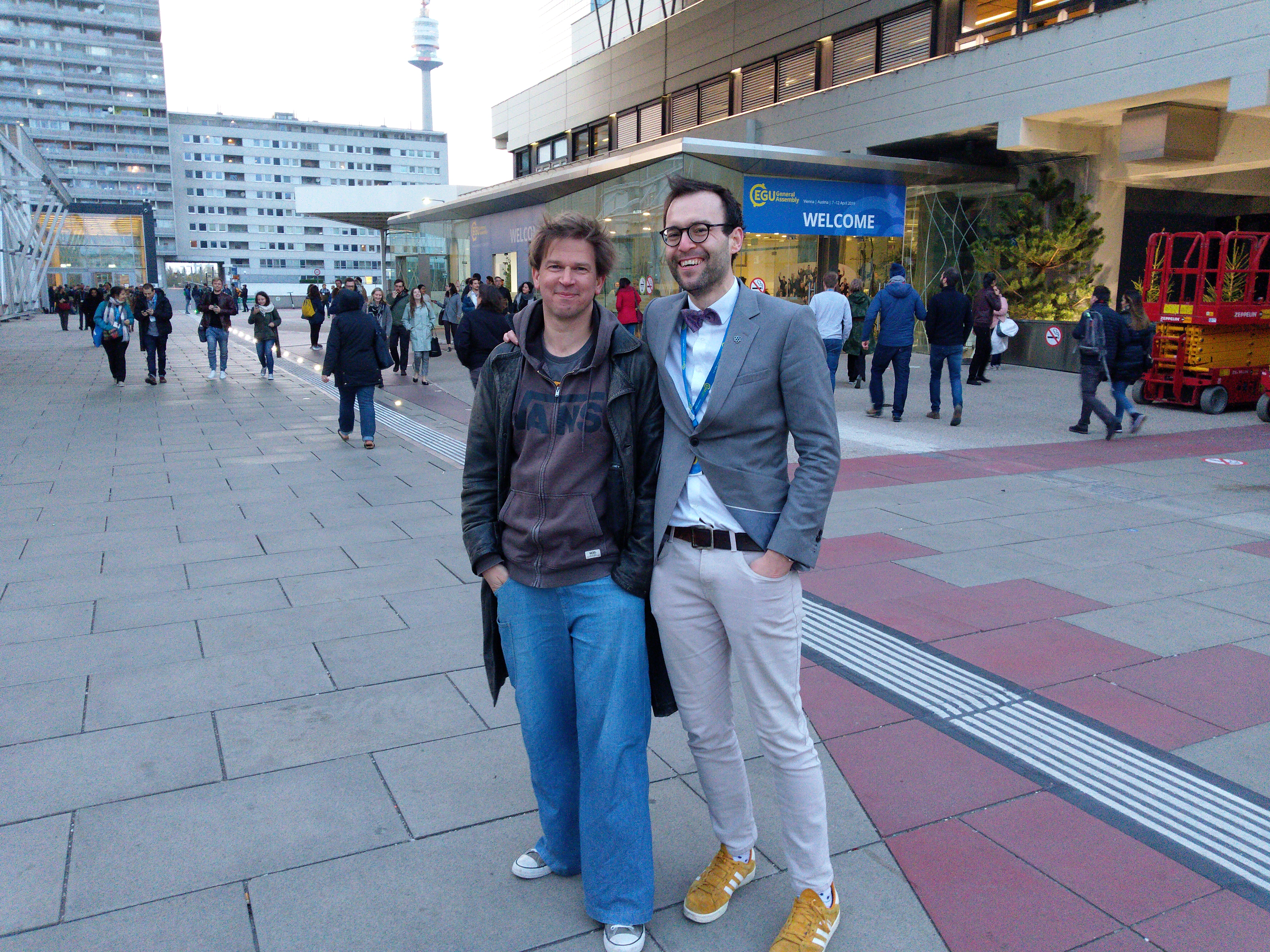
Rolf and Sam at EGU 2019, amazingly not deliberately cosplaying as two generations of the Dr.
We also held a Games Night. The first one being in a small room in the basement. I remember forking our around £500 from my research funds to purchase 80 bottles of beer and a few crisps for the players. The room and the beer were nowhere near sufficient for the event. Since then we have had very generous support from the EGU team, with the Games Night taking place in a much larger space with access to the free refreshments in the neighbouring poster halls (although security guards added an additional difficulty level to this in 2025!).
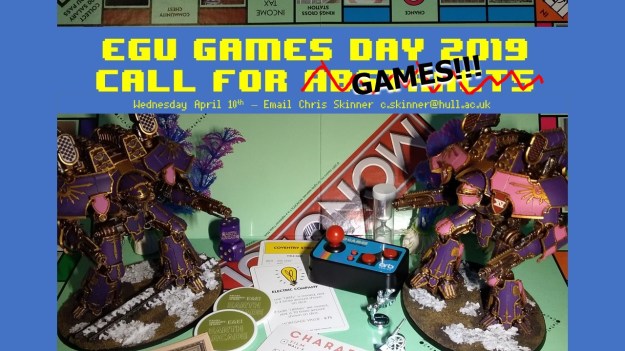
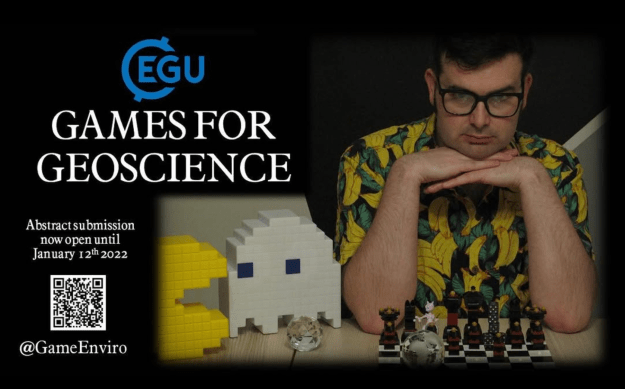
It also started the tradition of my awful promotional images for social media. I’m no artist and my design skills are minimal. I also have no budget for this (but apparently I did for beer…) and have a determination to do things myself. Each year I have made some form of crappy image in PowerPoint to drive abstract submissions and make people aware of the Games Night.
In 2019, were joined by Dungeon Master Liz Lewis and Volcano Explorer Jaz Scarlett. We even expanded over the pond, with Rolf heading up a Games for Geoscience session at the American Geophysical Union meeting, with quest speaker Isaac Kerlow, created of the EarthGirl games.
The Covid-19 lockdowns forced EGU online in 2020 and 2021 and the organisers did a phenomenal job in pulling together the meeting during this time. I hosted Games for Geoscience from my bedroom, whilst the 2020 Games Night saw the convenor team live stream a game of Monster Flux – not geoscience-themed but needs must! In 2021, the Games Night took to Gather Town where I hosted a pub quiz in a bespoke games room I designed. The convenor team changed, as we said goodbye to Sam and Jaz, and welcomed in Lisa Gallagher and Malena Orduna Allegria.
The meeting in 2022 was fully hybrid, with onsite and online connection. The Games Night returned to a physical setting and we tried a return of the Games Room hosted event. Sadly, there was not much demand for it and since the Games Night has remained an onsite only event.
I was so happy to be offered the chance to attend EGU in person again in 2024, my first time in five years, and host the Games for Geoscience session and the Geoscience Games Night live. I was back again this year too and the whole Games Day just keeps going from strength to strength. I think this year was our busiest ever Geoscience Games Night. It is an event that relies of organised chaos and I am worried we may be reaching the limits of that working successfully – we may need to adapt to expand. For now, watch this space!
This post was originally published as part of the Imagination Engines newsletter. To read my content earlier, subscribe using the box below:
Views expressed in this newsletter are mine and do not represent those of my employer. Content and links are provided for informational purposes and do not constitute endorsements. I am not responsible for the content of external sites, which may have changed since this newsletter was produced.
Those who work to plan and prepare for disasters will often use a method called counterfactuals. It proposes ‘what if?’ questions to the planners and they work out how they would respond if that circumstance arose. Similarly, after something bad happens we often look back and think about what we might have done differently.
Downward counterfactuals combine these two methods. It looks back at something that happened and asks ‘what if this other thing happened too?’. For example, planners might look back at how they responded to a disaster and then ask what they would have done if they lost power to their operations room, or if the phone network went down, for example.
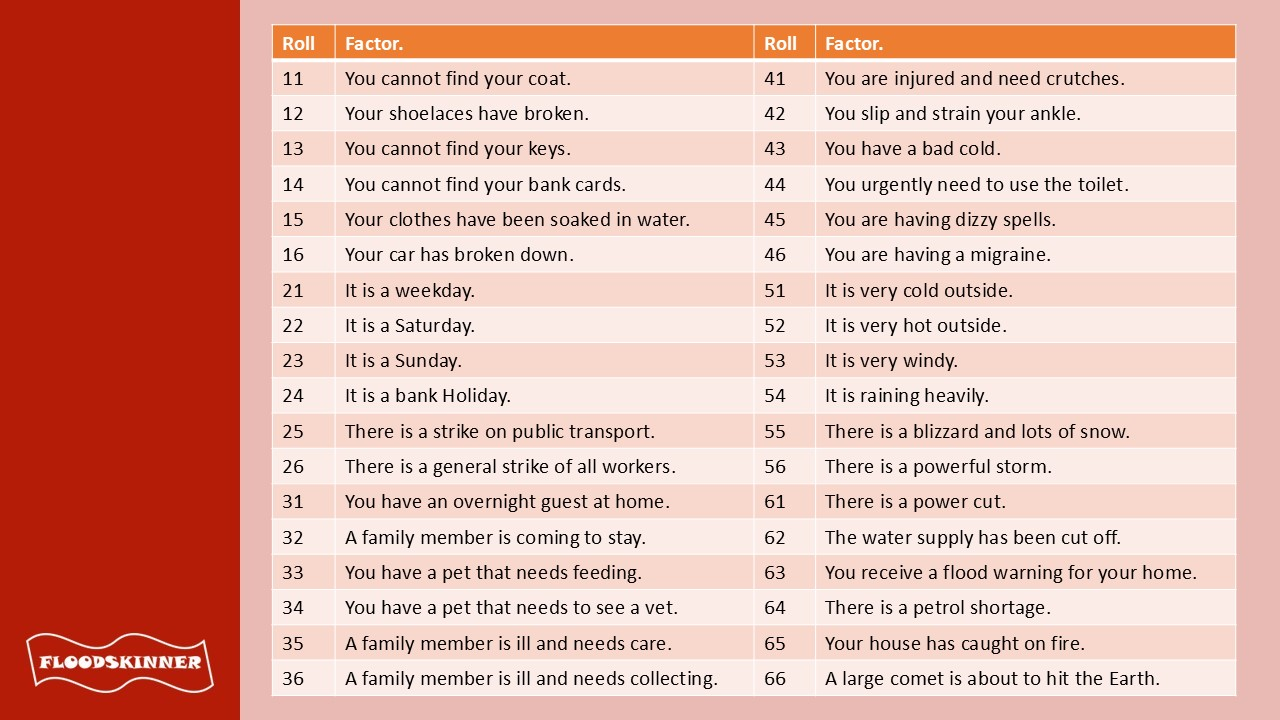
Good Morning is a very simple solo roleplay game. It asks you to first generate a task and then generate a complicating factor. You respond by writing down how you would respond to these. Then, generate a further complicating factor to add to your scenario. How does this change your response?
To generate a task or factor, roll two 6-sided dice, one after the other. The first roll is the first digit and the second the second digit. For example, roll a 2, then a 3, your result is 23. Then find that number on the corresponding table.
This isn’t meant to be serious, just a bit of fun to get you thinking – and imagining – how you might act is some very normal and some very odd circumstances. I hope you enjoy!
Let me know if you tried it and what happened by leaving a comment below.
This article originally appeared in the April issue of Imagination Engines. To get my content earlier and sent straight to your email, subscribe using the box below.
Science thinking different: Imagination as a skill – Numerical models – Game-based approaches.
Hello, and welcome to June’s edition of the Imagination Engines. In this newsletter, I share my latest news and the interesting things I have found about the use of imagination in STEM. Below you will find:
News of my first long-form YouTube video in over a year.
Inspiring Interactions with environmental engineer and action designer, Katie Patrick.
My review of The Science of Storytelling by Will Storr.
Playing the game 13 Beavers.
I just want to make a quick plea for you share and repost my content and the content of my fellow geoscience creators. I produce this newsletter in my spare time and for free and need help getting it out there. Many creators are finding engagement difficult at the moment, especially those of us who have chosen to abandon problematic platforms like Twitter and Substack. I now rely on BlueSky and LinkedIn to share my work and this brave new world is driven by reposting.
Whilst I appreciate every like or reaction I get on social media, it is shares and reposts that help people find content. I implore you to hit that report button as often as you do the like button – unlike other platforms, BlueSky does not post content you have liked to others.
I want to do my part and have created a list of geoscience creators on BlueSky. I regularly check this feed and repost any new content I see posted. Please help the geoscience creator community by using the list to do the same – if you’d like adding to the list, just send me a message. By supporting each other, we can beat the algorithms!
You can also subscribe to this newsletter and have it emailed to you each month – that way, whatever the future of social media, we can find each other:
Revamping My YouTube Journey: New Long-Form Video Released
This month I have released a new video on my YouTube channel! Ok, this should not be surprising but what is different here is that it is a long-form video (i.e., not a Short/Reel). My last long-form video was posted way back in April 2024 and that was just me recording a presentation I did – my last, proper, long-form video was about AI and Time posted in March 2024.
The reasons for this >year-long gap are multi-facetted. A big reason was just the craziness and big life changes that happened through 2024, as was the amount of headspace I needed to organise a month-long event with 120 volunteers at the Science Museum. But it was also a choice.
My main objective with the YouTube channel is to enjoy it and learn from it. I love making videos. With every video I make, I try something new, push myself a little further, and hopefully you can notice a gradual improvement if you go through my back catalogue. However, there were somethings I was not happy with and was finding much harder to improve:
Visual Appeal: I wanted my videos to look visually more appealing and interesting. I can only use small, temporary spaces to film so it is difficult to create an interesting and consistent background. Since moving, I don’t even have my trusty blue wall anymore.
Visual Style: I tried to make ‘crappy powerpoints’ a feature but they really are just crappy. I’ve experimented with a couple of branding styles too and I think they are too playful for my channel style. Together, they made me look very amateur and I want to project that I know what I am talking about.
Sound Quality: The sound quality on my videos has been awful and good sound quality is apparently important for YouTube. I had a Rode microphone that sat on top of my camera but the sound was too echoey and it picked up too much background noise.
In the last year I have been investing in more kit and experimenting through my short-form videos (like the SDG series). This has included using a greenscreen and increasing the use of background footage (a mix of my own and creative commons clips from Pexels), using 360 camera footage from my new Insta360 X4, and upgrading to Rode Wireless microphones. The final piece in this puzzle has been finally sitting down and learning Canva and moving on from PowerPoint (I now get the hype!). With all this, I finally felt happy enough to create something long-form once again.
So, please do check out my new video Using Games for Geoscience. It cover my thoughts on why we should and how we can use games in the geosciences, drawing on my over ten years of experience working in this area. I’ve put a lot of work into the video (and had to film it four times due to technical glitches…) so I’m hoping it will go down well. I get no love from the algorithm, so any boost you can give by sharing and Liking the video and subscribing to the channel is massively helpful.
I can see my channel pivoting towards geoscience gaming content from now on. I’m finally at a point where I feel my production quality is high enough to invite others to contribute, so hopefully you’ll be hearing from some of my favourite people in the geoscience community soon.
Inspiring Interactions – Katie Patrick
I can’t remember how I came about Katie’s book, How to Save the World, in 2019 but it almost seemed too good to be true. A research-led practical guide to create environmental change, combining gaming, behavioural psychology, design, and storytelling! It just meshed so perfectly with the work I was doing at the time with my science communication exhibit project, Earth Arcade. With the book, Katie combined all of these disciplines into something that is incredibly accessible, enjoyable, and also beautiful. It has been a key influence and reference guide for my work since.
From katiepatrick.com/about-katie
Katie Patrick is an environmental engineer and action designer passionate about seeing positive environmental action. Her work focusses on empowering people to be leaders in their own communities, turning grassroot movements into societal shifts. Her key tools are science and creativity – she takes the latest peer-reviewed research in behavioural psychology, gamification, and marketing and translates and transforms it into something that is accessible, applicable, and aesthetically pleasing. She has a rare and incredible talent.
Her clients include the United Nations Environment Programme, NASA Jet Propulsion Laboratory, and the European Commission, among many others. She regularly posts tips and guides on social media, in podcasts, and through webinars. Last year she launched Hello World Labs to equip sustainability leaders with the skills to transform their community engagement, with lots of free events, a newsletter packed with tips, and opportunities for 1-to-1 mentoring and to join the School of Climate Action Design.
Katie’s work does not explicitly cover my professional realm of flood risk but much of her work can be easily applied to the practice of community engagement for flood resilience. For example, it could be used alongside the Environment Agency’s ‘Applying behavioural insights to property flood resilience‘ report to better help protect people from flooding.
I asked Katie a few short questions about what imagination means to her:
Why is imagination important to the work you do?
Environmental sustainability needs a vision, a goal, and destination we can work towards. It needs to be a practical engineering solution AND it needs to be an exciting wonderful movement we can believe in.
How do you keep your imagination sharp?
I like to meditate on an energy question and just idea flow through me. I think making a meditation about a question is key to putting the mind in a state to answer that question.
What are you currently working on you would like to shout about?
The school of climate action design! I am building a community and 6 week coaching program to teach action design and environmental psychology.
The Science of Storytelling by Will Storr
This is not a new book, having been published in 2019, so I am probably not the first person to tell you this book is great, but… this book is great! The author, Will Storr, takes a scientific approach to storytelling. By this, I mean he has extensively researched what the research literature is telling us about what makes a good, compelling story, drawing on diverse fields but especially psychology. It started as a successful course for aspiring writers but thankfully Storr has made all this learning more easily accessible through The Science of Storytelling.
Its origins as a course are evident throughout the book. It is clear, it is engaging, it is packed with examples that illustrate the points, and it is exceptionally practical and useful. I initially listened to the audiobook, read by Storr himself, and found it entertaining in a way I have not found any other non-fiction book – his knowledge, his passion, and his belief in the message he’s communicating comes through in abundance and just makes you want to keep listening. I especially enjoyed his renditions of the many quotes from literary works throughout.
The true testament to the practicality of The Science of Storytelling is that once I had finished the audiobook I went straight out and bought a physical copy. My intention is to re-read it and make a whole load of notes. Of particular use is the Appendix, titled ‘The Sacred Flaw’, which is a step-by-step method for writing a novel – an ambition I have harboured since my early teens.
What I did not expect was for this book to help me improve my understanding of the nature of models. Talking about understanding characters and their motivations, Storr draws on the Theory of the Mind, which is our ability to understand how people perceive the world in different ways. Storr describes how we all create our own models of reality, which are not truth but controlled hallucinations. The best stories emerge from characters being faced with the wrongness of their model – the lie of it – and are forced to change as its usefulness has diminished. For a clear and extreme example of this happening to a character, think of the Truman Show. How can we ever build a perfect model of reality when even our own perceptions and understanding of that real world are themselves an imperfect model?
The Science of Storytelling is essential reading if you write fiction or harbour any ambition to write fiction. However, even if you do not write fiction but are involved in any form of science communication, I implore you to read this book. You will not regret it and it will help you craft compelling narratives and stories to engage and enthuse people with science and research. It sits well within a growing body of work that draws on fields like psychology and behavioural insights to make communication and storytelling more effective, such as How to Save the World by Katie Patrick.
Finally, if you are modeller read this book. It will help you appreciate the cognitive biases we all have and how these shape our perceptions of reality. In all good stories change happens, the resolution is achieved, when someone is able to escape from their own personal model land. This is a useful metaphor for escaping from our numerical model lands too.
13 Beavers – A Game We Played
I love a computer game called Timberborn. It’s a city builder game where you manage a colony of anthropomorphised beavers as they build a colony in the ruins of humanity, presumably now extinct. It is gentle, lovely, has a great sense of humour, and is highly addictive.
This is probably why Amy chose the board game 13 Beavers by Format Games as a silly Christmas gift for me. It’s a nice little game aimed at kids but we still had fun. The game has its own lore that tells of 13 legendary beavers who made it to beaver paradise*. These 13 beavers, each with its own theme such as a ninja, a robot, and a cowbeaver, form the artwork of the cards in the game – numbered 1 to 13, you move by correctly guessing whether the next card is higher or lower than the last.
The very simple game play is supplemented by some fun additions, including a magnetic fishing rod and fish that can either give you a bonus or set you back. There is also the opportunity to take a huge shortcut via the ‘tempting tunnel’ if you are able to correctly guess the exact value of the next card – something Amy did the first time we played, crossing the finishing line whilst I was still rooted to the start.
13 Beavers was lots of fun to play – it is funny, fast, and often frustrating (in a good way), whilst also being quite charming. It comes with a colourful board, a deck of attractive cards with the beaver artwork, a magnetic fishing rod and fish, and wooden beaver and dam playing counters. It’s recommended for ages 7+ and for 2-6 players. If you’re looking for a fun game for the family that doesn’t take too long or lead to arguments, this would fit the bill.
The reintroduction of beavers to UK landscapes is a hot topic these days. Beavers can bring great benefits as they create areas of wetland in wooded areas, which in turn increases biodiversity. Areas with beavers have greater resilience to forest fires and by allowing water to pond behind their dams they have potential to contribute to flood risk management too. 13 Beavers is not intended as an educational game but could make a fun hook for younger audiences as part of engagement work involving beaver reintroductions, facilitating conversations.
I am Chris Skinner, a science communicator, STEM professional, and ADHDer. I am on a mission empowering people to unlock their full potential by transforming imagination into a powerful, actionable skill. This newsletter tracks my journey. I would like you to join me, so please subscribe. This newsletter is free and I do not offer a paid tier. If you would like to say thank you and/or help me in my mission please buy me a coffee using the link below. I’m currently saving for a better PC to edit videos on and travel to run the Geoscience Games Day at EGU 2026.
Click to support me.
Views expressed in this newsletter are mine and do not represent those of my employer. Content and links are provided for informational purposes and do not constitute endorsements. I am not responsible for the content of external sites, which may have changed since this newsletter was produced.
Ayo is incredible. She is a colleague of mine at the Environment Agency and I first encountered her when she gave a keynote at my department’s annual face-to-face meeting. Ayo is autistic and her talk that day was the first time I had heard someone talk positively about their neurodivergence, whilst still acknowledging the challenges. I was struggling in the early part of my ADHD journey and I needed this message.
I remember a colleague asking Ayo what she did to relax and Ayo’s answer was “I’m learning to fly a helicopter”. This last point chimes with my own neurodivergent experience – both myself and Amy relax by doing things. For Amy it is things like learning new languages, for me it is putting together this newsletter. Ayo’s answer helped me to understand this about ourselves and also taught me the power of talking about your experiences. You never know who might be listening who needed to hear exactly that.
I asked Ayo a few short questions about what imagination means to her.
Why is imagination important to the work you do?
Imagination is about creativity, and creativity is about thinking in new ways. It’s not always about generating entirely new ideas but rather about connecting existing ones in ways others might not see. It allows us to apply knowledge innovatively, solve problems effectively, and add unique value. My interest in a wide range of areas allows me to do this effectively and imagine a whole new world.
How do you keep your imagination sharp?
Learning. I think it is important to always keep learning but most importantly following those organic glimmers and curiosities as they strike you as that feeds your imagination and enables you to think in wild and wonderful ways.
What are you currently working on that you would like to shout about?
I am focusing my energy currently on my AI coaching app, with the hope everyone in the world will try it and find value in coaching tools which I think helps us all to realise our potential.
This article originally appeared in the April issue of Imagination Engines. To get my content earlier and sent directly to your email, subscribe using the box below.
I’m not the sort of person who starts a project by doing loads of preparation and extensive planning. My neurodivergent brain much prefers to dive right in, try things out, and figure out what works along the way. I think this is quite common with ADHDers, making us well suited to things that require flexibility and rapid ingenuity but less suited to strategic thinking. It is a double edged sword for an academic. On the one-hand, the heuristic mindset and approach is a blessing for experimenting but can often leave you lacking the theoretical framework in which to place and define your work.
My science communication journey started in 2015 at the first Hull Science Festival. Back then I was running a hacked version of my model of the Humber Estuary that allowed people to change sea level in it. It was the idea of my then boss, Prof Tom Coulthard but it was my job to make and demonstrate it. In the 10+ years since, I have gained a lot of experience in science and environmental communication, trying out lots of ideas and exploring a shed load more. Surely, there’s plenty of knowledge stored in my head that would be useful to share with others?
This was my challenge when I was asked to give a two hour session on Environmental Communication to the Geography students at York St John University (see last month’s Imagination Engine to read more about my Visiting Fellowship there). The students will be undertaking research projects in Slovenia and as part of their coursework they will be creating communication materials to share that research, including posters, short-form videos, and social media posts. My session was to prepare them for this.
Lake Bled, Slovenia, just because it is pretty.
What I really appreciated from this experience was that it finally got me to sit down and pull my experiences together into a single narrative – a story told through powerpoint. The question I asked myself was ‘what is it that I do when I design an exhibit? What am I trying to achieve when I put a video together? I compiled together my building blocks for effective environmental communications:
Aim for impact – your communications want to change something, what is it, and how does it work towards it?
Embrace a behavioural model for change – work with the way people’s brains work, learn from psychologists.
Avoid robbing people of agency – empower people, don’t drown them in doom and gloom.
Emphasise positive actions – show examples of others doing good work so they won’t feel like Billy no mates.
Structure an engaging narrative – tell a story, don’t give a scientific report.
Share the ‘Hero’s Journey’ – all good stories have a hero who changes and grows, who it is?
Make it resonate with your audience – make your message relevant to the things your audience cares about.
When I reflect on the building blocks I shared, it was apparent that my approach is still that of a practitioner – not that there’s anything wrong with that. I find ideas and I apply them. It is still my ambition to put my work into relevant theoretical frameworks and critically reflect on the literature in the many fields I have drawn from, including psychology, museology, gaming, and scenography. Maybe one day I will study a Master’s degree in science communication to force me to do it!
If you’d like to learn more about my building blocks of environmental communication then Subscribe to my YouTube channel. I plan to turn the session into a series of resources that I will post there, possibly in the second half of 2025.
This article originally appeared in the April issue of Imagination Engines. To get my content earlier and sent directly to your email, subscribe using the box below.














 GeoSkinner