Category Archives: science communication

Imagination Engines. Inspiring Interactions - Simon Clark.

Inspiring Interactions – Simon Clark

Simon Clark is one of the most successful science communicators on YouTube. His channel, @SimonClark, currently has over 644,000 subscribers and his videos regularly amass hundreds of thousands of views. Although his channel is now focussed on promoting climate literacy it started 15 years ago as a vlog about his experiences as a state-educated student attending University of Oxford. This was significant because Oxford and Cambridge have traditionally been a space for privately-educated students – even today where less than 7% of students are privately educated they make up 30% of student intake at these universities, and historically this has led to a disproportionate under-representation of state-educated citizens in important roles (e.g., 65% of senior judges are privately-educated). It’s clear that his representation of the state-educated voice in that arena resonated with many people.

What I have found inspiring about Simon is how he has managed re-invent and evolve his channel throughout his career. From that original vlog, through his time doing a PhD at the University of Exeter, to going full-time afterwards, and now focussing on climate literacy. He has adapted and grown with his audience whilst remaining true to himself and the content he wants to make and feels is important. Recently, he has been open about struggling with YouTube’s algorithm and the threat that poses to his livelihood – this led to another re-invention and the incorporation of some physical models into his videos. Simon makes these by hand and they are beautiful and he has been rewarded with millions of views. It’s imagination, it’s craft, and it’s realness – all the things I think people yearn for.

I’m also inspired by Simon as he is living my dream in many ways. He gets to be creative, share knowledge, and inspire people to learn every single day. He has already achieved my ambition and written a book (with an excellent audiobook version read by Simon himself). Like me, he’s a big gaming and Warhammer fan and successfully brings these into his work (seriously, check out his awesome Hawaiian Orks). When I put together videos for my YouTube channel, I looked to Simon’s for ideas – how can I put it together, how do I tell the story, how can I film this? Simon also co-hosted a brilliant podcast How to Make a Science Video with Sophie Ward where they chatted to other science creators. It is so jammed with useful insights and ideas that I highly recommend you listen if you want to make science videos.

I asked Simon some questions about imagination and his work.

Why is imagination important to the work you do?

Imagination is vital to me for two reasons. Firstly, YouTube is such a crowded marketplace that anyone not being imaginative in how they present their work risks being crowded by any number of content creators making things by the book. By making things that no one has ever made before, you stand out in a competitive niche. But more than that, and this is the second reason, it’s deeply fulfilling. I would never dream of referring to myself as an artist, but I think there is a part of me that clamours to express itself via art. Making videos is of course itself an art form, but trying to innovate and ask “what could I do here that’s unique” provides another level of artistic fulfilment.

How do you keep your imagination sharp?

I firmly believe that in order to create art you must consume art, and so I’m almost constantly hunting for new stimuli in the form of videos, podcasts, ideas, films, games, but particularly music. I’m one of those people who absolutely rinses their Spotify subscription. I think being exposed to new ideas in one medium – such as music – makes you question preconceptions and biases you have in other media forms. And doing that is the first step to creating something innovative. Which is the other key component – in order to create… you need to create! So I try to do something creative, whether that’s painting or singing or writing or videomaking, every day.

What are you currently working on that you would like to shout about?

I’m in the very early stages of a mammoth video that’s a sequel of sorts to my tiny Earth video. I can’t say much, but it’s going to be big in scale and involve very small models. And trains.

This post was originally published as part of the Imagination Engines newsletter. To get my content earlier and straight to your email subscribe using the box below:

Views expressed in this newsletter are mine and do not represent those of my employer. Content and links are provided for informational purposes and do not constitute endorsements. I am not responsible for the content of external sites, which may have changed since this newsletter was produced.

Imagination Engines. Crafting Connections - Science Communication in a Digital Age

Crafting Connections: Science Communication in a Digital Age

I listen to the radio to help me focus on work. The station I often choose is called Absolute 80s and essentially plays the same ‘Best of the 80s’ CD collection on shuffle every day as far as I can tell. During the adverts, a narrator beckons me to join “Real Dating for Real People”. No thank you, I am a happily married man, I reply, and besides, if I was looking I’d be looking for a dating agency just for an imaginary girlfriend. The station’s ident, I think now voiced by Julian Barratt, then tells me “Absolute 80s, where real music matters” before they play the theme from Ghostbusters.

I’ve always found the way advertisers use language fascinating. For example, around about when Michael Gove unhelpfully spouted “People have had enough of experts” ushering in the erosion of trust in evidence-based approaches, toothpaste commercials transitioned from phrases like “scientifically formulated” and “chosen by experts” to “pro-experts”, and eventually to “professionally formulated”. The term professional seemingly became more palatable than scientific and expert – I tried using this on my online profiles, labelling myself as a ‘professional researcher’ rather than as a scientist.

It would seem today that ‘real’ is an favoured buzzword for advertisers. They are usually well informed about the zeitgeist and they are tapping into a genuine desire for experiences that are genuine, authentic, and human. The digital world has transformed the way we live – and artificial/abominable intelligence (AI) is transforming it again – yet this yearning for connection, for authenticity, for realness, will always win through. But in our digital and AI dominated world, what is ‘real’?

Objects are real.

In The Revenge of Analog by David Sax, he described this as “digital is the peak of convenience, analog is the peak of experience.” Sax places this in the context of the renaissance of vinyl records, sales of which have increased year on year for the last 18 years – he highlights a preference for the richer sound quality and being able to hold, and own, an object – a tangible, tactile thing. There is also a connection here – the music is played live, the very vibrations carving the grooves into a master that is then used to press the records, whose grooves return the original vibrations into music. Thus, a record has an echo of the liveness of the performance. You can run your fingers over the surface of a record, feel the grooves on your skin, and be connected with its creator. Contrast that to a CD or digital file. They are just data transformed multiple times and estranged from their creators.

In the realm of games, there has also been a resurgence for analogue, with the market for board games set to grow from $21bn in 2023 to $41bn in 2029. This isn’t at the expense of digital games either, whose market value far exceeds this and also continues to grow.

There is a strong desire for people to make and build. I love Warhammer – I do not play that often but I like to build and paint their model kits. Despite competition from digital gaming, and predictions 3D printing will kill their business model, parent company Games Workshop are posting year-on-year increases in sales and profits. The doomsayers wanting to write the companies eulogy fail to understand the enduring desire for the tactile – to feel and make things with your own hands and the joy that gives you. Some people call it the Ikea Effect. To me it’s obvious, for example, you cannot replicate the feeling of building a model airplane kit by building a digital model, or even printing out solid components of resin. The experiences are entirely different.

Craft is real.

Recently as I was wasting time in the evening by browsing YouTube I was reminded of the simple pleasure of seeing someone who is very good at their job being very good at their job. I watched Sarah Natochenny, the voice actor for Ash Ketchum on the Pokemon cartoon, being asked to improvise voices for characters she has only just seen. I love watching her facial expressions as she processes, imagines, then embodies the character, giving them not just a voice but a whole personality and back story. She has a craft, she is good at it, and its delightful to see her expressing that craft and me then thinking ‘wow, there’s no way I could do that’.

We will always be delighted by talented people showing off their talent and seeing something incredible being done for real. Even though Harry Palmer will always be my favourite spy, I do enjoy the Bond films. A huge part of their appeal is the action and the real stunts. When you see the Hornet X car do a mid-air corkscrew across a river in The Man with the Golden Gun it is because someone actually did that – it was planned on a computer and there is special FX trickery but ultimately, someone got in that car and drove it up the ramp. This was a rule for Bond films – the action was as authentic as possible. This was regrettably forgotten in the resultingly awful, CGI-riddled Die Another Day, something which will have been noted on Bond’s B107.

Both together are super-real.

The first Wallace & Gromit film, A Grand Day Out, was released, rather terrifyingly, in 1989. It used a painstakingly detailed process of stop motion animation and clay models to bring characters to life and tell the story. Each clay model is sculpted and manipulated by hand – a thing, an object, produced and controlled by someone good at their craft. At Christmas 2024, the latest instalment of the story, Vengeance Most Fowl, became the BBC’s most viewed scripted show since 2002 at a time when TV viewership is declining. Although now augmented with model digital effects, the heart of its production, and its lasting appeal, is that craft and the things it creates.

I don’t want you to mistake this as a false-nostalgia fuelled rant against the use computer animations and CGI. I love those too and my favourite shows as a kid included the vanguard of these, Reboot and Insektors. The point I am trying to make is that there is a still a space for hand-crafted shows and films to cut through –  Recently, the restored 1983 pilot of the original Thomas the Tank Engine show, made using real models of trains and landscapes, has been viewed over 1.6m in the last month of YouTube.

Realness in Science Communication.

Good science communication connects people to science and in particular to the scientists involved. People want to see the ‘realness’ of science, experiencing it in a genuine and authentic way. They want to know the stories of real scientists behind it.

My specialism in science communication has been game-based approaches at festival-style events. The sort of place where you get given a small 3x3m space, a trestle table, and present some form of tabletop activity. I’m probably best known for virtual reality activities in this spaces, such as Flash Flood! and Humber in a Box. There was an appeal for VR in the pre-pandemic era, which I was purposely tapping into but my bet would be this is nowhere near as strong now as it was back then as the novelty has worn off. However, other activities like the EmRiver mini-flume and AR Interactive Sandbox have a timeless popularity owing to their tactile, hands-on approach. If I was doing similar work these days, I’d be focussing on my physical demo work and storytelling, for example Earth Arcade: The Forest.

Science is a craft. It is not easy and it needs years of training, mentorship, and practice to master. We often forget this. Like any craft, people want to see scientists being good at science. In our efforts to make science sharable and understandable we should not lose sight of also needing to amaze people into saying ‘wow, there’s no way I could that’. This may seem counter-intuitive because part of the role of a science communicator is to inspire people to be scientists, but I think this is where inspiration comes from – if I was younger and was better at doing voices, I might instead watch Sarah’s video and say ‘wow, that’s so awesome I want to be able to do that’.

Science communication becomes really special when someone is able to bring together their craft for science and another craft. Sam Illingworth is a scientist and poet and a science-poet. Rolf Hut is scientist and a maker and a science MacGyver. Iris Van Zelst is a scientist and games developer and science-games developer. There is a growing movement of scientists expressing their crafts and research through science-art, including these examples from former colleagues at the University of Hull I had the pleasure of writing about.

As AI becomes more embedded in real-life, as every YouTube thumbnail or LinkedIn ‘thought leader’ relies on increasingly samey AI generated visual slop, and as online writing becomes ever more generic and unimaginative, people will increasing seek a connection to the authentic, the genuine, the real. It might not seem so now, but the desire for tactile objects and demonstrable craft will surge in the future. Science communicators, hold your nerve.

Imagination Engines. Exploring Games for Environmental Solutions - Play for the Planet 2025.

Exploring Games for Environmental Solutions at Play for the Planet 2

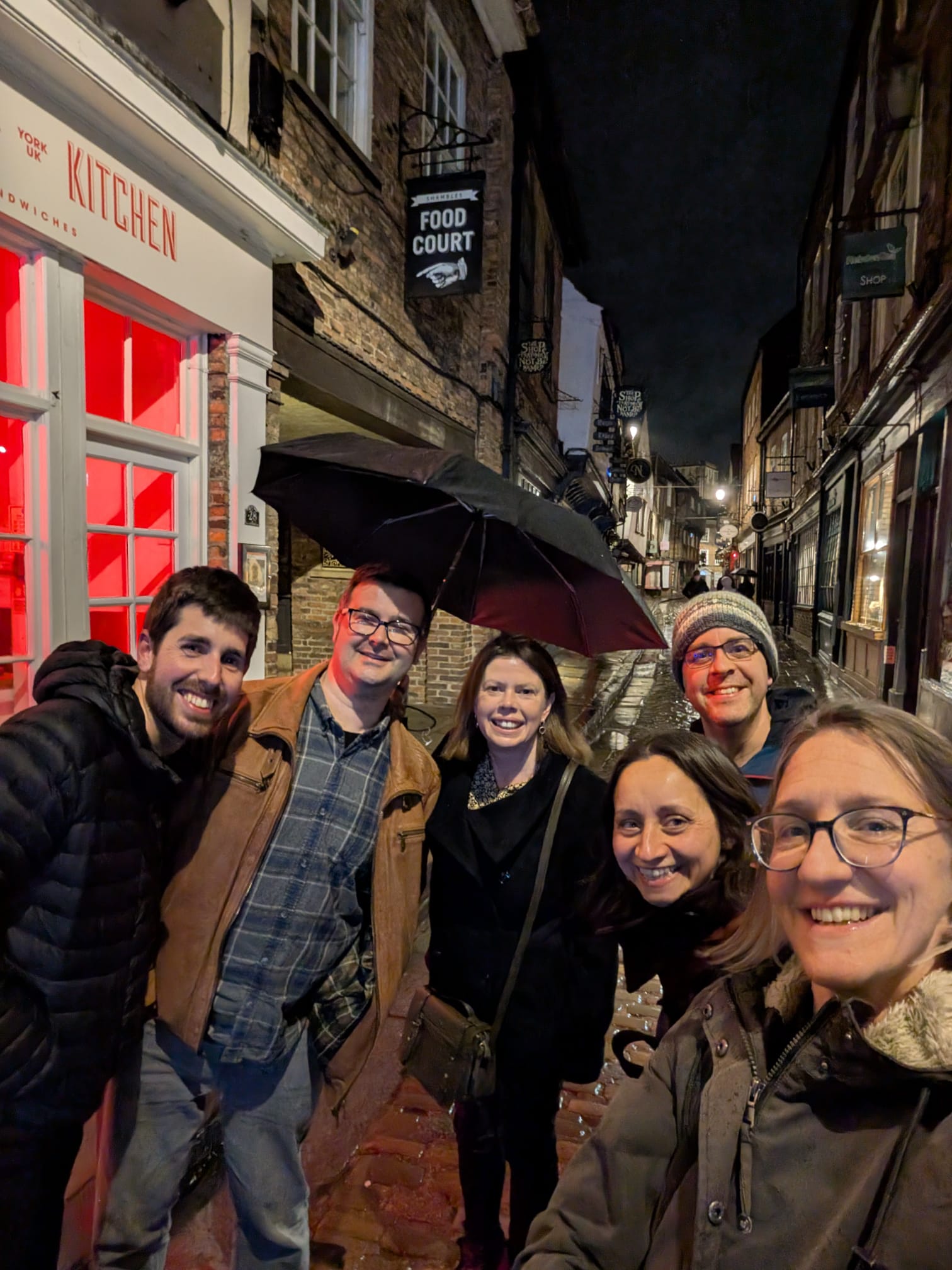
In April I had the opportunity to attend and present at the second Play for the Planet network meeting in York. It brings together people of different backgrounds who all use games to address environmental issues. Firmly within my interests and the remit of my work with Games for Geoscience, I attended the inaugural event in 2024 and jumped at the chance to attend again.

In the build up to the event, the venue was moved from the main University of York campus to their King’s Manor location in the city centre. It left me reflecting how ridiculously fortunate I am to have an environmental games conference held within a  ten minute walk of my house! A big change from the bus-train-bus trek I had to make (and self-fund) from North Lincolnshire last year. In 2024, I did not really have much to share so I presented on my thoughts about the relationship between models and games.

The presentations this year were in the form of research blast talks – 1 slide, 3-mins. This was a fun format and allowed for more people to share their work in the meeting. It was also pretty friendly to my easily distracted brain. For my research blast, I showed off the latest version of the Adventures in Model Land system I have been working on (see above for more). Following the research blasts there was a ‘world café’ style discussion where we debating crucial topics including ‘what is a game?’, ‘how do we best market environmental games?’, and ‘how do we evaluate our games?’.

Following the lunch break there was a chance to play demos of some of the games. This also gave the developers an opportunity to playtest and get feedback. For example, Games for Geoscience 2024 keynote Matteo Menapace was testing a streamlined card-based version of the immensely popular Daybreak game, provisionally titled Dawn.

I enjoyed catching up with my former University of Hull colleague, Steven Forrest, who was sharing the excellent work the Energy & Environment Institute have been doing with The Flood Recovery Game. This game is played with flood risk stakeholders, including community groups, to identify and better understand systemic gaps in the process of recovering after flooding. I’m sure I’ll do a summary of the research behind it in the near future.

Another highlight for me was playing the 2D city-builder game Oxygen Not Included. Whilst this is a commercial game, it was being used by Truzaar Dordi to help students understand how complex and coupled human-environment systems operate. This, along with some of the earlier discussions, reminded me of the power of good game (and model) design to effectively simulate complex systems whilst steering clear of becoming complicated. Complex is good, complicated is not.

As much as I enjoyed Play for the Planet, I did reflect on the lack of professional games designers at the meeting. There is a strong desire from that community to be part of the work tackling environmental issues, evidenced by the success and growth of movements like Playing for the Planet Alliance and the Global Green Game Jam. I would like to see much more interaction between those networks and our own academic networks like Play for Planet and Games for Geoscience. How? I’m still figuring that one out…

The Play for Planet network was established by and is run by the York Environmental Sustainability Institute (YESI), led by Linda Dunlop, Prasad Sandbhor, Pen Holland, Judith Krauss, Anna Morfitt, and Daisy Kemp. It is open to games designers, researchers, and educators with an interest in using games to address environmental crises. You can learn more and join the network here.

*I must remember to take photos when I attend things but I was having too much fun!

This post was originally published as part of the Imagination Engines newsletter. To get my content earlier and straight to your email subscribe using the box below:

Views expressed in this newsletter are mine and do not represent those of my employer. Content and links are provided for informational purposes and do not constitute endorsements. I am not responsible for the content of external sites, which may have changed since this newsletter was produced.

Imagination Engines. Creating game worlds from models - Adventures in Model Land

Creating Game Worlds from Models: Adventures in Model Land

Model Land is a concept proposed and explored by Professor Erica Thompson in her monograph Escape from Model Land. The idea will be well-known to those of us who use numerical models:

Models are built to simulate real world systems but to be useful they have to simplify the sheer complexity of nature. The way those simplifications are made is determined by the requirements, knowledge, experience, and biases of the model builder. Consequently, what these models simulate is not the real world but a world of its own making, a model land.

Erica implored us to get out of model land – to understand how the simplifications of the models make them wrong and use them carefully when they are informing real world decisions. This is absolutely vital, especially in my professional area where models are used to help us make decisions on flood risk. The key word in that last sentence is ‘help’ as models should never be making decisions for us otherwise, as Erica would likely say, that decision is made in model land and not the real world.

But when I hear the term model land, I have additional questions: what does a model land look like? What would it be like to explore one? How would life survive in one and could people call it home? These are probably not the most important questions for a modeller or decision-maker but wouldn’t it be fun?!

Quote by Frank Lantz, Director of the New York Games Center. "Making a game combines everything that’s hard about building a bridge with everything that’s hard about composing an opera. Games are basically operas made out of bridges.”

If games are ‘operas made out of bridges‘, models are simply bridges made out of bridges, or at best are very low quality operas. A game is a model of a system (sometimes often built using multiple models itself) – the bridge bit – that uses story and art to immerse players within it and bring it to life – the opera bit. Consequently, game worlds are themselves model lands. When you step into Link’s shoes and explore Hyrule in any game of the Zelda series, you are actually exploring a simplified representation of Hyrule, optimised for the purpose of the game and the hardware available. You are entering a model land.

What separates the model lands created by numerical models and game worlds is that paucity of opera. That’s all.

And we can fix that by using the Adventures in Model Land system and our imaginations.

Adventures in Model Land has been created by myself, Erica, Liz Lewis, Sam Illingworth, Rolf Hut, and Jess Enright as an open-source resource for numerical modellers. The latest version, v0.2, still in the beta stage, provides a step-by-step guide for the ‘operafication’ of any numerical model to create an explorable model land/game world. It leans heavily on the world-building methods of tabletop roleplay games (TTRPG) and the intention is to allow modellers to lead players on quests within their model lands.

A visual description of the steps used in the Adventures in Model Land system.
Summary of the Adventures in Model Land system.

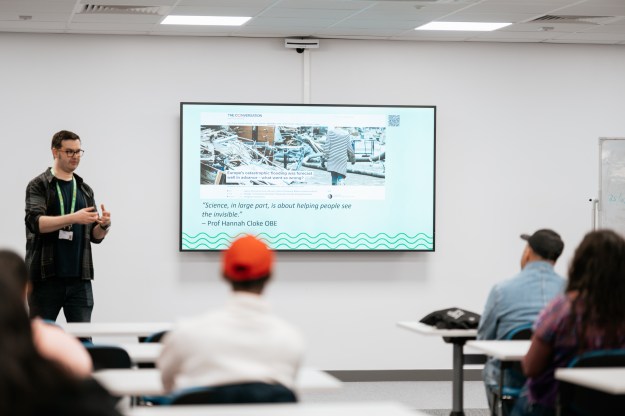
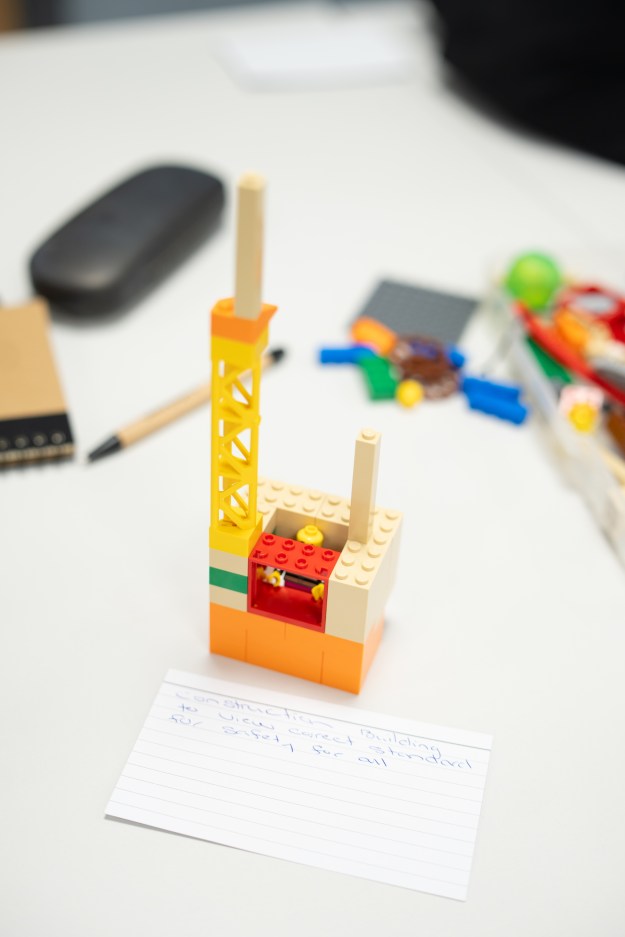
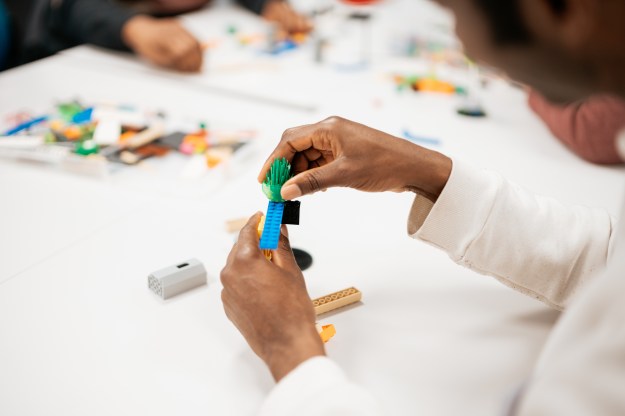
At EGU this year, I led a short course using the v0.2 of Adventures in Model Land, leading over thirty participants through the worlding process, creating model lands and writing postcards describing their experiences. It was a great opportunity to test the idea out, gather some feedback, and further refine the system. We even had people designing new games based on the model lands they had brought to life! I think there is great potential in using the system as a workshop with modelling groups and the users of models to help them better understand the models used to make decisions – something I am working towards.

You can download the system for free and use it whatever you like. However, we would really appreciate feedback on the system and how you have used it. Please do also share your model lands and the games you create, our plan is to produce a compendium of our favourites in the future. I plan to release an update to the system later this year as a v1 – subscribe to this newsletter to keep up to date with progress and new releases.

This post was originally published as part of the Imagination Engines newsletter. To get my content earlier and straight to your email, subscribe using the box below:

Views expressed in this newsletter are mine and do not represent those of my employer. Content and links are provided for informational purposes and do not constitute endorsements. I am not responsible for the content of external sites, which may have changed since this newsletter was produced.

Imagination Engines. Celebrating the EGU Games Day - A look back

Celebrating the EGU Games Day: A Look Back

April 30th 2025 was officially the eight edition of the (unofficial) European Geoscience Union Games Day! Where does the time go, eh? In this post I take a look back at the origins of the Games Day and the story so far.

For the uninitiated, the General Assembly of the European Geoscience Union, often just referred to as EGU, is Europe’s largest gathering of geoscientists. Each year, around 21,000 of them converge in Vienna to share science and schnitzel. For the last seven years, Wednesdays have been what I have dubbed the Games Day, featuring our science sharing session – Games for Geoscience – and our social event – the Geoscience Games Night.

It all began when Sam Illingworth and Rolf Hut approached me in 2017 about convening a gaming session as part of the education and outreach programme. The following year we held the first ever Games for Geoscience session, thankfully with enough abstracts for both a session of talks and a session of posters.

Sam Illingworth and Rolf Hut stand in front of the EGU conference centre entrance. Sam wears a suit and trainers with a bowtie. Rolf wears jeans and a long leather coat.
Rolf and Sam at EGU 2019, amazingly not deliberately cosplaying as two generations of the Dr.

We also held a Games Night. The first one being in a small room in the basement. I remember forking our around £500 from my research funds to purchase 80 bottles of beer and a few crisps for the players. The room and the beer were nowhere near sufficient for the event. Since then we have had very generous support from the EGU team, with the Games Night taking place in a much larger space with access to the free refreshments in the neighbouring poster halls (although security guards added an additional difficulty level to this in 2025!).

It also started the tradition of my awful promotional images for social media. I’m no artist and my design skills are minimal. I also have no budget for this (but apparently I did for beer…) and have a determination to do things myself. Each year I have made some form of crappy image in PowerPoint to drive abstract submissions and make people aware of the Games Night.

  • Image for 2018 EGU Games Day. Includes an EGU lanyard, a Pokemon League cap, Blood Bowl Skaven, and playing cards.
  • Advert for the 2019 EGU Games Day. Two Warhammer warlord Titans face over a Monopoly board.
  • Image to promote the 2019 Games Day at AGU. A small Arcade machine floating on a retrowave background.
  • Image to promote the 2020 EGU Games Day. It copies the style of Sonic the Hedgehog games.
  • Image to promote the 2021 EGU Games Day. A screen on a green board surrounded by game controllers, cardboard trees, a VR headset, and card saying Game Over.
  • Image for Games for Geoscience 2022. Chris in a banana shirt over a Lego chess board, copying the poster for The Queen's Gambit.

In 2019, were joined by Dungeon Master Liz Lewis and Volcano Explorer Jaz Scarlett. We even expanded over the pond, with Rolf heading up a Games for Geoscience session at the American Geophysical Union meeting, with quest speaker Isaac Kerlow, created of the EarthGirl games.

The Covid-19 lockdowns forced EGU online in 2020 and 2021 and the organisers did a phenomenal job in pulling together the meeting during this time. I hosted Games for Geoscience from my bedroom, whilst the 2020 Games Night saw the convenor team live stream a game of Monster Flux – not geoscience-themed but needs must! In 2021, the Games Night took to Gather Town where I hosted a pub quiz in a bespoke games room I designed. The convenor team changed, as we said goodbye to Sam and Jaz, and welcomed in Lisa Gallagher and Malena Orduna Allegria.

The meeting in 2022 was fully hybrid, with onsite and online connection. The Games Night returned to a physical setting and we tried a return of the Games Room hosted event. Sadly, there was not much demand for it and since the Games Night has remained an onsite only event.

I was so happy to be offered the chance to attend EGU in person again in 2024, my first time in five years, and host the Games for Geoscience session and the Geoscience Games Night live. I was back again this year too and the whole Games Day just keeps going from strength to strength. I think this year was our busiest ever Geoscience Games Night. It is an event that relies of organised chaos and I am worried we may be reaching the limits of that working successfully – we may need to adapt to expand. For now, watch this space!

Visit the Games for Geoscience website and join the LinkedIn group.

This post was originally published as part of the Imagination Engines newsletter. To read my content earlier, subscribe using the box below:

Views expressed in this newsletter are mine and do not represent those of my employer. Content and links are provided for informational purposes and do not constitute endorsements. I am not responsible for the content of external sites, which may have changed since this newsletter was produced.