
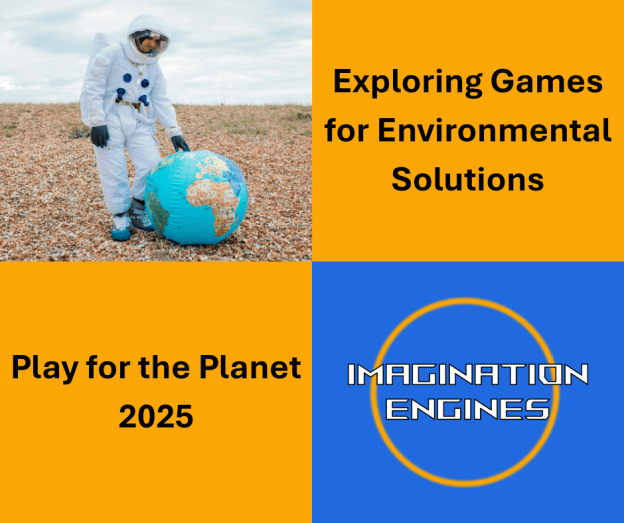
In April I had the opportunity to attend and present at the second Play for the Planet network meeting in York. It brings together people of different backgrounds who all use games to address environmental issues. Firmly within my interests and the remit of my work with Games for Geoscience, I attended the inaugural event in 2024 and jumped at the chance to attend again.
In the build up to the event, the venue was moved from the main University of York campus to their King’s Manor location in the city centre. It left me reflecting how ridiculously fortunate I am to have an environmental games conference held within a ten minute walk of my house! A big change from the bus-train-bus trek I had to make (and self-fund) from North Lincolnshire last year. In 2024, I did not really have much to share so I presented on my thoughts about the relationship between models and games.
The presentations this year were in the form of research blast talks – 1 slide, 3-mins. This was a fun format and allowed for more people to share their work in the meeting. It was also pretty friendly to my easily distracted brain. For my research blast, I showed off the latest version of the Adventures in Model Land system I have been working on (see above for more). Following the research blasts there was a ‘world café’ style discussion where we debating crucial topics including ‘what is a game?’, ‘how do we best market environmental games?’, and ‘how do we evaluate our games?’.
Following the lunch break there was a chance to play demos of some of the games. This also gave the developers an opportunity to playtest and get feedback. For example, Games for Geoscience 2024 keynote Matteo Menapace was testing a streamlined card-based version of the immensely popular Daybreak game, provisionally titled Dawn.
I enjoyed catching up with my former University of Hull colleague, Steven Forrest, who was sharing the excellent work the Energy & Environment Institute have been doing with The Flood Recovery Game. This game is played with flood risk stakeholders, including community groups, to identify and better understand systemic gaps in the process of recovering after flooding. I’m sure I’ll do a summary of the research behind it in the near future.
Another highlight for me was playing the 2D city-builder game Oxygen Not Included. Whilst this is a commercial game, it was being used by Truzaar Dordi to help students understand how complex and coupled human-environment systems operate. This, along with some of the earlier discussions, reminded me of the power of good game (and model) design to effectively simulate complex systems whilst steering clear of becoming complicated. Complex is good, complicated is not.
As much as I enjoyed Play for the Planet, I did reflect on the lack of professional games designers at the meeting. There is a strong desire from that community to be part of the work tackling environmental issues, evidenced by the success and growth of movements like Playing for the Planet Alliance and the Global Green Game Jam. I would like to see much more interaction between those networks and our own academic networks like Play for Planet and Games for Geoscience. How? I’m still figuring that one out…
The Play for Planet network was established by and is run by the York Environmental Sustainability Institute (YESI), led by Linda Dunlop, Prasad Sandbhor, Pen Holland, Judith Krauss, Anna Morfitt, and Daisy Kemp. It is open to games designers, researchers, and educators with an interest in using games to address environmental crises. You can learn more and join the network here.
*I must remember to take photos when I attend things but I was having too much fun!
This post was originally published as part of the Imagination Engines newsletter. To get my content earlier and straight to your email subscribe using the box below:
Views expressed in this newsletter are mine and do not represent those of my employer. Content and links are provided for informational purposes and do not constitute endorsements. I am not responsible for the content of external sites, which may have changed since this newsletter was produced.
 GeoSkinner