In April I had the opportunity to attend and present at the second Play for the Planet network meeting in York. It brings together people of different backgrounds who all use games to address environmental issues. Firmly within my interests and the remit of my work with Games for Geoscience, I attended the inaugural event in 2024 and jumped at the chance to attend again.
In the build up to the event, the venue was moved from the main University of York campus to their King’s Manor location in the city centre. It left me reflecting how ridiculously fortunate I am to have an environmental games conference held within a ten minute walk of my house! A big change from the bus-train-bus trek I had to make (and self-fund) from North Lincolnshire last year. In 2024, I did not really have much to share so I presented on my thoughts about the relationship between models and games.
The presentations this year were in the form of research blast talks – 1 slide, 3-mins. This was a fun format and allowed for more people to share their work in the meeting. It was also pretty friendly to my easily distracted brain. For my research blast, I showed off the latest version of the Adventures in Model Land system I have been working on (see above for more). Following the research blasts there was a ‘world café’ style discussion where we debating crucial topics including ‘what is a game?’, ‘how do we best market environmental games?’, and ‘how do we evaluate our games?’.
Following the lunch break there was a chance to play demos of some of the games. This also gave the developers an opportunity to playtest and get feedback. For example, Games for Geoscience 2024 keynote Matteo Menapace was testing a streamlined card-based version of the immensely popular Daybreak game, provisionally titled Dawn.
I enjoyed catching up with my former University of Hull colleague, Steven Forrest, who was sharing the excellent work the Energy & Environment Institute have been doing with The Flood Recovery Game. This game is played with flood risk stakeholders, including community groups, to identify and better understand systemic gaps in the process of recovering after flooding. I’m sure I’ll do a summary of the research behind it in the near future.
Another highlight for me was playing the 2D city-builder game Oxygen Not Included. Whilst this is a commercial game, it was being used by Truzaar Dordi to help students understand how complex and coupled human-environment systems operate. This, along with some of the earlier discussions, reminded me of the power of good game (and model) design to effectively simulate complex systems whilst steering clear of becoming complicated. Complex is good, complicated is not.
As much as I enjoyed Play for the Planet, I did reflect on the lack of professional games designers at the meeting. There is a strong desire from that community to be part of the work tackling environmental issues, evidenced by the success and growth of movements like Playing for the Planet Alliance and the Global Green Game Jam. I would like to see much more interaction between those networks and our own academic networks like Play for Planet and Games for Geoscience. How? I’m still figuring that one out…
The Play for Planet network was established by and is run by the York Environmental Sustainability Institute (YESI), led by Linda Dunlop, Prasad Sandbhor, Pen Holland, Judith Krauss, Anna Morfitt, and Daisy Kemp. It is open to games designers, researchers, and educators with an interest in using games to address environmental crises. You can learn more and join the network here.
*I must remember to take photos when I attend things but I was having too much fun!
This post was originally published as part of the Imagination Engines newsletter. To get my content earlier and straight to your email subscribe using the box below:
Views expressed in this newsletter are mine and do not represent those of my employer. Content and links are provided for informational purposes and do not constitute endorsements. I am not responsible for the content of external sites, which may have changed since this newsletter was produced.
Model Land is a concept proposed and explored by Professor Erica Thompson in her monograph Escape from Model Land. The idea will be well-known to those of us who use numerical models:
Models are built to simulate real world systems but to be useful they have to simplify the sheer complexity of nature. The way those simplifications are made is determined by the requirements, knowledge, experience, and biases of the model builder. Consequently, what these models simulate is not the real world but a world of its own making, a model land.
Erica implored us to get out of model land – to understand how the simplifications of the models make them wrong and use them carefully when they are informing real world decisions. This is absolutely vital, especially in my professional area where models are used to help us make decisions on flood risk. The key word in that last sentence is ‘help’ as models should never be making decisions for us otherwise, as Erica would likely say, that decision is made in model land and not the real world.
But when I hear the term model land, I have additional questions: what does a model land look like? What would it be like to explore one? How would life survive in one and could people call it home? These are probably not the most important questions for a modeller or decision-maker but wouldn’t it be fun?!
If games are ‘operas made out of bridges‘, models are simply bridges made out of bridges, or at best are very low quality operas. A game is a model of a system (sometimes often built using multiple models itself) – the bridge bit – that uses story and art to immerse players within it and bring it to life – the opera bit. Consequently, game worlds are themselves model lands. When you step into Link’s shoes and explore Hyrule in any game of the Zelda series, you are actually exploring a simplified representation of Hyrule, optimised for the purpose of the game and the hardware available. You are entering a model land.
What separates the model lands created by numerical models and game worlds is that paucity of opera. That’s all.
And we can fix that by using the Adventures in Model Land system and our imaginations.
Adventures in Model Land has been created by myself, Erica, Liz Lewis, Sam Illingworth, Rolf Hut, and Jess Enright as an open-source resource for numerical modellers. The latest version, v0.2, still in the beta stage, provides a step-by-step guide for the ‘operafication’ of any numerical model to create an explorable model land/game world. It leans heavily on the world-building methods of tabletop roleplay games (TTRPG) and the intention is to allow modellers to lead players on quests within their model lands.
Summary of the Adventures in Model Land system.
At EGU this year, I led a short course using the v0.2 of Adventures in Model Land, leading over thirty participants through the worlding process, creating model lands and writing postcards describing their experiences. It was a great opportunity to test the idea out, gather some feedback, and further refine the system. We even had people designing new games based on the model lands they had brought to life! I think there is great potential in using the system as a workshop with modelling groups and the users of models to help them better understand the models used to make decisions – something I am working towards.
You can download the system for free and use it whatever you like. However, we would really appreciate feedback on the system and how you have used it. Please do also share your model lands and the games you create, our plan is to produce a compendium of our favourites in the future. I plan to release an update to the system later this year as a v1 – subscribe to this newsletter to keep up to date with progress and new releases.
This post was originally published as part of the Imagination Engines newsletter. To get my content earlier and straight to your email, subscribe using the box below:
Views expressed in this newsletter are mine and do not represent those of my employer. Content and links are provided for informational purposes and do not constitute endorsements. I am not responsible for the content of external sites, which may have changed since this newsletter was produced.
I have a whole bunch of new papers recently published to tell you about. I can’t take (all) the credit though as they have been led by amazing colleagues. Huge shout out especially to Josh Wolstenholme who has been working hard to publish various bits of his PhD research.
The first paper in this update led by Josh covers the modelling work performed for his PhD. He used an enhancement of CAESAR-Lisflood I wrote that allows users to represent leaky woody dames in the model, including those with flow gaps underneath. This provides an ideal tool to simulate the long-term changes natural flood management can cause in rivers. Josh’s research demonstrates the feasibility of this including verification against field observations.
This is the second paper Josh has produced from his PhD research, currently under review but you can access the pre-print. Whilst the paper above covers his modelling work, this one covers his fieldwork. This includes some enjoyable, yet very cold, trips to Dalby Forest, North Yorkshire, and the installation of trail cams. The field work observed changes to the river before and after natural flood management interventions had been undertaken.
I cannot tell you how happy I am to see this paper out! Five years ago this was going to my big paper, the one with significant findings rather than some niche model sensitivity tests. But every time I made progress something in the model popped up to frustrate me. After I left Hull in 2021 I let it sit. Last year, Josh picked it up again and brought fresh eyes and energy to it. He has done a brilliant job and made it his own.
The way we assess flood risk assumes rivers do not change shape during floods. In the majority of cases this is a reasonable assumption, however, the modelling work here shows that it is not always the case. Large amounts of sediment can be transported downstream and deposited, increasing flood inundations and volumes during later stages of the same event.
This paper, led by Katie Parsons, describes the work we did co-creating educational materials to support the Help Callum and Help Sali 360 videos. The videos came about when I worked with Alison Lloyd-Williams to use my immersive storytelling research to tell the real-life stories of flood-affected children that were shared through Alison’s research. Katie brought her education expertise to work with children, young people, and teachers to create resources to use the videos in the classroom.
I have been so privileged to get to collaborate with amazing and wonderful researchers like Josh and Katie. It’s also great to see them work together on the HedgeHunter’s project too. I had nothing to do with this but it is really cool work:
Back in 2020, just before the lockdown, Katie took part in my NERC-funded Earth Arcade Academy project with a project called INSECURE and it grew massively since (nothing to do with me!). Katie used creative methods to foster intergenerational engagement in communities at risk of coastal erosion. Even though my contribution was tiny and remote, it is such a great project I am going to pretend I had a small hand in it!:
Both Josh and Katie are now at Loughborough University and working on new projects together. I cannot wait to see what they will produce.
This article was originally posted in the Imagination Engines newsletter. To receive this content in your email weeks earlier, subscribe using the box below.
Easter is probably my favourite, and busiest, time of year. In recent years it has been filled with lots of gaming activities that I just love. 2025 has been no different.
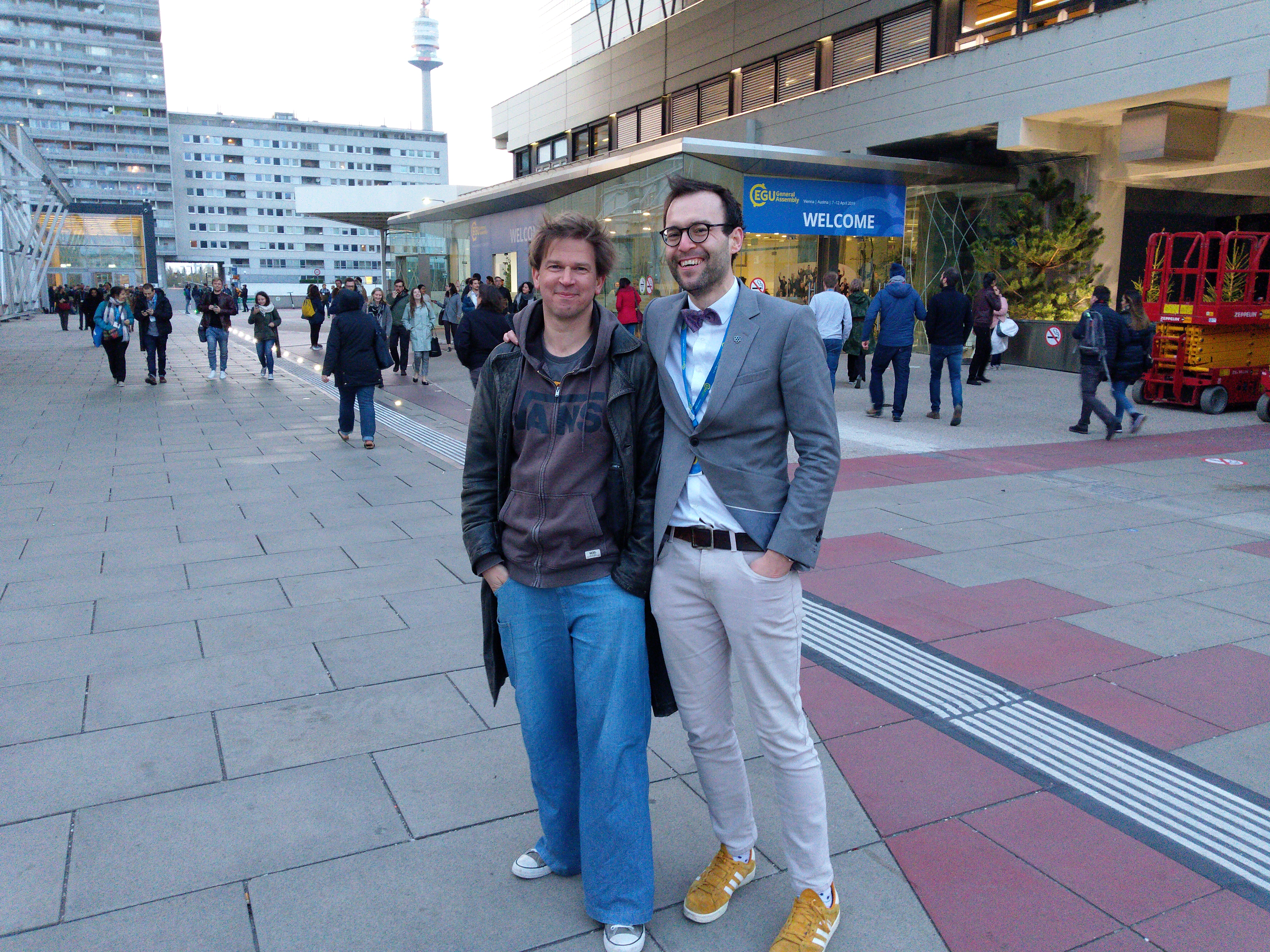
Obviously, the European Geoscience Union General Assembly (EGU) in Vienna looms large over Easter. It is often the highlight of the year for me. I’ve attending it for fifteen years now and Vienna feels like a home from home. This year I had the great and rare joy of representing my employer at the meeting, something I had been advocating for and immensely valued and appreciated. In addition, I still got the opportunity to do my usual bits for the (unofficial) Geoscience Games Day.
Double chin warning!
In 2025, my activities included:
Two presentations for my day job work, plus lots of networking and learning about the latest science from the hydrology and flood worlds.
Hosting the Games for Geoscience oral session and the Geoscience Games Night.
Running a short course based on Adventures in Model Land whilst ‘presenting’ a poster on it at the same time.
Hosting a pop-up networking event for neurodivergent attendees of the meeting.
I also got the chance to attend the second Play for the Planet network meeting, which was much closer to home.
You can read all about these things, and more, in the newsletter below. Subscribe to get future issues sent straight to your email.
Celebrating the EGU Games Day: A Look Back
April 30th 2025 was officially the eight edition of the (unofficial) European Geoscience Union Games Day! Where does the time go, eh? In this post I take a look back at the origins of the Games Day and the story so far.
For the uninitiated, the General Assembly of the European Geoscience Union, often just referred to as EGU, is Europe’s largest gathering of geoscientists. Each year, around 21,000 of them converge in Vienna to share science and schnitzel. For the last seven years, Wednesdays have been what I have dubbed the Games Day, featuring our science sharing session – Games for Geoscience – and our social event – the Geoscience Games Night.
It all began when Sam Illingworth and Rolf Hut approached me in 2017 about convening a gaming session as part of the education and outreach programme. The following year we held the first ever Games for Geoscience session, thankfully with enough abstracts for both a session of talks and a session of posters.
Rolf and Sam at EGU 2019, amazingly not deliberately cosplaying as two generations of the Dr.
We also held a Games Night. The first one being in a small room in the basement. I remember forking our around £500 from my research funds to purchase 80 bottles of beer and a few crisps for the players. The room and the beer were nowhere near sufficient for the event. Since then we have had very generous support from the EGU team, with the Games Night taking place in a much larger space with access to the free refreshments in the neighbouring poster halls (although security guards added an additional difficulty level to this in 2025!).
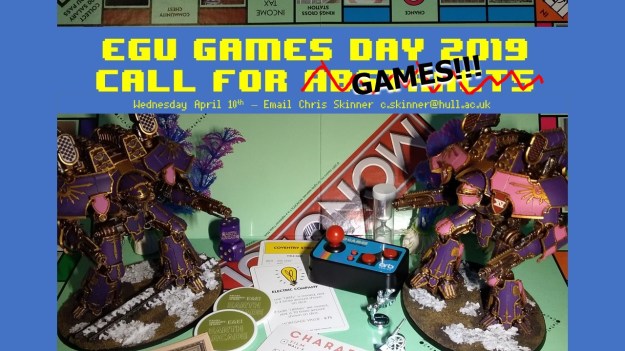
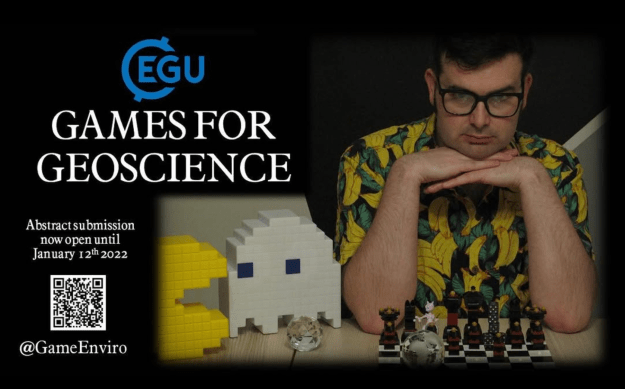
It also started the tradition of my awful promotional images for social media. I’m no artist and my design skills are minimal. I also have no budget for this (but apparently I did for beer…) and have a determination to do things myself. Each year I have made some form of crappy image in PowerPoint to drive abstract submissions and make people aware of the Games Night.
In 2019, were joined by Dungeon Master Liz Lewis and Volcano Explorer Jaz Scarlett. We even expanded over the pond, with Rolf heading up a Games for Geoscience session at the American Geophysical Union meeting, with quest speaker Isaac Kerlow, created of the EarthGirl games.
The Covid-19 lockdowns forced EGU online in 2020 and 2021 and the organisers did a phenomenal job in pulling together the meeting during this time. I hosted Games for Geoscience from my bedroom, whilst the 2020 Games Night saw the convenor team live stream a game of Monster Flux – not geoscience-themed but needs must! In 2021, the Games Night took to Gather Town where I hosted a pub quiz in a bespoke games room I designed. The convenor team changed, as we said goodbye to Sam and Jaz, and welcomed in Lisa Gallagher and Malena Orduna Allegria.
The meeting in 2022 was fully hybrid, with onsite and online connection. The Games Night returned to a physical setting and we tried a return of the Games Room hosted event. Sadly, there was not much demand for it and since the Games Night has remained an onsite only event.
I was so happy to be offered the chance to attend EGU in person again in 2024, my first time in five years, and host the Games for Geoscience session and the Geoscience Games Night live. I was back again this year too and the whole Games Day just keeps going from strength to strength. I think this year was our busiest ever Geoscience Games Night. It is an event that relies of organised chaos and I am worried we may be reaching the limits of that working successfully – we may need to adapt to expand. For now, watch this space!
Creating Game Worlds from Models: Adventures in Model Land
Model Land is a concept proposed and explored by Professor Erica Thompson in her monograph Escape from Model Land. The idea will be well-known to those of us who use numerical models:
Models are built to simulate real world systems but to be useful they have to simplify the sheer complexity of nature. The way those simplifications are made is determined by the requirements, knowledge, experience, and biases of the model builder. Consequently, what these models simulate is not the real world but a world of its own making, a model land.
Erica implored us to get out of model land – to understand how the simplifications of the models make them wrong and use them carefully when they are informing real world decisions. This is absolutely vital, especially in my professional area where models are used to help us make decisions on flood risk. The key word in that last sentence is ‘help’ as models should never be making decisions for us otherwise, as Erica would likely say, that decision is made in model land and not the real world.
But when I hear the term model land, I have additional questions: what does a model land look like? What would it be like to explore one? How would life survive in one and could people call it home? These are probably not the most important questions for a modeller or decision-maker but wouldn’t it be fun?!
If games are ‘operas made out of bridges‘, models are simply bridges made out of bridges, or at best are very low quality operas. A game is a model of a system (sometimes often built using multiple models itself) – the bridge bit – that uses story and art to immerse players within it and bring it to life – the opera bit. Consequently, game worlds are themselves model lands. When you step into Link’s shoes and explore Hyrule in any game of the Zelda series, you are actually exploring a simplified representation of Hyrule, optimised for the purpose of the game and the hardware available. You are entering a model land.
What separates the model lands created by numerical models and game worlds is that paucity of opera. That’s all.
And we can fix that by using the Adventures in Model Land system and our imaginations.
Adventures in Model Land has been created by myself, Erica, Liz Lewis, Sam Illingworth, Rolf Hut, and Jess Enright as an open-source resource for numerical modellers. The latest version, v0.2, still in the beta stage, provides a step-by-step guide for the ‘operafication’ of any numerical model to create an explorable model land/game world. It leans heavily on the world-building methods of tabletop roleplay games (TTRPG) and the intention is to allow modellers to lead players on quests within their model lands.
Summary of the Adventures in Model Land system.
At EGU this year, I led a short course using the v0.2 of Adventures in Model Land, leading over thirty participants through the worlding process, creating model lands and writing postcards describing their experiences. It was a great opportunity to test the idea out, gather some feedback, and further refine the system. We even had people designing new games based on the model lands they had brought to life! I think there is great potential in using the system as a workshop with modelling groups and the users of models to help them better understand the models used to make decisions – something I am working towards.
You can download the system for free and use it whatever you like. However, we would really appreciate feedback on the system and how you have used it. Please do also share your model lands and the games you create, our plan is to produce a compendium of our favourites in the future. I plan to release an update to the system later this year as a v1 – subscribe to this newsletter to keep up to date with progress and new releases.
Neurodiversity at EGU
I am a big fan of social media. Probably too much so. I am not so great at in person networking but I feel I have successfully made use of social media to plug this gap. Not only does it connect me with people working on things I am interested in, it also allows me to learn a bit about them and that means when I meet them in person it is much easier to start that conversation.
It is also a catalyst for ideas and starting things – something I apparently have a knack for. In the run up to EGU this year, I saw a post by Simon Clark, EGU’s Projects Manager, who was asking if anyone knew of a STEM-focussed network for neurodivergent folk. I reflected that I would be interested too but did not know of any. However, I also reflected that EGU has an active and effective EDI committee, so if any STEM-focussed organisation should be hosting an network for neurodivergent folk, EGU is a great candidate.
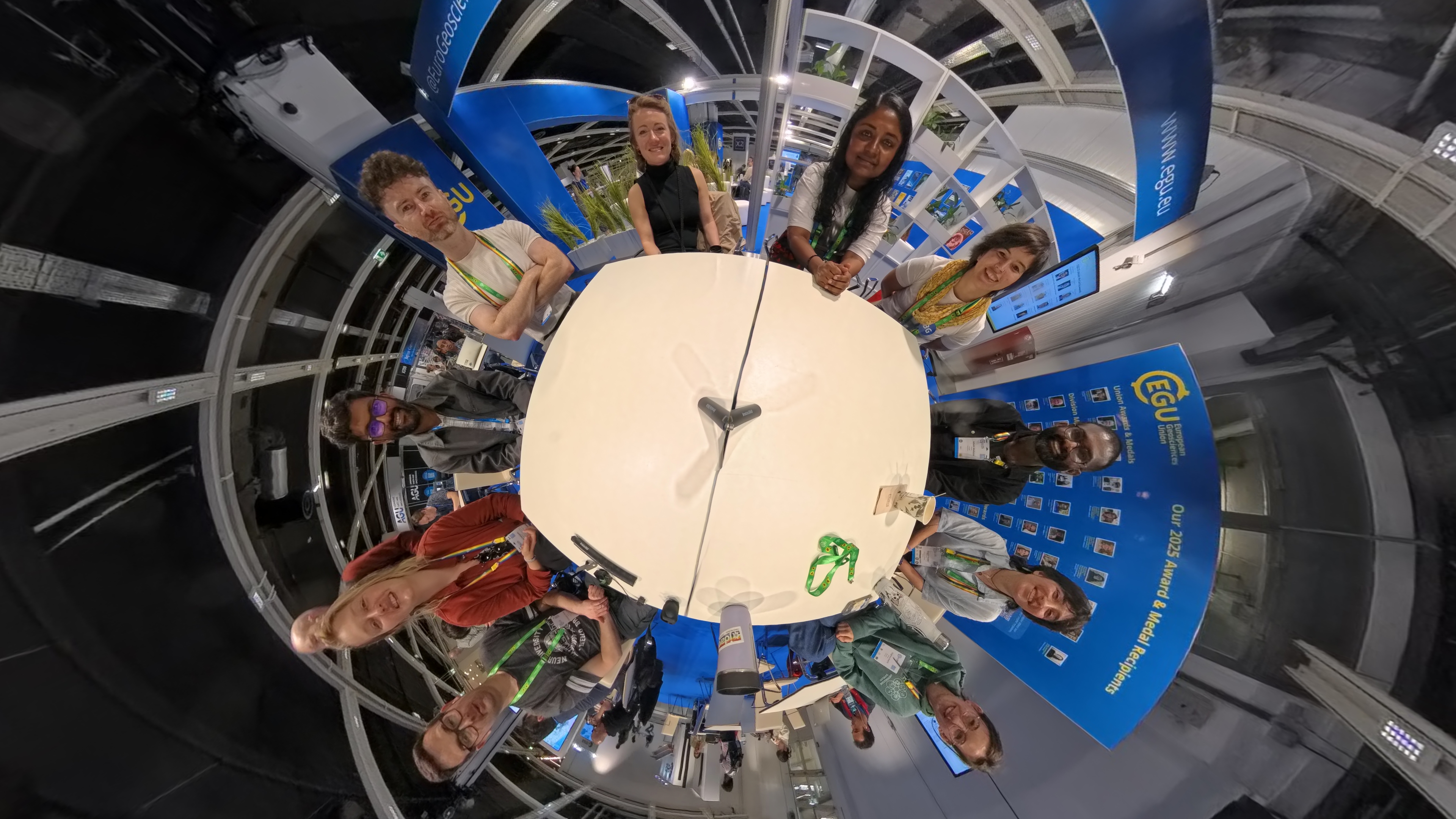
Simon and I exchanged a few messages and agreed to host an informal networking event at the conference to try and bring together others who might be interested in a network. We held this on the Wednesday morning and it really was a positive experience. Having attended the General Assembly for 15 years now, it was just nice to connect with people who struggle with the same things and remind yourself you are not broken and you are not alone. Simon put it best on BlueSky after the event when he said it “filled my heart”.
Some of the attendees at the pop up event.
Alongside the pop-up event we also put out a survey simply asking people what does and what does not work well for them at the General Assembly, along with a chance to register their interest in being part of the network. This will be open until end of May 2025 and you can complete it here.
Encouragingly, we were not the only ones to have this idea. Lucile Turc and Ana Bastos (who recently wrote about her experiences of ADHD and science in an article for Nature), was part of a group organising an neurodivergent scientists picnic. I was enjoying an apple strudel at gate D35 of Vienna airport at the time, sadly, so could not attend.
The next steps will be contacting those who registered their interest, and pooling the learning from the two events and the survey to compile a report for the conference organisers and the EDI committee. I’m really excited about the supportive community we can build together.
Exploring Games for Environmental Solutions at Play for the Planet 2
In April I had the opportunity to attend and present at the second Play for the Planet network meeting in York. It brings together people of different backgrounds who all use games to address environmental issues. Firmly within my interests and the remit of my work with Games for Geoscience, I attended the inaugural event in 2024 and jumped at the chance to attend again.
In the build up to the event, the venue was moved from the main University of York campus to their King’s Manor location in the city centre. It left me reflecting how ridiculously fortunate I am to have an environmental games conference held within a ten minute walk of my house! A big change from the bus-train-bus trek I had to make (and self-fund) from North Lincolnshire last year. In 2024, I did not really have much to share so I presented on my thoughts about the relationship between models and games.
The presentations this year were in the form of research blast talks – 1 slide, 3-mins. This was a fun format and allowed for more people to share their work in the meeting. It was also pretty friendly to my easily distracted brain. For my research blast, I showed off the latest version of the Adventures in Model Land system I have been working on (see above for more). Following the research blasts there was a ‘world café’ style discussion where we debating crucial topics including ‘what is a game?’, ‘how do we best market environmental games?’, and ‘how do we evaluate our games?’.
Following the lunch break there was a chance to play demos of some of the games. This also gave the developers an opportunity to playtest and get feedback. For example, Games for Geoscience 2024 keynote Matteo Menapace was testing a streamlined card-based version of the immensely popular Daybreak game, provisionally titled Dawn.
I enjoyed catching up with my former University of Hull colleague, Steven Forrest, who was sharing the excellent work the Energy & Environment Institute have been doing with The Flood Recovery Game. This game is played with flood risk stakeholders, including community groups, to identify and better understand systemic gaps in the process of recovering after flooding. I’m sure I’ll do a summary of the research behind it in the near future.
Another highlight for me was playing the 2D city-builder game Oxygen Not Included. Whilst this is a commercial game, it was being used by Truzaar Dordi to help students understand how complex and coupled human-environment systems operate. This, along with some of the earlier discussions, reminded me of the power of good game (and model) design to effectively simulate complex systems whilst steering clear of becoming complicated. Complex is good, complicated is not.
As much as I enjoyed Play for the Planet, I did reflect on the lack of professional games designers at the meeting. There is a strong desire from that community to be part of the work tackling environmental issues, evidenced by the success and growth of movements like Playing for the Planet Alliance and the Global Green Game Jam. I would like to see much more interaction between those networks and our own academic networks like Play for Planet and Games for Geoscience. How? I’m still figuring that one out…
The Play for Planet network was established by and is run by the York Environmental Sustainability Institute (YESI), led by Linda Dunlop, Prasad Sandbhor, Pen Holland, Judith Krauss, Anna Morfitt, and Daisy Kemp. It is open to games designers, researchers, and educators with an interest in using games to address environmental crises. You can learn more and join the network here.
*I must remember to take photos when I attend things but I was having too much fun!
Building a Business Plan for Creative Success
Back in my January issue of Imagination Engines I wrote about accountability and how I hoped to use this newsletter to keep myself accountable to my own plans. In hand with this was a promise to produce a business plan and progress report each April so I can measure if I have been successful or not. It might also stop my mind wondering into new projects that take me further from my goal and help me know what I should say yes to and, probably more importantly, what I should say no to.
I promised to produce my first business plan in April this year and here it is if you fancy a read. As it turns out, my business plan is not much of a business plan after all. My ambition, the end game for all my work with FloodSkinner, is not to make money and to sustain myself off the profits of a small business but a means to be creative and work on things I enjoy. Ultimately, I want to write a book and everything I do should contribute to that.
I start with my mission: to empower people to unlock their full potential by transforming their imagination into a powerful, actionable skill. I will do this by providing science communication and education consultation and services.
A common way of planning business activities is to use a funnel analogy. At the bottom of the funnel is the actual stuff that makes you profit – it has a very narrow focus. In my analogy, I replace profit-making with writing my book. In the middle of the funnel are activities that help build relationships with people who could be potential customers. In my analogy, these are the research projects and workshops I will work on that help me make connections and learn more deeply about relevant topics. Finally, the top of the funnel is the widest point and this is about building an audience and signing people up to your mission.
Businesses should start at the top and progressively narrow their focus. This means starting with the mission, the purpose for why they exist, and only then do they progress down through the funnel and find that thing they can provide that will produce a profit. In 2025, I am still at the top of the funnel and my activities will be focussed on continuing to build an audience, both through this newsletter and on my YouTube channel.
I hope you will continue to join me on this journey.
Gaming Environments… no more…
I have sadly decided to retire the Gaming Environments newsletter. This was where I shared the latest news I had found from the nexus of gaming and tackling environmental issues. It was a surprisingly time consuming process to put it together and it does not help me get to where I want to be – managing my time is increasingly important.
I will be more actively recruiting volunteers to support Games for Geoscience in the future, so if you would be interested in taking over the Gaming Environments newsletter please do get in touch (chris at floodskinner dot games).
About This Newsletter
I am Chris Skinner, a science communicator, STEM professional, and ADHDer. I am on a mission empowering people to unlock their full potential by transforming imagination into a powerful, actionable skill. This newsletter tracks my journey. I would like you to join me, so please subscribe. The newsletter also includes a copy of Gaming Environments, the monthly news relating to the nexus of gaming and the environment that I collate for the Games for Geoscience website. This newsletter is free and I do not offer a paid tier. If you would like to say thank you and/or help me in my mission please buy me a coffee using the link below.
Views expressed in this newsletter are mine and do not represent those of my employer. Content and links are provided for informational purposes and do not constitute endorsements. I am not responsible for the content of external sites, which may have changed since this newsletter was produced.
Welcome to the April edition of Imagination Engines. My month ahead is going to busy getting ready for the European Geoscience Union General Assembly – I am attending as part of my day job this year whilst also doing my usually Games for Geoscience bits. To get the full lowdown on this year’s (unofficial) EGU Games Day, scroll down the Gaming Environments newsletter at the end of this newsletter.
Building Blocks of Environmental Communication
I’m not the sort of person who starts a project by doing loads of preparation and extensive planning. My neurodivergent brain much prefers to dive right in, try things out, and figure out what works along the way. I think this is quite common with ADHDers, making us well suited to things that require flexibility and rapid ingenuity but less suited to strategic thinking. It is a double edged sword for an academic. On the one-hand, the heuristic mindset and approach is a blessing for experimenting but can often leave you lacking the theoretical framework in which to place and define your work.
My science communication journey started in 2015 at the first Hull Science Festival. Back then I was running a hacked version of my model of the Humber Estuary that allowed people to change sea level in it. It was the idea of my then boss, Prof Tom Coulthard but it was my job to make and demonstrate it. In the 10+ years since, I have gained a lot of experience in science and environmental communication, trying out lots of ideas and exploring a shed load more. Surely, there’s plenty of knowledge stored in my head that would be useful to share with others?
This was my challenge when I was asked to give a two hour session on Environmental Communication to the Geography students at York St John University (see last month’s Imagination Engine to read more about my Visiting Fellowship there). The students will be undertaking research projects in Slovenia and as part of their coursework they will be creating communication materials to share that research, including posters, short-form videos, and social media posts. My session was to prepare them for this.
What I really appreciated from this experience was that it finally got me to sit down and pull my experiences together into a single narrative – a story told through powerpoint. The question I asked myself was ‘what is it that I do when I design an exhibit? What am I trying to achieve when I put a video together? I compiled together my building blocks for effective environmental communications:
Aim for impact – your communications want to change something, what is it, and how does it work towards it?
Embrace a behavioural model for change – work with the way people’s brains work, learn from psychologists.
Avoid robbing people of agency – empower people, don’t drown them in doom and gloom.
Emphasise positive actions – show examples of others doing good work so they won’t feel like Billy no mates.
Structure an engaging narrative – tell a story, don’t give a scientific report.
Share the ‘Hero’s Journey’ – all good stories have a hero who changes and grows, who it is?
Make it resonate with your audience – make your message relevant to the things your audience cares about.
When I reflect on the building blocks I shared, it was apparent that my approach is still that of a practitioner – not that there’s anything wrong with that. I find ideas and I apply them. It is still my ambition to put my work into relevant theoretical frameworks and critically reflect on the literature in the many fields I have drawn from, including psychology, museology, gaming, and scenography. Maybe one day I will study a Master’s degree in science communication to force me to do it!
If you’d like to learn more about my building blocks of environmental communication then Subscribe to my YouTube channel. I plan to turn the session into a series of resources that I will post there, possibly in the second half of 2025.
Inspiring Interactions – Ayo Sokale
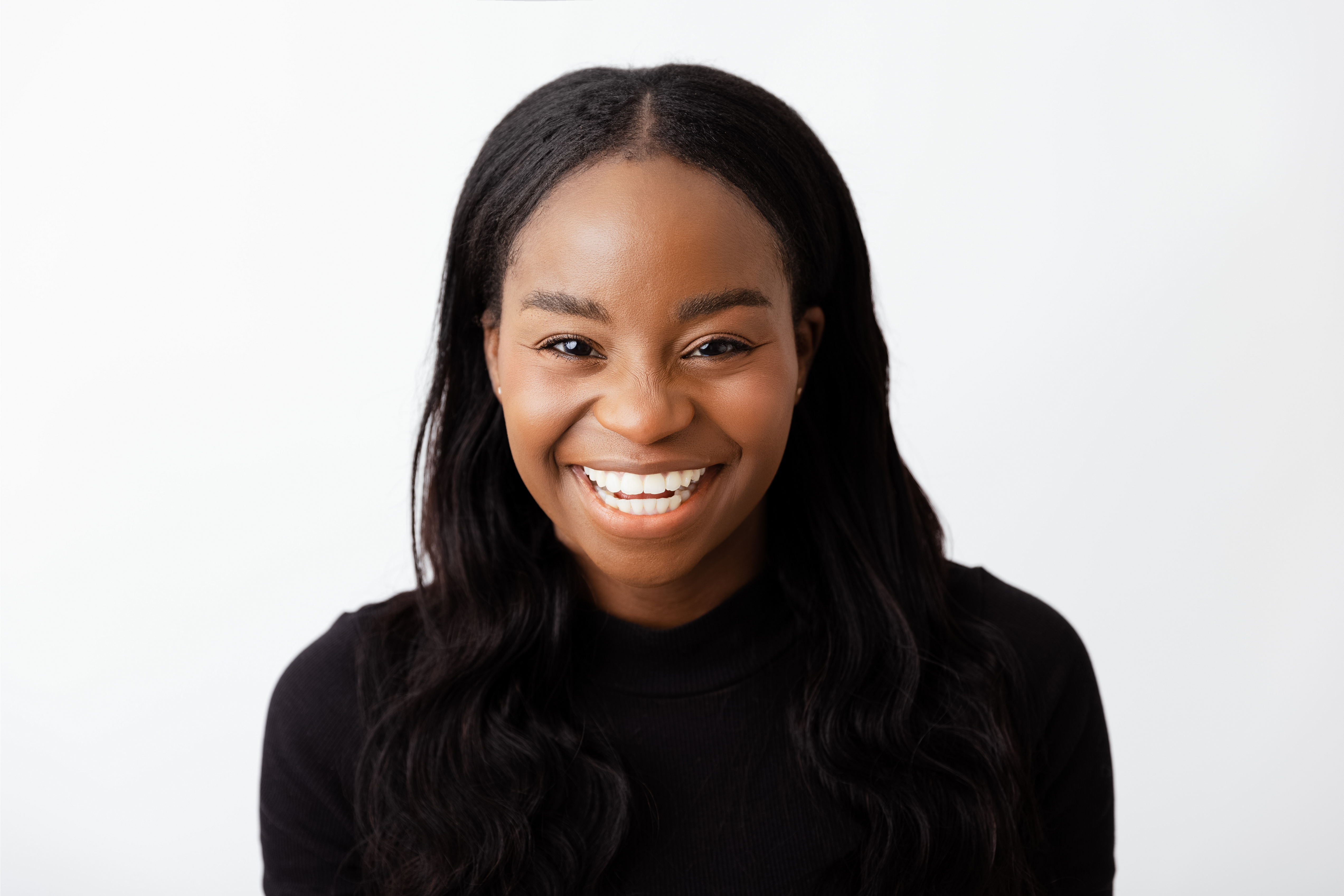
Ayo is incredible. She is a colleague of mine at the Environment Agency and I first encountered her when she gave a keynote at my department’s annual face-to-face meeting. Ayo is autistic and her talk that day was the first time I had heard someone talk positively about their neurodivergence, whilst still acknowledging the challenges. I was struggling in the early part of my ADHD journey and I needed this message.
Ayo is incredible. She is a colleague of mine at the Environment Agency and I first encountered her when she gave a keynote at my department’s annual face-to-face meeting. Ayo is autistic and her talk that day was the first time I had heard someone talk positively about their neurodivergence, whilst still acknowledging the challenges. I was struggling in the early part of my ADHD journey and I needed this message.
I remember a colleague asking Ayo what she did to relax and Ayo’s answer was “I’m learning to fly a helicopter”. This last point chimes with my own neurodivergent experience – both myself and Amy relax by doing things. For Amy it is things like learning new languages, for me it is putting together this newsletter. Ayo’s answer helped me to understand this about ourselves and also taught me the power of talking about your experiences. You never know who might be listening who needed to hear exactly that.
I asked Ayo a few short questions about what imagination means to her.
Why is imagination important to the work you do?
Imagination is about creativity, and creativity is about thinking in new ways. It’s not always about generating entirely new ideas but rather about connecting existing ones in ways others might not see. It allows us to apply knowledge innovatively, solve problems effectively, and add unique value. My interest in a wide range of areas allows me to do this effectively and imagine a whole new world.
How do you keep your imagination sharp?
Learning. I think it is important to always keep learning but most importantly following those organic glimmers and curiosities as they strike you as that feeds your imagination and enables you to think in wild and wonderful ways.
What are you currently working on that you would like to shout about?
I am focusing my energy currently on my AI coaching app, with the hope everyone in the world will try it and find value in coaching tools which I think helps us all to realise our potential.
A bunch of new research publications
I have a whole bunch of new papers recently published to tell you about. I can’t take (all) the credit though as they have been led by amazing colleagues. First, a huge shout out especially to Josh Wolstenholme who has been working hard to publish various bits of his PhD research.
The first paper in this update led by Josh covers the modelling work performed for his PhD. He used an enhancement of CAESAR-Lisflood I wrote that allows users to represent leaky woody dames in the model, including those with flow gaps underneath. This provides an ideal tool to simulate the long-term changes natural flood management can cause in rivers. Josh’s research demonstrates the feasibility of this including verification against field observations.
This is the second paper Josh has produced from his PhD research, currently under review but you can access the pre-print. Whilst the paper above covers his modelling work, this one covers his fieldwork. This includes some enjoyable, yet very cold, trips to Dalby Forest, North Yorkshire, and the installation of trail cams. The field work observed changes to the river before and after natural flood management interventions had been undertaken.
I cannot tell you how happy I am to see this paper out! Five years ago this was going to my big paper, the one with significant findings rather than some niche model sensitivity tests. But every time I made progress something in the model popped up to frustrate me. After I left Hull in 2021 I let it sit. Last year, Josh picked it up again and brought fresh eyes and energy to it. He has done a brilliant job and made it his own.
The way we assess flood risk assumes rivers do not change shape during floods. In the majority of cases this is a reasonable assumption, however, the modelling work here shows that it is not always the case. Large amounts of sediment can be transported downstream and deposited, increasing flood inundations and volumes during later stages of the same event.
This paper, led by Katie Parsons, describes the work we did co-creating educational materials to support the Help Callum and Help Sali 360 videos. The videos came about when I worked with Alison Lloyd-Williams to use my immersive storytelling research to tell the real-life stories of flood-affected children that were shared through Alison’s research. Katie brought her education expertise to work with children, young people, and teachers to create resources to use the videos in the classroom.
I have been so privileged to get to collaborate with amazing and wonderful researchers like Josh and Katie. It’s also great to see them work together on the HedgeHunter’s project too. I had nothing to do with this but it is really cool work:
Back in 2020, just before the lockdown, Katie took part in my NERC-funded Earth Arcade Academy project with a project called INSECURE and it grew massively since (nothing to do with me!). Katie used creative methods to foster intergenerational engagement in communities at risk of coastal erosion. Even though my contribution was tiny and remote, it is such a great project I am going to pretend I had a small hand in it!:
Both Josh and Katie are now at Loughborough University and working on new projects together. I cannot wait to see what they will produce next.
Good Morning – A Solo Roleplay Game
Those who work to plan and prepare for disasters will often use a method called counterfactuals. It proposes ‘what if?’ questions to the planners and they work out how they would respond if that circumstance arose. Similarly, after something bad happens we often look back and think about what we might have done differently.
Downward counterfactuals combine these two methods. It looks back at something that happened and asks ‘what if this other thing happened too?’. For example, planners might look back at how they responded to a disaster and then ask what they would have done if they lost power to their operations room, or if the phone network went down, for example.
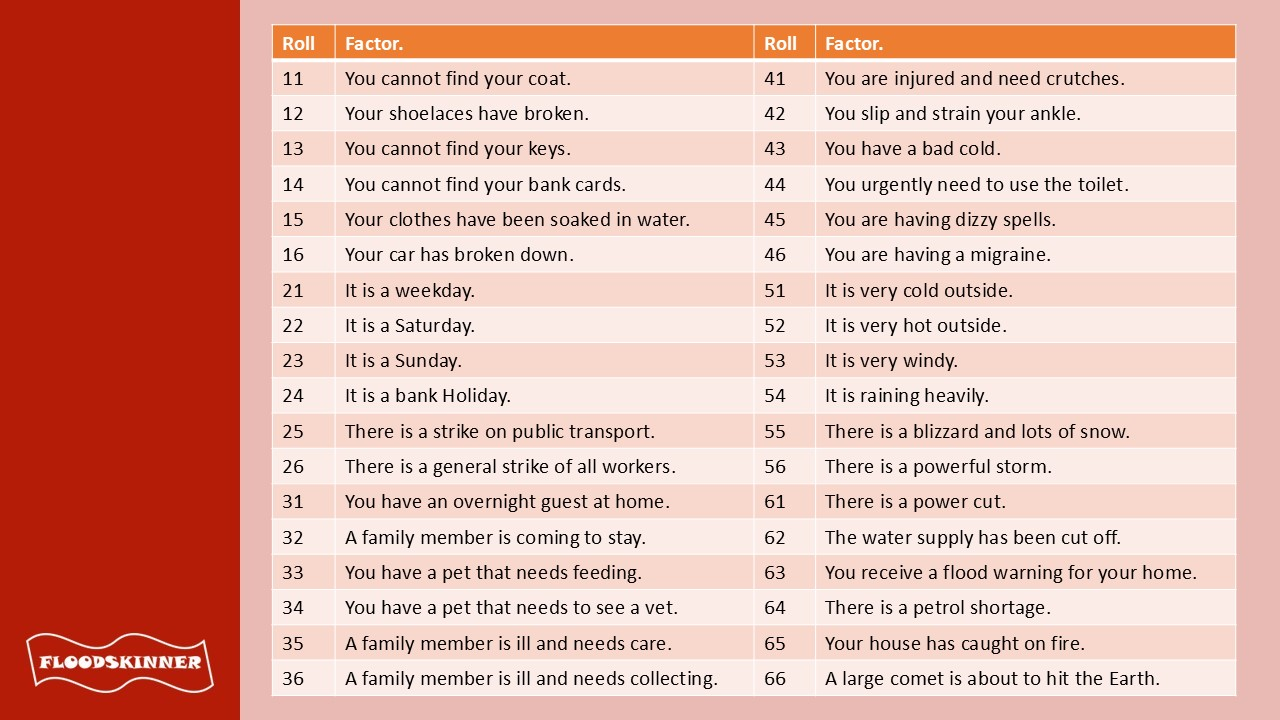
Good Morning is a very simple solo roleplay game. It asks you to first generate a task and then generate a complicating factor. You respond by writing down how you would respond to these. Then, generate a further complicating factor to add to your scenario. How does this change your response?
To generate a task or factor, roll two 6-sided dice, one after the other. The first roll is the first digit and the second the second digit. For example, roll a 2, then a 3, your result is 23. Then find that number on the corresponding table.
This isn’t meant to be serious, just a bit of fun to get you thinking – and imagining – how you might act is some very normal and some very odd circumstances. I hope you enjoy!
FloodSkinner YouTube Update
It has been an unusually busy month on my YouTube channel with the release of three new Shorts. The first was a test of my new kit, having recently purchased an Insta360 x4 and a Rode Wireless Go 3 microphone set. The mic receiver handily attaches to the side of the camera, allowing me to film in 360 and have two people radio mic-ed at once. I’m exciting about what I could do with this set up.
I’ve been desperate to test it, so during a quick trip to Hull I had a play around near the barrier and later put this video below together. Unfortunately, my desktop PC really struggled editing the 8K video, so a new PC is on the shopping list (don’t forget to check out my Ko-fi link at the bottom of the newsletter!).
I am very pleased to bring my series on the Sustainable Development Goals to a close this month! A total of 18 videos, covering the 17 goals and a ‘half-time’ summary, which I started in October 2023. The reason I chose a series on the SDGs was because it would give a sustained amount of content in order to practice and learn filming and editing videos and hopefully you can see that progression through the series.
The video are from having gone viral but at last count the series has been collated over 1300 views on YouTube and about the same again on Instagram. I just need another 2,998,700 views on them to be eligible to be a YouTube partner!
I have enjoyed making these short form videos so will continue to do so but I have to admit, I’m pleased I don’t have any more SDG to cover!
Gaming Environments
Gaming Environments contains all the news I have found relating to the nexus of gaming and the environment. This news is also published on the Games for Geoscience website each month and can be found here.
The (unofficial) European Geoscience Union Games Day is back for 2025! As is now traditional, the middle day of the General Assembly will host both the Games for Geoscience sessions and the world famous Geoscience Games Night.
Games for Geoscience Poster Session – Weds 30th April, 14:00-15:45 CEST (display until 18:00), Hall X2 – In-person online.
Games for Geoscience Oral Presentations – Weds 30th April, 16:15-18:00 CEST, Room -2.41/2.42 – Hybrid in-person and Zoom.
(The World Famous) Geoscience Games Night – Weds April 30th, 18:00-19:30 CEST, Foyer D – In-person only.
Want to go Into Model Land? Join this workshop at the European Geoscience Union General Assembly (Wed, 30 Apr, 14:00–15:45 CEST. Room -2.82) to learn how to use tabletop roleplay games to explore the bizarre world’s created by numerical models. It is inspired by Escape from Model Land written by Erica Thompson. More details here.
The current issue of Consilience, the “online journal exploring the spaces where the science and the arts meet” is out. Issue 20 is themed about Change and can be read here. Submissions for Issue 21 open on 31st March 2025 with the theme Chaos.
I am Chris Skinner, a science communicator, STEM professional, and ADHDer. I am on a mission empowering people to unlock their full potential by transforming imagination into a powerful, actionable skill. This newsletter tracks my journey. I would like you to join me, so please subscribe. The newsletter also includes a copy of Gaming Environments, the monthly news relating to the nexus of gaming and the environment that I collate for the Games for Geoscience website. This newsletter is free and I do not offer a paid tier. If you would like to say thank you and/or help me in my mission please buy me a coffee using the link below.
Views expressed in this newsletter are mine and do not represent those of my employer. Content and links are provided for informational purposes and do not constitute endorsements. I am not responsible for the content of external sites, which may have changed since this newsletter was produced.











 GeoSkinner