

Easter is probably my favourite, and busiest, time of year. In recent years it has been filled with lots of gaming activities that I just love. 2025 has been no different.
Obviously, the European Geoscience Union General Assembly (EGU) in Vienna looms large over Easter. It is often the highlight of the year for me. I’ve attending it for fifteen years now and Vienna feels like a home from home. This year I had the great and rare joy of representing my employer at the meeting, something I had been advocating for and immensely valued and appreciated. In addition, I still got the opportunity to do my usual bits for the (unofficial) Geoscience Games Day.

In 2025, my activities included:
- Two presentations for my day job work, plus lots of networking and learning about the latest science from the hydrology and flood worlds.
- Hosting the Games for Geoscience oral session and the Geoscience Games Night.
- Running a short course based on Adventures in Model Land whilst ‘presenting’ a poster on it at the same time.
- Hosting a pop-up networking event for neurodivergent attendees of the meeting.
I also got the chance to attend the second Play for the Planet network meeting, which was much closer to home.
You can read all about these things, and more, in the newsletter below. Subscribe to get future issues sent straight to your email.
Celebrating the EGU Games Day: A Look Back
April 30th 2025 was officially the eight edition of the (unofficial) European Geoscience Union Games Day! Where does the time go, eh? In this post I take a look back at the origins of the Games Day and the story so far.
For the uninitiated, the General Assembly of the European Geoscience Union, often just referred to as EGU, is Europe’s largest gathering of geoscientists. Each year, around 21,000 of them converge in Vienna to share science and schnitzel. For the last seven years, Wednesdays have been what I have dubbed the Games Day, featuring our science sharing session – Games for Geoscience – and our social event – the Geoscience Games Night.
It all began when Sam Illingworth and Rolf Hut approached me in 2017 about convening a gaming session as part of the education and outreach programme. The following year we held the first ever Games for Geoscience session, thankfully with enough abstracts for both a session of talks and a session of posters.
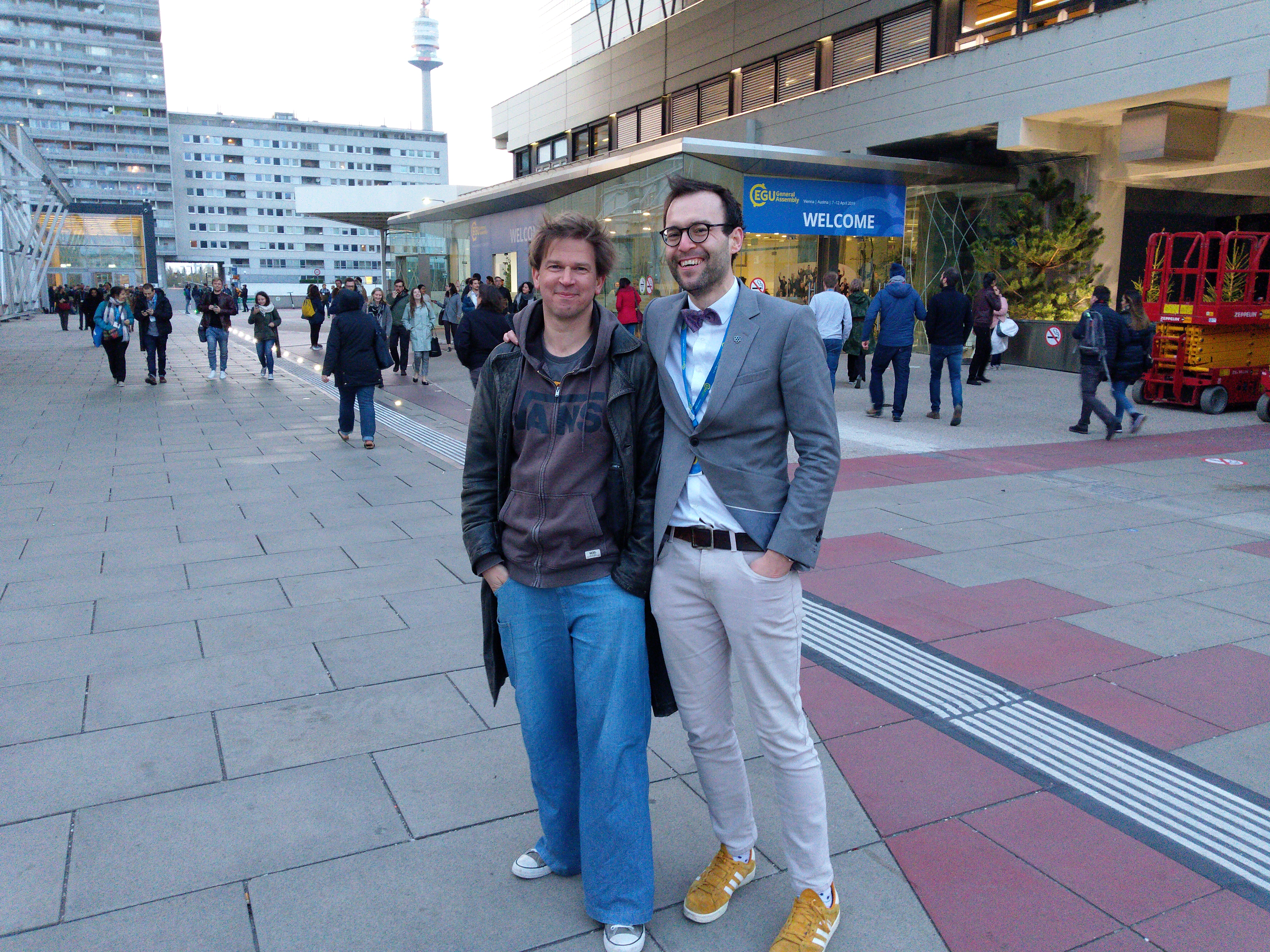
We also held a Games Night. The first one being in a small room in the basement. I remember forking our around £500 from my research funds to purchase 80 bottles of beer and a few crisps for the players. The room and the beer were nowhere near sufficient for the event. Since then we have had very generous support from the EGU team, with the Games Night taking place in a much larger space with access to the free refreshments in the neighbouring poster halls (although security guards added an additional difficulty level to this in 2025!).
It also started the tradition of my awful promotional images for social media. I’m no artist and my design skills are minimal. I also have no budget for this (but apparently I did for beer…) and have a determination to do things myself. Each year I have made some form of crappy image in PowerPoint to drive abstract submissions and make people aware of the Games Night.

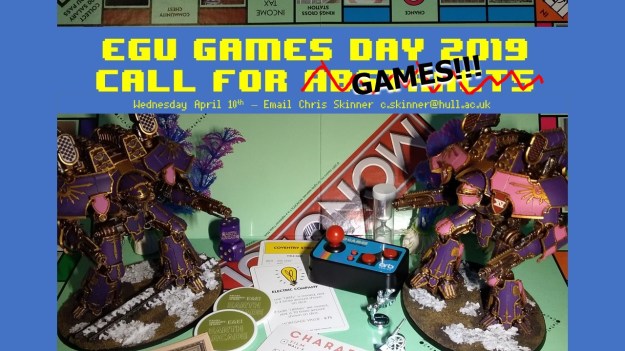


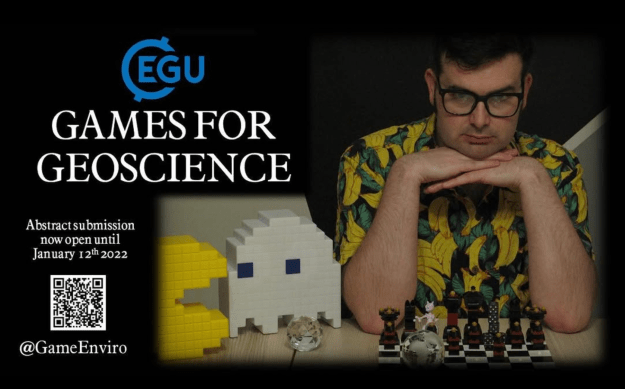
In 2019, were joined by Dungeon Master Liz Lewis and Volcano Explorer Jaz Scarlett. We even expanded over the pond, with Rolf heading up a Games for Geoscience session at the American Geophysical Union meeting, with quest speaker Isaac Kerlow, created of the EarthGirl games.
The Covid-19 lockdowns forced EGU online in 2020 and 2021 and the organisers did a phenomenal job in pulling together the meeting during this time. I hosted Games for Geoscience from my bedroom, whilst the 2020 Games Night saw the convenor team live stream a game of Monster Flux – not geoscience-themed but needs must! In 2021, the Games Night took to Gather Town where I hosted a pub quiz in a bespoke games room I designed. The convenor team changed, as we said goodbye to Sam and Jaz, and welcomed in Lisa Gallagher and Malena Orduna Allegria.
The meeting in 2022 was fully hybrid, with onsite and online connection. The Games Night returned to a physical setting and we tried a return of the Games Room hosted event. Sadly, there was not much demand for it and since the Games Night has remained an onsite only event.
I was so happy to be offered the chance to attend EGU in person again in 2024, my first time in five years, and host the Games for Geoscience session and the Geoscience Games Night live. I was back again this year too and the whole Games Day just keeps going from strength to strength. I think this year was our busiest ever Geoscience Games Night. It is an event that relies of organised chaos and I am worried we may be reaching the limits of that working successfully – we may need to adapt to expand. For now, watch this space!
Visit the Games for Geoscience website and join the LinkedIn group.
Creating Game Worlds from Models: Adventures in Model Land
Model Land is a concept proposed and explored by Professor Erica Thompson in her monograph Escape from Model Land. The idea will be well-known to those of us who use numerical models:
Models are built to simulate real world systems but to be useful they have to simplify the sheer complexity of nature. The way those simplifications are made is determined by the requirements, knowledge, experience, and biases of the model builder. Consequently, what these models simulate is not the real world but a world of its own making, a model land.
Erica implored us to get out of model land – to understand how the simplifications of the models make them wrong and use them carefully when they are informing real world decisions. This is absolutely vital, especially in my professional area where models are used to help us make decisions on flood risk. The key word in that last sentence is ‘help’ as models should never be making decisions for us otherwise, as Erica would likely say, that decision is made in model land and not the real world.
But when I hear the term model land, I have additional questions: what does a model land look like? What would it be like to explore one? How would life survive in one and could people call it home? These are probably not the most important questions for a modeller or decision-maker but wouldn’t it be fun?!

If games are ‘operas made out of bridges‘, models are simply bridges made out of bridges, or at best are very low quality operas. A game is a model of a system (sometimes often built using multiple models itself) – the bridge bit – that uses story and art to immerse players within it and bring it to life – the opera bit. Consequently, game worlds are themselves model lands. When you step into Link’s shoes and explore Hyrule in any game of the Zelda series, you are actually exploring a simplified representation of Hyrule, optimised for the purpose of the game and the hardware available. You are entering a model land.
What separates the model lands created by numerical models and game worlds is that paucity of opera. That’s all.
And we can fix that by using the Adventures in Model Land system and our imaginations.
Adventures in Model Land has been created by myself, Erica, Liz Lewis, Sam Illingworth, Rolf Hut, and Jess Enright as an open-source resource for numerical modellers. The latest version, v0.2, still in the beta stage, provides a step-by-step guide for the ‘operafication’ of any numerical model to create an explorable model land/game world. It leans heavily on the world-building methods of tabletop roleplay games (TTRPG) and the intention is to allow modellers to lead players on quests within their model lands.

At EGU this year, I led a short course using the v0.2 of Adventures in Model Land, leading over thirty participants through the worlding process, creating model lands and writing postcards describing their experiences. It was a great opportunity to test the idea out, gather some feedback, and further refine the system. We even had people designing new games based on the model lands they had brought to life! I think there is great potential in using the system as a workshop with modelling groups and the users of models to help them better understand the models used to make decisions – something I am working towards.
You can download the system for free and use it whatever you like. However, we would really appreciate feedback on the system and how you have used it. Please do also share your model lands and the games you create, our plan is to produce a compendium of our favourites in the future. I plan to release an update to the system later this year as a v1 – subscribe to this newsletter to keep up to date with progress and new releases.
Neurodiversity at EGU
I am a big fan of social media. Probably too much so. I am not so great at in person networking but I feel I have successfully made use of social media to plug this gap. Not only does it connect me with people working on things I am interested in, it also allows me to learn a bit about them and that means when I meet them in person it is much easier to start that conversation.
It is also a catalyst for ideas and starting things – something I apparently have a knack for. In the run up to EGU this year, I saw a post by Simon Clark, EGU’s Projects Manager, who was asking if anyone knew of a STEM-focussed network for neurodivergent folk. I reflected that I would be interested too but did not know of any. However, I also reflected that EGU has an active and effective EDI committee, so if any STEM-focussed organisation should be hosting an network for neurodivergent folk, EGU is a great candidate.
EGU is attended by nearly 21,000 people, so if 15-20% of the global population are neurodivergent or have a neurodivergence, we should anticipate that includes around 3-4000 people at the conference.
Simon and I exchanged a few messages and agreed to host an informal networking event at the conference to try and bring together others who might be interested in a network. We held this on the Wednesday morning and it really was a positive experience. Having attended the General Assembly for 15 years now, it was just nice to connect with people who struggle with the same things and remind yourself you are not broken and you are not alone. Simon put it best on BlueSky after the event when he said it “filled my heart”.
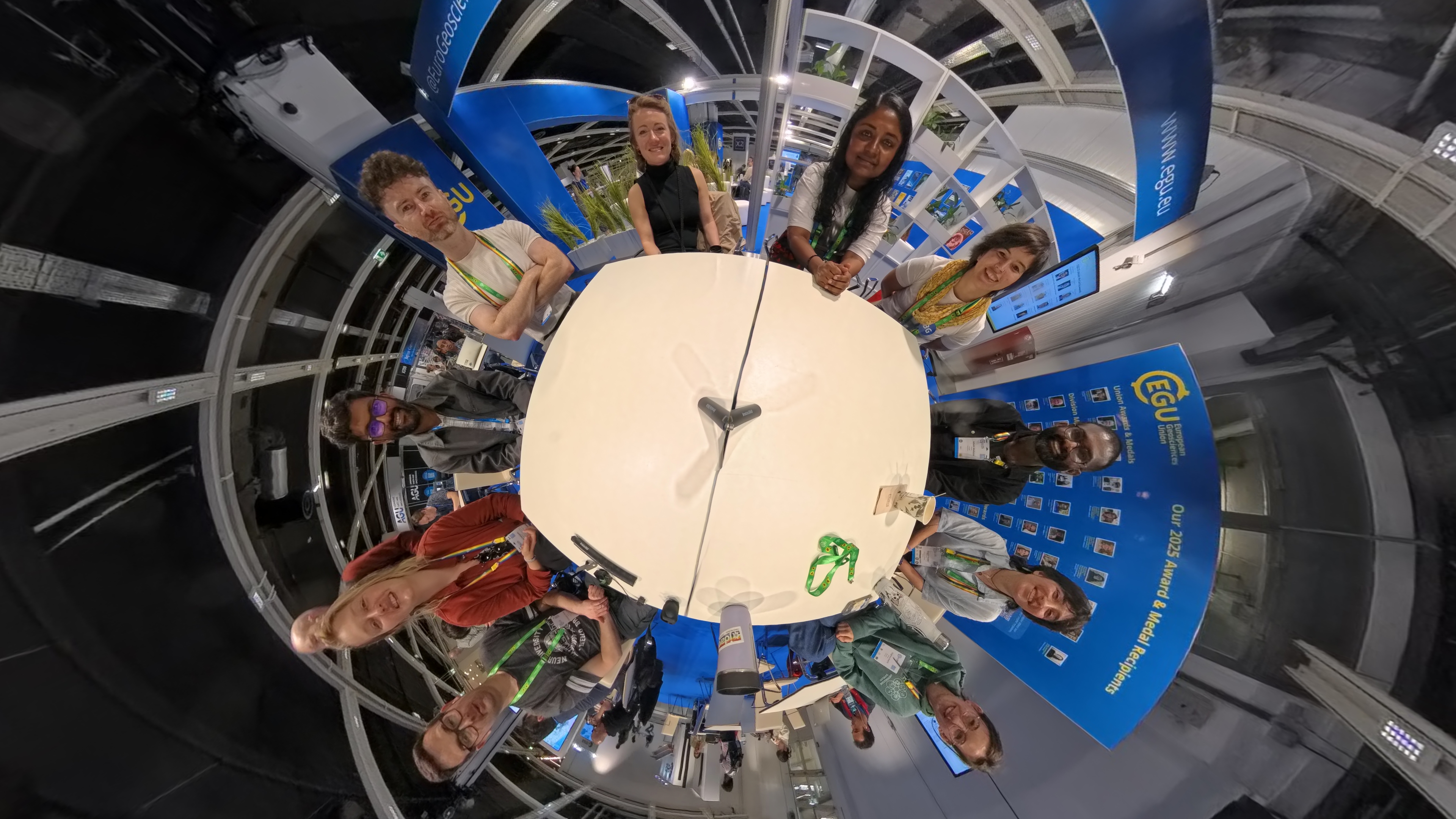
Alongside the pop-up event we also put out a survey simply asking people what does and what does not work well for them at the General Assembly, along with a chance to register their interest in being part of the network. This will be open until end of May 2025 and you can complete it here.
Encouragingly, we were not the only ones to have this idea. Lucile Turc and Ana Bastos (who recently wrote about her experiences of ADHD and science in an article for Nature), was part of a group organising an neurodivergent scientists picnic. I was enjoying an apple strudel at gate D35 of Vienna airport at the time, sadly, so could not attend.
The next steps will be contacting those who registered their interest, and pooling the learning from the two events and the survey to compile a report for the conference organisers and the EDI committee. I’m really excited about the supportive community we can build together.
Exploring Games for Environmental Solutions at Play for the Planet 2
In April I had the opportunity to attend and present at the second Play for the Planet network meeting in York. It brings together people of different backgrounds who all use games to address environmental issues. Firmly within my interests and the remit of my work with Games for Geoscience, I attended the inaugural event in 2024 and jumped at the chance to attend again.
In the build up to the event, the venue was moved from the main University of York campus to their King’s Manor location in the city centre. It left me reflecting how ridiculously fortunate I am to have an environmental games conference held within a ten minute walk of my house! A big change from the bus-train-bus trek I had to make (and self-fund) from North Lincolnshire last year. In 2024, I did not really have much to share so I presented on my thoughts about the relationship between models and games.
The presentations this year were in the form of research blast talks – 1 slide, 3-mins. This was a fun format and allowed for more people to share their work in the meeting. It was also pretty friendly to my easily distracted brain. For my research blast, I showed off the latest version of the Adventures in Model Land system I have been working on (see above for more). Following the research blasts there was a ‘world café’ style discussion where we debating crucial topics including ‘what is a game?’, ‘how do we best market environmental games?’, and ‘how do we evaluate our games?’.
Following the lunch break there was a chance to play demos of some of the games. This also gave the developers an opportunity to playtest and get feedback. For example, Games for Geoscience 2024 keynote Matteo Menapace was testing a streamlined card-based version of the immensely popular Daybreak game, provisionally titled Dawn.
I enjoyed catching up with my former University of Hull colleague, Steven Forrest, who was sharing the excellent work the Energy & Environment Institute have been doing with The Flood Recovery Game. This game is played with flood risk stakeholders, including community groups, to identify and better understand systemic gaps in the process of recovering after flooding. I’m sure I’ll do a summary of the research behind it in the near future.
Another highlight for me was playing the 2D city-builder game Oxygen Not Included. Whilst this is a commercial game, it was being used by Truzaar Dordi to help students understand how complex and coupled human-environment systems operate. This, along with some of the earlier discussions, reminded me of the power of good game (and model) design to effectively simulate complex systems whilst steering clear of becoming complicated. Complex is good, complicated is not.
As much as I enjoyed Play for the Planet, I did reflect on the lack of professional games designers at the meeting. There is a strong desire from that community to be part of the work tackling environmental issues, evidenced by the success and growth of movements like Playing for the Planet Alliance and the Global Green Game Jam. I would like to see much more interaction between those networks and our own academic networks like Play for Planet and Games for Geoscience. How? I’m still figuring that one out…
The Play for Planet network was established by and is run by the York Environmental Sustainability Institute (YESI), led by Linda Dunlop, Prasad Sandbhor, Pen Holland, Judith Krauss, Anna Morfitt, and Daisy Kemp. It is open to games designers, researchers, and educators with an interest in using games to address environmental crises. You can learn more and join the network here.
*I must remember to take photos when I attend things but I was having too much fun!
Building a Business Plan for Creative Success
Back in my January issue of Imagination Engines I wrote about accountability and how I hoped to use this newsletter to keep myself accountable to my own plans. In hand with this was a promise to produce a business plan and progress report each April so I can measure if I have been successful or not. It might also stop my mind wondering into new projects that take me further from my goal and help me know what I should say yes to and, probably more importantly, what I should say no to.
I promised to produce my first business plan in April this year and here it is if you fancy a read. As it turns out, my business plan is not much of a business plan after all. My ambition, the end game for all my work with FloodSkinner, is not to make money and to sustain myself off the profits of a small business but a means to be creative and work on things I enjoy. Ultimately, I want to write a book and everything I do should contribute to that.
I start with my mission: to empower people to unlock their full potential by transforming their imagination into a powerful, actionable skill. I will do this by providing science communication and education consultation and services.
A common way of planning business activities is to use a funnel analogy. At the bottom of the funnel is the actual stuff that makes you profit – it has a very narrow focus. In my analogy, I replace profit-making with writing my book. In the middle of the funnel are activities that help build relationships with people who could be potential customers. In my analogy, these are the research projects and workshops I will work on that help me make connections and learn more deeply about relevant topics. Finally, the top of the funnel is the widest point and this is about building an audience and signing people up to your mission.
Businesses should start at the top and progressively narrow their focus. This means starting with the mission, the purpose for why they exist, and only then do they progress down through the funnel and find that thing they can provide that will produce a profit. In 2025, I am still at the top of the funnel and my activities will be focussed on continuing to build an audience, both through this newsletter and on my YouTube channel.
I hope you will continue to join me on this journey.
Gaming Environments… no more…
I have sadly decided to retire the Gaming Environments newsletter. This was where I shared the latest news I had found from the nexus of gaming and tackling environmental issues. It was a surprisingly time consuming process to put it together and it does not help me get to where I want to be – managing my time is increasingly important.
I will be more actively recruiting volunteers to support Games for Geoscience in the future, so if you would be interested in taking over the Gaming Environments newsletter please do get in touch (chris at floodskinner dot games).
About This Newsletter
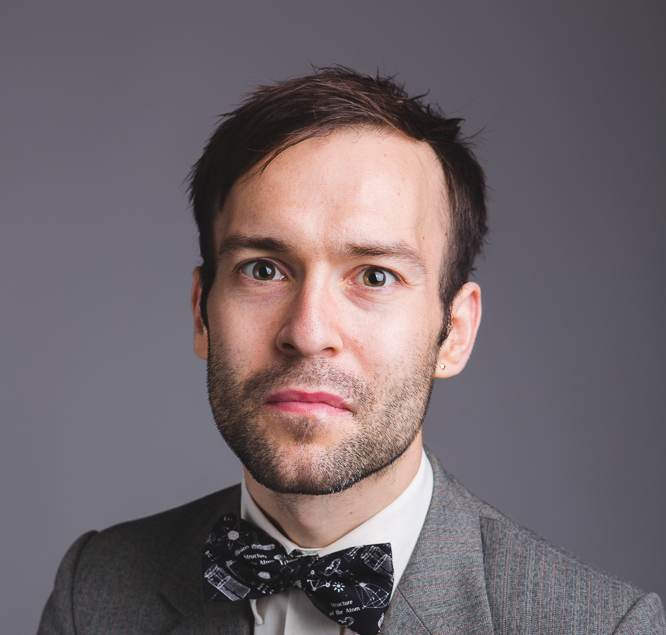
I am Chris Skinner, a science communicator, STEM professional, and ADHDer. I am on a mission empowering people to unlock their full potential by transforming imagination into a powerful, actionable skill. This newsletter tracks my journey. I would like you to join me, so please subscribe. The newsletter also includes a copy of Gaming Environments, the monthly news relating to the nexus of gaming and the environment that I collate for the Games for Geoscience website. This newsletter is free and I do not offer a paid tier. If you would like to say thank you and/or help me in my mission please buy me a coffee using the link below.

Views expressed in this newsletter are mine and do not represent those of my employer. Content and links are provided for informational purposes and do not constitute endorsements. I am not responsible for the content of external sites, which may have changed since this newsletter was produced.



 GeoSkinner