We lost my father-in-law, George, a year ago between Christmas and New Year. He was a good man, into his eighties, who had spent much of his career in the British Civil Service, including the Ministry of Agriculture, Farming and Fisheries. He had many interesting stories to tell, including how he ended up at Wembley for the 1966 World Cup Final with free tickets as none of his colleagues believed England would reach that far!
George’s passion was for books. He was always reading, was never without a book in his hand, and when asked what he would like for presents we were sent a list of books. He very reluctantly halved the size of his library when he an my mother-in-law, Beverley, downsized and moved to the seaside for their retirement. Beverley still found books hidden in cupboards and drawers.
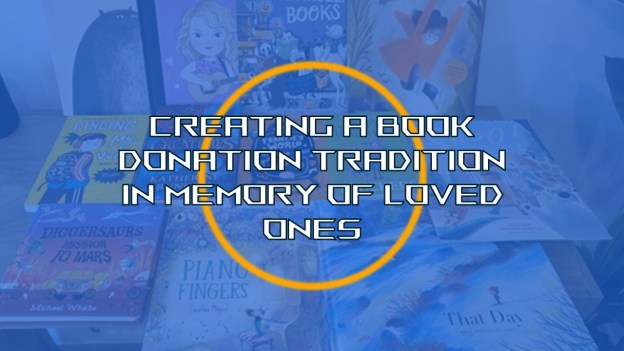
This is how we wanted to remember him, so instead of flowers at his funeral we asked people to buy a a children’s book that meant something to them. We arranged with the Primary school he attended to donate them to their library. We were blown away by people’s generosity and we were able to donate over 100 beautiful books!
We continued it again this year but on a smaller scale. With my wife’s family staying with us over Christmas, we visited a local bookshop and each bought a couple of books to donate to a Primary school local to us. I chose some books about neurodiversity because I’d have liked to have read these when I was a kid. We plan on making this an annual tradition. George would have loved sharing his joy of reading with the school kids.
What book would you choose to give to your younger self?
This post originally appeared in the Imagination Engines newsletter. To read this content a few weeks earlier, subscribe to the newsletter below.
In July 2021 devastating flood impacted northern Europe, including Belgium, Germany, and the Netherlands. The floods caused over 10 billion Euros worth of damage and caused extensive damage to properties and communities over large areas. Tragically, nearly 200 people lost their lives.
This is despite the flooding being well forecast by the European Flood Awareness System (EFAS), which provided warnings 3 to 4 days in advance, seemingly giving organisations and individuals enough time to prepare. Even if they could keep their homes and businesses safe, they should have had time to keep themselves safe.
Professor Hannah Cloke of the University of Reading, who specialises in flooding, wrote an article for The Conversation following the flooding examining the reasons for why warnings were not as effective as expected. Hannah was involved in setting up EFAS, so was well positioned to comment and I think you might expect her to pass the buck, to say the science was right and it was not the fault of the forecasters that those warnings were not heeded. But she doesn’t.
The philosopher Paul Virilio wrote about technology: “When you invent the ship, you also invent the shipwreck…“. As scientists, when we create anything we need to imagine what could go wrong and own that. It is not enough to put together an early warning system, however world leading, accurate, and timely, if no one acts on it.
Golding et al (2019) described how early warning systems are made up of steps together in a chain. At each step, value is built as a mountain, between each step the value is lost in the ‘valleys of death’. Bridges of communication, understanding, and knowledge transfer ensure that value is retained and passed forward. The only value of an early warning system emerges when people respond to it appropriately.
Hannah described in her article how the failure laid in the way that warnings were produced, disseminated, and interpreted. The EFAS relies on public agencies to respond to their warnings – as happened in some places but not others – they are not available to the public. Professor Linda Speight, University of Oxford, who also specialises in flooding, described the difficulty of issuing warnings with the right message, especially when working with numerous different groups and organisations – a one-size fits all approach does not work for effective warning.
Both Hannah and Linda conclude that flood warnings are only effective if people understand the potential impacts on them. Linda described the benefits on impact-based forecasting, for example: “river levels will rise rapidly causing widespread flooding. Damage to roads and property is expected”. Hannah summarised the job of a flood warning (and science more widely) as “helping people see the invisible” – it is helping people imagine those potential impacts in response to the warning so they are compelled to take action. To Hannah, this failure in imagination was the missing bridge in the early warning chain, between warning and decision, where that value, tragically and literally, fell into the valley of death.
How would you help people see the invisible?
This post originally appeared in the Imagination Engines newsletter. To read this content a few weeks earlier, subscribe to the newsletter below.
I would not be in my line of work if I did not love being around water. I grew up, was raised, and lived most of my life on the banks of the Humber. Whether it was the open expanses of the bank and cliffs between Barton and South Ferriby, or the concrete defences around the Hull tidal barrier, I have marvelled and been inspired by the mighty tides and the big open skies of the Estuary. These were places I would sit, reflect, and let my imagination wonder.
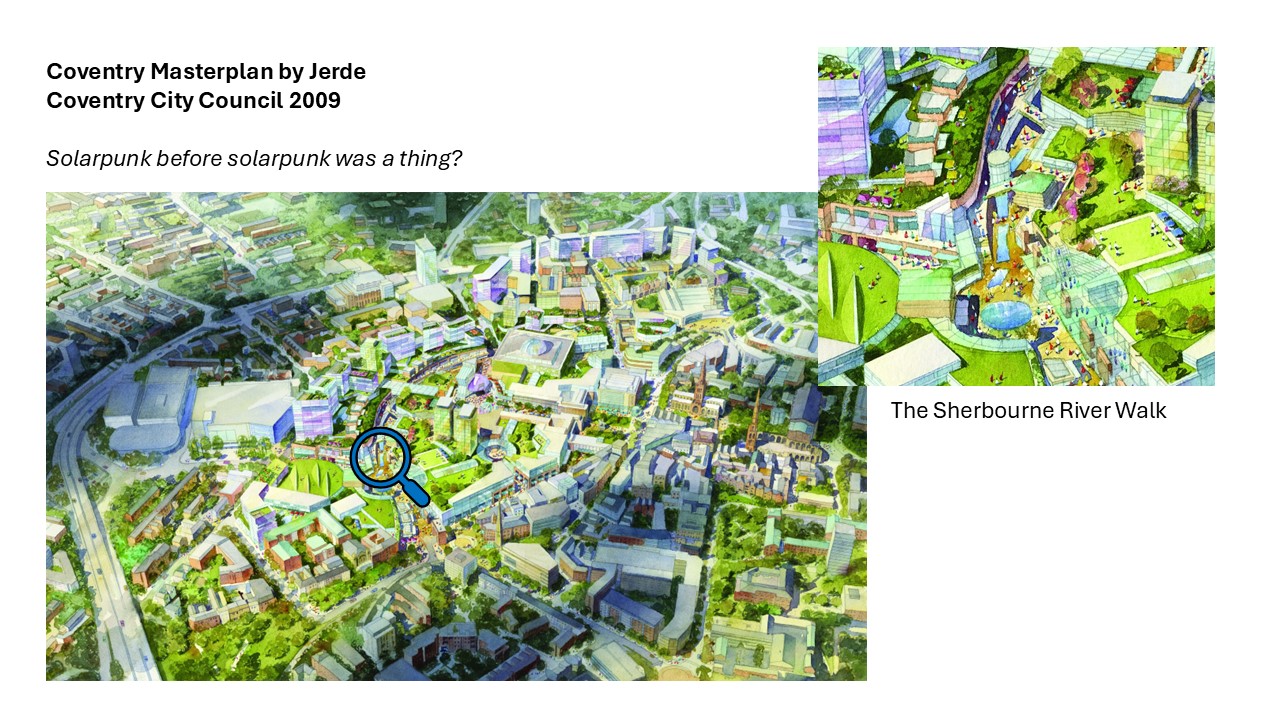
Until recently, the only time I have lived away from the Humber was three years spent in Coventry. This city, a La Corbusien nightmare of concrete and ringroad, sits close to the point in the UK that is furthest away from any coast. Having buried its river, the Sherbourne, under the concrete the post-war planners loved so much, it is entirely cut off from any form of waterscape altogether. When I worked there, the ‘Jerde Masterplan’ had an ambition to install water features along the old route of the river but this a long way from the daylighting of buried rivers that has been successful elsewhere.
Needless to say, I did not enjoy my time in Coventry. I do not want to bash it, it has lots going for it, but I personally was not inspired or enriched by it. I did not find any spaces where I could sit and imagine. It was not the city for me. A large part of this, I think, was the lack of a waterscape and I felt homesick and longed to be under those open skies of the Humber once again the whole time.
It was not easy then to prepare myself for the move to York. It was move an hour’s drive inland, away from the estuary and the sea. I did not want to feel disconnected and homesick again. Thankfully, York was not devastated by well-intentioned yet misguided town planners whilst recovering from the Blitz and retains much of its Medieval charm (I once heard pre-war Coventry described as “York on steroids”). The River Ouse flows through its centre and I now live just a short walk away. Lunchtime and after-work meanders along its banks have become a near daily ritual, watching the boats, the rowers, and birds diving for fish and trying to guess where they’ll pop up again.
What I really love about the river is how dynamic it is and the liminal spaces at its edges. The river level can rise and drop quickly and since we moved here a few months ago it has spilled over its human-defined edges on handful of occasions. These are my favourite times and places. As I write, one of my favourite walks is diverted by the flood of the river. Not enough to cause harm, just minor nuisance, but it reminds me of its power and creates ambiguity over where belongs to us and where belongs to it.
It prompts my imagination. The water is much higher than usual and higher than I would visualise when it is ‘in bank’. The Ouse can flood to an extent that it causes real damage and misery and woe to those people unfortunate to be impacted by it. It is hard to visualise how it would look and the volume of water that would be needed for it to happen. You can see the evidence in the barriers on houses and businesses. You see it on flood markers (although I haven’t spotted any yet). And, when I see the water spilled over onto footpaths and the layer of fine silt left behind from the river when it was higher the day before, it sparks my mind to consider the hazards.
Here at the river edge, I find something similar to that I find on the banks of the Humber. It different, yet in a metaphorical, spiritual, and a very literal hydrological sense, they are connected. It is a place I can sit, reflect, and imagine. I am excited for the ideas I will have here.
Where are the spaces that spark your imagination?
This post originally appeared in the Imagination Engines newsletter. To read this content a few weeks earlier, subscribe to the newsletter below.
Welcome to the March edition of Imagination Engines! How is it March already? I’m starting this newsletter with some personal news I have been eager to share with the world but have been holding in since before Christmas – I have been appointed a Visiting Fellow at York St John University!
This is a voluntary role, supported by Associate Professor Pauline Couper, Associate Head of Geography and the Liberal Arts. The role will see me supporting students in the area of environmental communication through lectures and project co-supervision. I can’t wait to start working with the students and helping them develop their ideas.
York St John, or YSJ, is my local University. My wife has been working there since last year and I have had the pleasure of visiting the campus many times now. I have been deeply impressed by their commitment to sustainability and also social mobility. It is currently the Good University Guide’s 2025 University of the Year for Social Inclusion. Their ethos aligns with my own and I am proud to join the YSJ family.
As joyful as I am at joining YSJ, I am equally sad to be saying goodbye to the University of Hull at the end of this month. I was an undergraduate at Hull, I did my PhD there, and progressed from research assistant to a research fellow in the Energy and Environment Institute there before leaving to join the Environment Agency. For the last four years I have been a visiting researcher there. Nearly 20 years in total!
I have been pleased to contribute over those four years as a visiting researcher but over time – as people move on, projects finish, and leadership changes – my links have grown very thin. With Amy leaving and us moving to York, now feels the right time to finally say a reluctant goodbye. The University of Hull will always feel like ‘home’ to me but I imagine I will visit in the future to see friends, see how the campus has changed, and for one more piece of the ginger flapjack.
You will never know how much I loved you…
Inspiring Interactions: Sam Illingworth’s Games, Science, and Poetry
Ideas do not come out of nowhere. We are all influenced by the environment around us. We absorb information and experiences that shape our mindsets. The people we encounter will bring us new ways of seeing the world and inspire us. In this new item, which I hope to make a regular feature, I introduce you to someone who has been an inspiration to me and ask them a few questions about their thoughts on imagination. I’m going go to start with legendary science-poet, Professor Sam Illingworth.
Sam is a Professor in Academic Practice at Edinburgh Napier University. After completing a PhD in Atmospheric Physics at the University of Leicester, Sam instead chose to pursue a career in science communication. He is best known for his poetry, with his science poetry blog attracting over 100,000 readers a year.
He is dedicated to service in scicomm too. He is the Chief Executive Editor for Geoscience Communication and founder of science-art journal Consilience. He was a convener for the popular EGU science communication session, which was where I first met Sam after I presented my work with Humber in a Box.
Sam shares my love for games and has published many himself, including a climate change hack of Settlers of Catan and Carbon City Zero. He gave me a hugest of legs up in my career when he and Rolf Hut approached me about starting Games for Geoscience at EGU – it wouldn’t have happened without them.
I refer to Sam on how science communication research should happen: innovative, blurring boundaries, fun, yet thoroughly evidence-based. Every so often, I revisit his presentation from when he accepted the Katie and Maurice Krafft Award to remind me of these things.
Why is imagination important to the work you do?
Imagination is at the heart of everything I do – whether it is writing poetry, exploring how students interact with GenAI, or making games. For me, poetry is a way of stretching thought, a means of making connections between ideas and disciplines that might not otherwise meet. It is also a space for possibility, for imagining the world not just as it is but as it could be.
How do you keep your imagination sharp?
Writing poetry is one of the best ways I know to keep my imagination alive. The constraints of form – whether haiku, sonnet, or something more free form – force me to think differently, to approach ideas from new angles. I also find that collaborating across disciplines, whether with artists, scientists, or educators, pushes me to engage with new perspectives and ways of thinking.
What are you currently working on you would like to shout about?
Two projects I am particularly excited about at the moment:
Student x GenAI ( https://www.studentxgenai.co.uk/) explores how students are using generative AI, giving them a platform to share their experiences and perspectives. It is an ongoing, collaborative project funded by the Leverhulme Trust that raises some fascinating questions about creativity, authorship, and learning in an AI-shaped world.
Rooted in Crisis ( https://rootedincrisis.com/) is an incredible project at the intersection of science, art, and environmental storytelling. It uses games and narrative to explore climate change, and we should hopefully go live on Kickstarter later this year. We also have some new artwork to share very soon!
Failure of Imagination in Flooding (2)
In a previous post, I looked at how a failure of imagination potentially contributed to a tragic loss of life in the 2021 floods across Northern Europe. Because people were not able to grasp the potential impacts of the flood that they were being warned of, they did not take appropriate action to keep themselves safe. Professor Hannah Cloke of the University of Reading described the role of scientists here as “helping people see the invisible”.
Recent research led by Joy Ommer, part of Cloke’s research group, begins with the line “What’s the worst that could happen?“. The paper, ‘Surprise floods: the role of our imaginations in preparing for disasters‘ – published open-access in Natural Hazards and Earth System Sciences – looks back at those floods in 2021 and explores the role a lack of imagination played. Crucially, it also shows the role we as scientists have in helping people understand risks.
Ommer places imagination in the context of this research as “the ability to depict a particular situation in your mind and your actions linked to that situation“. We use this cognitive ability to visualise in our everyday decision-making and for trying to work out what the future might hold. It is informed by our experiences and our ability to imagine – Ommer describes people as having different abilities to imagine, which may be cultivated, but does not explore it as a skill that can be trained. Importantly for disaster preparedness, imagination plays a key role in risk perception by adding to our reality and existing knowledge of a situation.
The research used a survey of people who were affected by the floods to better understand their perspectives. As highlighted in the paper, many of those affected reported that their ability to understand the impacts of the flooding was lacking – it was unimaginable or they did not have the imagination to understand the scale of it. Several linked their inability to imagine the flooding to a lack of preparedness for it. To many, it was only when they saw videos of flooding happening, and feeling empathy for those in the videos, that they started to comprehend the potential consequences for themselves.
This research by Ommer and co-authors highlights and breaks down key aspects about how imagination is linked to risk perception and preparedness for disasters. The solutions they propose include using forecasts and warnings designed to trigger imaginations. They also argue that we need to work with those at risk to cultivate their imaginations using creative approaches, such as local storylines, and helping them to visualise potential impacts.
This is a really important and interesting paper for understanding the important role imagination has to play in disaster preparedness.
Deskinning ‘Environmental’ Games
Back in 2019, at the peak of my work on the Earth Arcade, I picked up a board game called Photosynthesis. I am not a big board game player but I was attracted by its beautiful, and very ‘green’, aesthetic and its tactile tree playing pieces*. I was also drawn by its promising environmental messaging, with the publisher’s, Blue Orange, motto proudly stated ‘Hot Games Cool Planet’.
I also remember playing it with Amy. Each turn the sun moves around the board. You plant trees. Those trees collect light energy and cast shadows on other tree to stop them collecting energy. You use energy to grow your trees or plant new ones. You score by chopping grown trees down. We remarked how it was bizarre how you won an environmentally-themed game through deforestation but then thought no more of it. I went on to use the game as an example of an environmentally themes board game as part of my Earth Arcade Academy launch event.
Dr Chloé Germaine and Prof Paul Wake of the Manchester Game Centre think about games on a whole different level to most people. Certainly more than me. Recently, I was very happy to be invited to the University of York’s Environmental Sustainability at York (ESAY) by Director of Education, Prof Lynda Dunlop, to hear Chloé and Paul talk about their research. And Photosynthesis was right in the heart of their work.
Games can be broken down into their components: the mechanisms of the rules and systems that dictate how it plays; the dynamics of player inputs and decision-making; and the skin of aesthetics and story that add flavour to the game. They saw through the skin of Photosynthesis to what it was hiding underneath. It isn’t an environmental game at all, it is a war game and they were going to show it by peeling back the game’s skin and revealing its true nature.
Chloé and Paul took the game back to its bare bones. They created a new narrative based on the siege of Bastogne during World War 2’s Battle of the Bulge. New artwork was commissioned for the board and all of the game assets. The rule book was reproduced but not rewritten – only names were changed. Suppressive Fire was created. Functionally, the game was completely unchanged yet visually it was unrecognisable. When they tested it alongside Photosynthesis, audiences preferred the deskinned version as the narrative fit the mechanism more comfortably.
The presentation taught me valuable lesson about the importance game mechanics. The way a game works, the decisions it compels players to make, are a huge part of what they take away. Assuming good faith from developers, the mechanics of their game will be leaving players having learned the wrong message. A pretty, green-coloured skin is not enough to make a game environmentally-themed, especially when it is rooted in a system that is creating the problem.
You can read more in Chloé’s chapter, Nature’ Games in a Time of Crisis, in Material Game Studies: A Philosophy of Analogue Play. More publications based on this work are in the pipeline and will likely be included in the Gaming Environments newsletter in the future.
The Imagination Muscle by Albert Read
A few years ago we started a new Christmas tradition in our house. On We would each buy each other a book – we’d say what we wanted – and on Christmas Eve we’d exchange them and read them in bed with some nice hot chocolate. We turn the lights day, put on some fairy lights, and snuggle up warm under the duvet to read our books, accompanied by our cats. I’m not going to claim originality, The exchange of books is a common tradition in Iceland that inspired the term Jólabókaflóðið, or Yule Book Flood, which refers to the release of new books at this time of year to fuel the demand. The duvet, the lights, and the hot chocolate is inspired by the Danish concept of hygge, its meaning elusive but involves coziness and warm atmosphere.
The problem is, unlike my wife, I have never been an avid reader. It is something I find hard to focus on and get easily distracted and frustrated. For what I can now see as a form of accommodation, I chose a graphic novel the first time round, the first volume of Scott Pilgrim series (I’m a big fan of the film). In 2023, I reached the end of the series and I had to recommend something else. In the last few years I have discovered audiobooks and they have revolutionised my reading habits – I’ve always wanted to read but it just was not accessible for me – I have read more in these past couple of year than I have in the rest of my life. I wanted something to inspire me and my imagination and settled on The Imagination Muscle by Albert Read.
I did not anything about this book or its author. I was drawn to the title and its promising subtitle of “Where good ideas come from (and how to have more of them)”, which perfectly resonates with my journey of seeking imagination as a skill. At 7 hours and 51 minutes long, I did not consume the whole book on Christmas Eve and it kept me inspired until mid-January whilst I sorted the kitchen and the cats at the end of the day.
I must admit, it did not meet my expectations. But that is not a negative. From the title and the blurb, I was expecting something that would be more of a lifestyle guide, with a stronger focus on the “and how to have more of them” angle. I thought it would be packed with helpful tips and exercises you could do to practice and strengthen that ‘imagination muscle’. This is not that book but I am pleased it was not.
In the book, the author takes us on a deep dive of human imagination, both individual and collective, as it has developed in concert with society – a symbiotic relationship. He weaves this narrative, from the earliest cave paintings to the latest technological developments, showing that society has developed because of imagination and that imagination has developed, and been allowed to flourish, because of the advancement of society. He shows how historical leaps, like the emergence of language and the inventions of the printing press and the internet, born from imagination and building on chains of individual genius, have facilitated great expansions of imagination. The journey Albert Read takes the reader on is enlightening and enriching.
But that is not to say there is not anything helpful in here on how to build your imagination muscle. There are explorations of what made people so imaginative (and what can lead to deterioration of the muscle). For example, Read demonstrates how the ‘beginners mindset’ is fertile ground for imagination and good ideas – that space of uncertainty and needing to learn creating a breeding ground of problem solving. Maybe ADHDers tend to be creative and imaginative because we are always trying something new! Connection with nature, the rhythm of walking, and the power of coffee as both a stimulate and its role in networking are all discussed.
I was very pleased I chose this book. I really enjoyed listening to it and found myself both informed and inspired by the human story of imagination laid out by Read. The imagination as a muscle is a useful metaphor and a different, yet complimentary, way of thinking to imagination being a skill. Both attest to it being something that gets better with practice and advocate for us to make time to do just that.
YouTube Update
In the last month I have released two new YouTube Shorts onto my FloodSkinner channel. Both are part of my Sustainable Development Goals series, covering the progress of the goals at their half-way point to 2030.
These two videos cover Goals 14 and 15, Life Below Water and Life on Land respectively. I think the UN must have been getting tired when naming these later goals as the full titles just keep getting longer. For example, Goal 15’s full name is:
“Protect, restore and promote sustainable use of terrestrial ecosystems, sustainably manage forests, combat desertification, and halt and reverse land degradation and halt biodiversity loss”
Catchy, right? With Shorts needing to be under 1 minute long, these longer titles are causing me problems as they are beginning to take up a significant chunk of the videos!
With each tranche of videos in this series I have sought to push myself a little further. For these videos I tried out my green screen for the first time, having let it sit unused for a few months. It took me an afternoon to figure out the editing to make it work but I got there in the end. I’m really pleased with the results too. The greenscreen allows me to film anywhere, so I can film in a larger room and actually set my lighting rig up in a way that works.
I am pleased with these videos and really happy with how the greenscreen turned out and what it will allow me to do with future videos. YouTube disagrees though, as my video for Goal 15 is currently my worst performing video on the channel! Even worse than the Fog one…
The footage for Goals 16 and 17 is ‘in the can’ and I hope to get these edited up over the next month or two and get this series finished off.
Gaming Environments
Gaming Environments contains all the news I have found relating to the nexus of gaming and the environment. This news is also published on the Games for Geoscience website each month and can be found here.
Games for Geoscience 2025 at the European Geoscience Union (EGU) General Assembly is looking to be another strong and exciting session! Thank you to all our contributors who submitted 21 abstracts to the session. The convenor team is now working behind the scenes to assign oral and poster presentations to the submissions and the schedule will be posted on March 14 2025.
The infamous Geoscience Games Night will also be returning to EGU in 2025! The date, time, and location will be confirmed on March 14 2025. Any attending is free to bring and host or game or just turn up to play. If you are bringing a game, please contact the convenors so they can add it to the list of confirmed games.
Former Games for Geoscience convenor the awesome Dr Jazmin Scarlett recently presented at An Evening of Unnecessary Detail. In her late hearted and humorous talk, Jaz describes the good and the bad of Lava Flows in Video Games. Check it out on YouTube below.
The current issue of Consilience, the “online journal exploring the spaces where the science and the arts meet” is out. Issue 19 is themed about Insects and can be read here. Submissions for Issue 21 open on 31st March 2025 with the theme Chaos.
Environmental Sustainability at York’s environmental games meeting is returning for 2025. Play for the Planet 2 will be held at the University of York, April 25 2025. The deadline to register is March 14 2025, and you can do those things here.
The 6th Workshop on Tabletop Games, FDG 2025, is taking place April 15-18 2025 in Vienna and Graz, Austria. The workshop aims “to address the gap between research and practice, looking at the ways in which academics can apply their tools to the discussion of analog games“. You can find out more here.
There’s a new roleplaying game exploring governance of water pollution, published by the European Commission’s Joint Research Centre. Debating Solutions to Water Contamination: a Role-Play Game is inspired by the ‘Model UN’ and is available for free here.
Power of Play is a global report on the reasons people play games. Produced by Videogames Europe, the survey found that whilst “having fun” was the main reason people played games there were many more, including for wellbeing and having an outlet. Find the full report here.
Games for Change have released their Games for Change: 2024 Impact Report. It covers the annual festival attended by over 2300 people, the 2024 Games and SDGs summit, and 10 years of the G4C Student Challenge. Find it here.
In other Games for Change, the 2025 Games for Change Festival will be held on June 26-27 at the Parsons School of Design, New York, USA.
Looking to make your games as accessible as possible? Check out these free Games Accessibility Guidelines, a “collaborative effort between a group of studios, specialists and academics”. Find them here.
The journal Media and Communication has published an open access special issue: Digital Games at the Forefront of Change: On the Meaningfulness of Games and Game Studies. Articles cover the use of Cities:Skylines (one of my favourite games) for urban planning education, emotions in commercial war games, political discourse in games, and the experience of women, and playing women, in games. You can access the special issue here.
About this Newsletter
I am Chris Skinner, a science communicator, STEM professional, and ADHDer. I am on a mission empowering people to unlock their full potential by transforming imagination into a powerful, actionable skill. This newsletter tracks my journey. I would like you to join me, so please subscribe. The newsletter also includes a copy of Gaming Environments, the monthly news relating to the nexus of gaming and the environment that I collate for the Games for Geoscience website. This newsletter is free and I do not offer a paid tier. If you would like to say thank you and/or help me in my mission please buy me a coffee using the link below.
Views expressed in this newsletter are mine and do not represent those of my employer. Content and links are provided for informational purposes and do not constitute endorsements. I am not responsible for the content of external sites, which may have changed since this newsletter was produced.
It is commonly considered that imagination is something some people have and others are born lacking. That it is something that artists, poets, and storytellers are blessed with whilst the rest of us philistines have not been bestowed our fair share. I do not believe this to be true. Instead, I believe we all have an imagination, or what Albert Read would call an imagination muscle, that can be exercised and strengthened.
In fact, my belief is backed up by research. A 2022 paper by Dr Andrea Blomkvist, a researcher in philosophy of cognitive science at the Centre for the Study of Perceptual Experience, University of Glasgow, showed empirical evidence that our imaginations demonstrate the hallmarks of two key qualities of a skill:
1. It can be improved through practice.
2. It can be controlled.
A key piece of evidence given by Blomkvist for imagination being improved by practice comes from mental rotation tasks. People are shown a test object and a number of images that could correspond to the test object having been rotated. They are asked to mentally rotate, i.e. to visualise, the test object and answer which of the images is correct. As participants practiced the visualising, they got better and faster at completing the task.
We control our imaginations by constraining them to reality. An example used by Blomkvist is imagining moving a bedframe up a staircase. To imagine this usefully, you have to imagine the bed and the staircase as the right sizes and also not being able to change shape or size or even vanish altogether. Our imaginations can visualise them doing those things but we can control it to help us achieve our goal. In exercises with children of different ages where they were asked to plan for imagined events, it was found that older children were better able to constrain their imaginations to reality.
There is much in this paper about imagining that reminds me of modelling and dealing with assumptions and uncertainty. Imagination is described as always involving simulation. When we simulate, either numerically or imaginably, we make assumptions, we have biases, and we miss potentially important information. Modellers can develop their imaginations to better understand the limits of their outputs and better communicate where they, and are not, useful.
How will you develop you imagination and your control of it?
This post was originally published in the January 2025 issue of The Imagination Engine. You can get first access to these articles by subscribing to the posts using the box below.
Views expressed in this newsletter are mine and do not represent those of my employer. Content and links are provided for informational purposes and do not constitute endorsements. I am not responsible for the content of external sites, which may have changed since this newsletter was produced.









 GeoSkinner