Tag Archives: Imagination

Building Blocks of Environmental Communications

Building Blocks of Environmental Communication

I’m not the sort of person who starts a project by doing loads of preparation and extensive planning. My neurodivergent brain much prefers to dive right in, try things out, and figure out what works along the way. I think this is quite common with ADHDers, making us well suited to things that require flexibility and rapid ingenuity but less suited to strategic thinking. It is a double edged sword for an academic. On the one-hand, the heuristic mindset and approach is a blessing for experimenting but can often leave you lacking the theoretical framework in which to place and define your work.

My science communication journey started in 2015 at the first Hull Science Festival. Back then I was running a hacked version of my model of the Humber Estuary that allowed people to change sea level in it. It was the idea of my then boss, Prof Tom Coulthard but it was my job to make and demonstrate it. In the 10+ years since, I have gained a lot of experience in science and environmental communication, trying out lots of ideas and exploring a shed load more. Surely, there’s plenty of knowledge stored in my head that would be useful to share with others?

This was my challenge when I was asked to give a two hour session on Environmental Communication to the Geography students at York St John University (see last month’s Imagination Engine to read more about my Visiting Fellowship there). The students will be undertaking research projects in Slovenia and as part of their coursework they will be creating communication materials to share that research, including posters, short-form videos, and social media posts. My session was to prepare them for this.

A photo of Lake Bled, Slovenia, under clear blue skies.
Lake Bled, Slovenia, just because it is pretty.

What I really appreciated from this experience was that it finally got me to sit down and pull my experiences together into a single narrative – a story told through powerpoint. The question I asked myself was ‘what is it that I do when I design an exhibit? What am I trying to achieve when I put a video together? I compiled together my building blocks for effective environmental communications:

  • Aim for impact – your communications want to change something, what is it, and how does it work towards it?
  • Embrace a behavioural model for change – work with the way people’s brains work, learn from psychologists.
  • Avoid robbing people of agency – empower people, don’t drown them in doom and gloom.
  • Emphasise positive actions – show examples of others doing good work so they won’t feel like Billy no mates.
  • Structure an engaging narrative – tell a story, don’t give a scientific report.
  • Share the ‘Hero’s Journey’ – all good stories have a hero who changes and grows, who it is?
  • Make it resonate with your audience – make your message relevant to the things your audience cares about.

When I reflect on the building blocks I shared, it was apparent that my approach is still that of a practitioner – not that there’s anything wrong with that. I find ideas and I apply them. It is still my ambition to put my work into relevant theoretical frameworks and critically reflect on the literature in the many fields I have drawn from, including psychology, museology, gaming, and scenography. Maybe one day I will study a Master’s degree in science communication to force me to do it!

If you’d like to learn more about my building blocks of environmental communication then Subscribe to my YouTube channel. I plan to turn the session into a series of resources that I will post there, possibly in the second half of 2025.

This article originally appeared in the April issue of Imagination Engines. To get my content earlier and sent directly to your email, subscribe using the box below.

Views are my own.
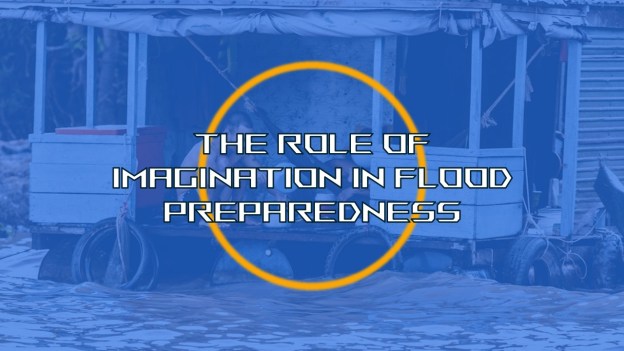
The role of imagination in flood preparedness.

The Role of Imagination in Flood Preparedness

In a previous post, I looked at how a failure of imagination potentially contributed to a tragic loss of life in the 2021 floods across Northern Europe. Because people were not able to grasp the potential impacts of the flood that they were being warned of, they did not take appropriate action to keep themselves safe. Professor Hannah Cloke of the University of Reading described the role of scientists here as “helping people see the invisible”.

Recent research led by Joy Ommer, part of Cloke’s research group, begins with the line “What’s the worst that could happen?“. The paper, ‘Surprise floods: the role of our imaginations in preparing for disasters‘ – published open-access in Natural Hazards and Earth System Sciences – looks back at those floods in 2021 and explores the role a lack of imagination played. Crucially, it also shows the role we as scientists have in helping people understand risks.

Ommer places imagination in the context of this research as “the ability to depict a particular situation in your mind and your actions linked to that situation“. We use this cognitive ability to visualise in our everyday decision-making and for trying to work out what the future might hold. It is informed by our experiences and our ability to imagine – Ommer describes people as having different abilities to imagine, which may be cultivated, but does not explore it as a skill that can be trained. Importantly for disaster preparedness, imagination plays a key role in risk perception by adding to our reality and existing knowledge of a situation.

The research used a survey of people who were affected by the floods to better understand their perspectives. As highlighted in the paper, many of those affected reported that their ability to understand the impacts of the flooding was lacking – it was unimaginable or they did not have the imagination to understand the scale of it. Several linked their inability to imagine the flooding to a lack of preparedness for it. To many, it was only when they saw videos of flooding happening, and feeling empathy for those in the videos, that they started to comprehend the potential consequences for themselves.

This research by Ommer and co-authors highlights and breaks down key aspects about how imagination is linked to risk perception and preparedness for disasters. The solutions they propose include using forecasts and warnings designed to trigger imaginations. They also argue that we need to work with those at risk to cultivate their imaginations using creative approaches, such as local storylines, and helping them to visualise potential impacts.

This is a really important and interesting paper for understanding the important role imagination has to play in disaster preparedness.

How can you help to become more prepared for disasters like flooding?

This post originally appeared in the Imagination Engines newsletter. To read this content a few weeks earlier, subscribe to the newsletter below.

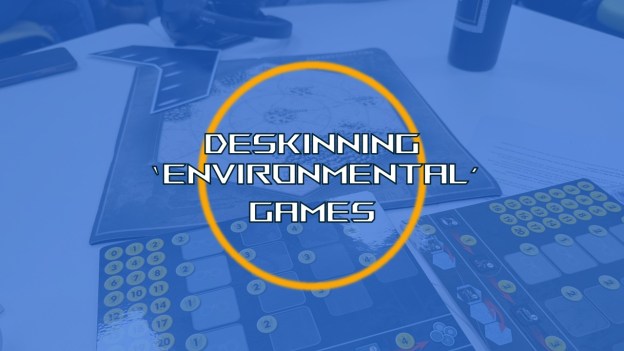
Deskinning environmental games.

Deskinning ‘Environmental’ Games

Back in 2019, at the peak of my work on the Earth Arcade, I picked up a board game called Photosynthesis. I am not a big board game player but I was attracted by its beautiful, and very ‘green’, aesthetic and its tactile tree playing pieces*. I was also drawn by its promising environmental messaging, with the publisher’s, Blue Orange, motto proudly stated ‘Hot Games Cool Planet’.

I also remember playing it with Amy. Each turn the sun moves around the board. You plant trees. Those trees collect light energy and cast shadows on other tree to stop them collecting energy. You use energy to grow your trees or plant new ones. You score by chopping grown trees down. We remarked how it was bizarre how you won an environmentally-themed game through deforestation but then thought no more of it. I went on to use the game as an example of an environmentally themes board game as part of my Earth Arcade Academy launch event.

Dr Chloé Germaine and Prof Paul Wake of the Manchester Game Centre think about games on a whole different level to most people. Certainly more than me. Recently, I was very happy to be invited to the University of York’s Environmental Sustainability at York (ESAY) by Director of Education, Prof Lynda Dunlop, to hear Chloé and Paul talk about their research. And Photosynthesis was right in the heart of their work.

Games can be broken down into their components: the mechanisms of the rules and systems that dictate how it plays; the dynamics of player inputs and decision-making; and the skin of aesthetics and story that add flavour to the game. They saw through the skin of Photosynthesis to what it was hiding underneath. It isn’t an environmental game at all, it is a war game and they were going to show it by peeling back the game’s skin and revealing its true nature.

A photo of the Suppressive Fire game, with game board, rulebook, and playing assets. It has a military style.

Chloé and Paul took the game back to its bare bones. They created a new narrative based on the siege of Bastogne during World War 2’s Battle of the Bulge. New artwork was commissioned for the board and all of the game assets. The rule book was reproduced but not rewritten – only names were changed.  Suppressive Fire was created. Functionally, the game was completely unchanged yet visually it was unrecognisable. When they tested it alongside Photosynthesis, audiences preferred the deskinned version as the narrative fit the mechanism more comfortably.

The presentation taught me valuable lesson about the importance game mechanics. The way a game works, the decisions it compels players to make, are a huge part of what they take away.  Assuming good faith from developers, the mechanics of their game will be leaving players having learned the wrong message. A pretty, green-coloured skin is not enough to make a game environmentally-themed, especially when it is rooted in a system that is creating the problem. 

You can read more in Chloé’s chapter, Nature’ Games in a Time of Crisis, in Material Game Studies: A Philosophy of Analogue Play. More publications based on this work are in the pipeline and will likely be included in the Gaming Environments newsletter in the future.

What game would you reskin to give it an environmental aesthetic?

*The trees have been useful for my gaming imagery over the years…

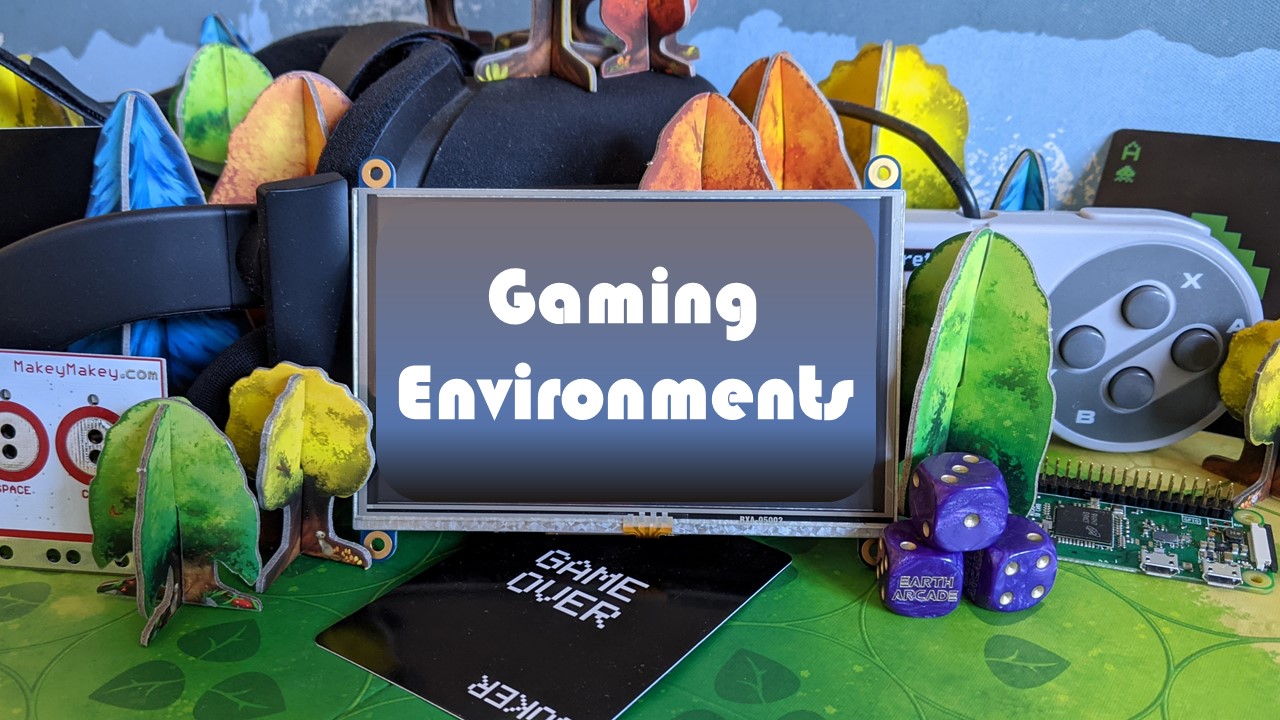
A screen with Gaming Environments written on it. It sits surrounded by gaming items, the green gaming board from Photosynthesis and green, yellow, orange, and blue trees. There is a gaming controller, VR headset and a Makey-makey.

This post originally appeared in the Imagination Engines newsletter. To read this content a few weeks earlier, subscribe to the newsletter below.

Inspiring Interactions: Sam Illingworth's Games, Science, and Poetry.

Inspiring Interactions: Sam Illingworth’s Games, Science, and Poetry

Ideas do not come out of nowhere. We are all influenced by the environment around us. We absorb information and experiences that shape our mindsets. The people we encounter will bring us new ways of seeing the world and inspire us. In this new item, which I hope to make a regular feature, I introduce you to someone who has been an inspiration to me and ask them a few questions about their thoughts on imagination. I’m going go to start with legendary science-poet, Professor Sam Illingworth.

Sam is a Professor in Academic Practice at Edinburgh Napier University. After completing a PhD in Atmospheric Physics at the University of Leicester, Sam instead chose to pursue a career in science communication. He is best known for his poetry, with his science poetry blog attracting over 100,000 readers a year.

A headshot of Sam.

He is dedicated to service in scicomm too. He is the Chief Executive Editor for Geoscience Communication and founder of science-art journal Consilience. He was a convener for the popular EGU science communication session, which was where I first met Sam after I presented my work with Humber in a Box.

Sam shares my love for games and has published many himself, including a climate change hack of Settlers of Catan and Carbon City Zero. He gave me a hugest of legs up in my career when he and Rolf Hut approached me about starting Games for Geoscience at EGU – it wouldn’t have happened without them.

I refer to Sam on how science communication research should happen: innovative, blurring boundaries, fun, yet thoroughly evidence-based. Every so often, I revisit his presentation from when he accepted the Katie and Maurice Krafft Award to remind me of these things.

Why is imagination important to the work you do?

Imagination is at the heart of everything I do – whether it is writing poetry, exploring how students interact with GenAI, or making games. For me, poetry is a way of stretching thought, a means of making connections between ideas and disciplines that might not otherwise meet. It is also a space for possibility, for imagining the world not just as it is but as it could be.

How do you keep your imagination sharp?

Writing poetry is one of the best ways I know to keep my imagination alive. The constraints of form – whether haiku, sonnet, or something more free form – force me to think differently, to approach ideas from new angles. I also find that collaborating across disciplines, whether with artists, scientists, or educators, pushes me to engage with new perspectives and ways of thinking.

What are you currently working on you would like to shout about?

Two projects I am particularly excited about at the moment:

  • Student x GenAI ( https://www.studentxgenai.co.uk/) explores how students are using generative AI, giving them a platform to share their experiences and perspectives. It is an ongoing, collaborative project funded by the Leverhulme Trust that raises some fascinating questions about creativity, authorship, and learning in an AI-shaped world.
  • Rooted in Crisis ( https://rootedincrisis.com/) is an incredible project at the intersection of science, art, and environmental storytelling. It uses games and narrative to explore climate change, and we should hopefully go live on Kickstarter later this year. We also have some new artwork to share very soon!

What would you write a science-poem about?

This post originally appeared in the Imagination Engines newsletter. To read this content a few weeks earlier, subscribe to the newsletter below.

The Imagination Muscle by Albert Read

The Imagination Muscle by Albert Read

A few years ago we started a new Christmas tradition in our house. On We would each buy each other a book – we’d say what we wanted – and on Christmas Eve we’d exchange them and read them in bed with some nice hot chocolate. We turn the lights day, put on some fairy lights, and snuggle up warm under the duvet to read our books, accompanied by our cats. I’m not going to claim originality, The exchange of books is a common tradition in Iceland that inspired the term Jólabókaflóðið, or Yule Book Flood, which refers to the release of new books at this time of year to fuel the demand. The duvet, the lights, and the hot chocolate is inspired by the Danish concept of hygge, its meaning elusive but involves coziness and warm atmosphere.

The problem is, unlike my wife, I have never been an avid reader. It is something I find hard to focus on and get easily distracted and frustrated. For what I can now see as a form of accommodation, I chose a graphic novel the first time round, the first volume of Scott Pilgrim series (I’m a big fan of the film). In 2023, I reached the end of the series and I had to recommend something else. In the last few years I have discovered audiobooks and they have revolutionised my reading habits – I’ve always wanted to read but it just was not accessible for me – I have read more in these past couple of year than I have in the rest of my life. I wanted something to inspire me and my imagination and settled on The Imagination Muscle by Albert Read.

I did not know anything about this book or its author. I was drawn to the title and its promising subtitle of “Where good ideas come from (and how to have more of them)”, which perfectly resonates with my journey of seeking imagination as a skill. At 7 hours and 51 minutes long, I did not consume the whole book on Christmas Eve and it kept me inspired until mid-January whilst I sorted the kitchen and the cats at the end of the day.

I must admit, it did not meet my expectations. But that is not a negative. From the title and the blurb, I was expecting something that would be more of a lifestyle guide, with a stronger focus on the “and how to have more of them” angle. I thought it would be packed with helpful tips and exercises you could do to practice and strengthen that ‘imagination muscle’. This is not that book but I am pleased it was not.

In the book, the author takes us on a deep dive of human imagination, both individual and collective, as it has developed in concert with society – a symbiotic relationship. He weaves this narrative, from the earliest cave paintings to the latest technological developments, showing that society has developed because of imagination and that imagination has developed, and been allowed to flourish, because of the advancement of society. He shows how historical leaps, like the emergence of language and the inventions of the printing press and the internet, born from imagination and building on chains of individual genius, have facilitated great expansions of imagination. The journey Albert Read takes the reader on is enlightening and enriching.

But that is not to say there is not anything helpful in here on how to build your imagination muscle. There are explorations of what made people so imaginative (and what can lead to deterioration of the muscle). For example, Read demonstrates how the ‘beginners mindset’ is fertile ground for imagination and good ideas – that space of uncertainty and needing to learn creating a breeding ground of problem solving. Maybe ADHDers tend to be creative and imaginative because we are always trying something new! Connection with nature, the rhythm of walking, and the power of coffee as both a stimulate and its role in networking are all discussed.

I was very pleased I chose this book. I really enjoyed listening to it and found myself both informed and inspired by the human story of imagination laid out by Read. The imagination as a muscle is a useful metaphor and a different, yet complimentary, way of thinking to imagination being a skill. Both attest to it being something that gets better with practice and advocate for us to make time to do just that.

How would you strengthen your imagination muscle?

This post originally appeared in the Imagination Engines newsletter. To read this content a few weeks earlier, subscribe to the newsletter below.