Tag Archives: Preparedness

Good Morning - Solo roleplay game

Good Morning – Solo Roleplay Game

Those who work to plan and prepare for disasters will often use a method called counterfactuals. It proposes ‘what if?’ questions to the planners and they work out how they would respond if that circumstance arose. Similarly, after something bad happens we often look back and think about what we might have done differently.

Downward counterfactuals combine these two methods. It looks back at something that happened and asks ‘what if this other thing happened too?’. For example, planners might look back at how they responded to a disaster and then ask what they would have done if they lost power to their operations room, or if the phone network went down, for example.

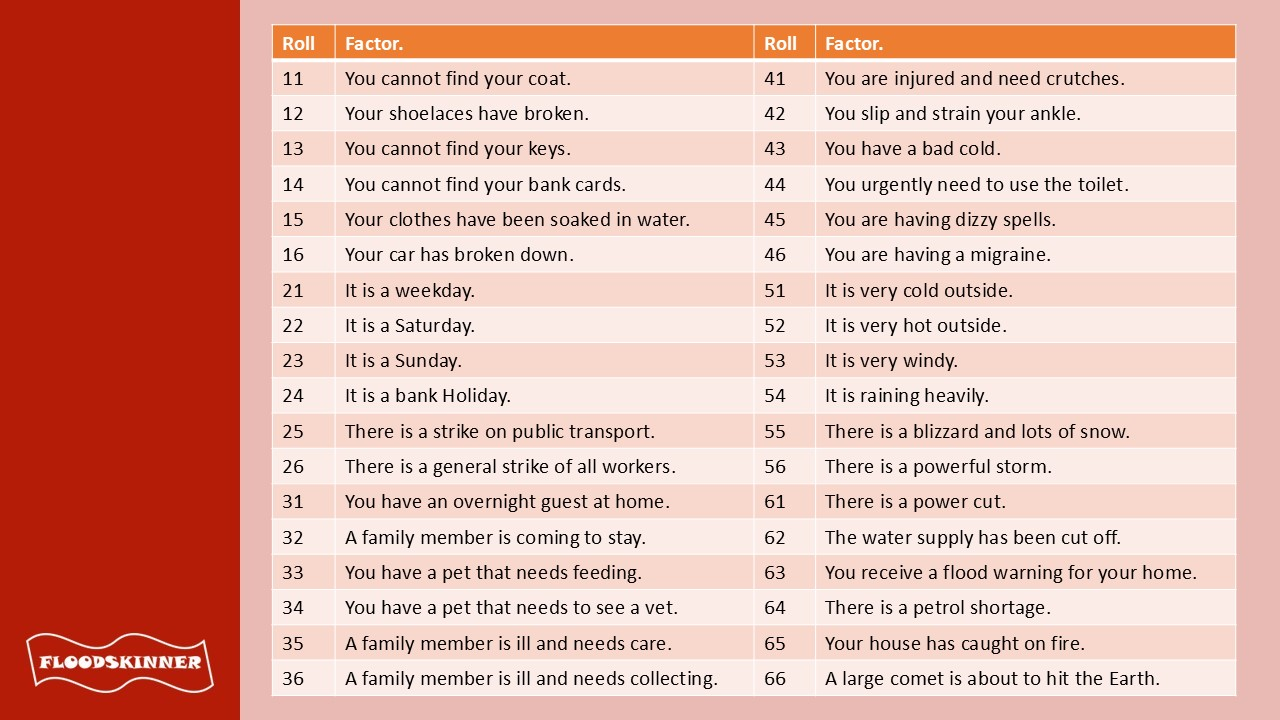
Good Morning is a very simple solo roleplay game. It asks you to first generate a task and then generate a complicating factor. You respond by writing down how you would respond to these. Then, generate a further complicating factor to add to your scenario. How does this change your response?

To generate a task or factor, roll two 6-sided dice, one after the other. The first roll is the first digit and the second the second digit. For example, roll a 2, then a 3, your result is 23. Then find that number on the corresponding table.

Rules sheet for Good Morning game.
Matrix sheet for tasks for Good Morning game.
Matrix sheet for factors for Good Morning game.

This isn’t meant to be serious, just a bit of fun to get you thinking – and imagining – how you might act is some very normal and some very odd circumstances. I hope you enjoy!

Let me know if you tried it and what happened by leaving a comment below.

This article originally appeared in the April issue of Imagination Engines. To get my content earlier and sent straight to your email, subscribe using the box below.

Views are my own.
The role of imagination in flood preparedness.

The Role of Imagination in Flood Preparedness

In a previous post, I looked at how a failure of imagination potentially contributed to a tragic loss of life in the 2021 floods across Northern Europe. Because people were not able to grasp the potential impacts of the flood that they were being warned of, they did not take appropriate action to keep themselves safe. Professor Hannah Cloke of the University of Reading described the role of scientists here as “helping people see the invisible”.

Recent research led by Joy Ommer, part of Cloke’s research group, begins with the line “What’s the worst that could happen?“. The paper, ‘Surprise floods: the role of our imaginations in preparing for disasters‘ – published open-access in Natural Hazards and Earth System Sciences – looks back at those floods in 2021 and explores the role a lack of imagination played. Crucially, it also shows the role we as scientists have in helping people understand risks.

Ommer places imagination in the context of this research as “the ability to depict a particular situation in your mind and your actions linked to that situation“. We use this cognitive ability to visualise in our everyday decision-making and for trying to work out what the future might hold. It is informed by our experiences and our ability to imagine – Ommer describes people as having different abilities to imagine, which may be cultivated, but does not explore it as a skill that can be trained. Importantly for disaster preparedness, imagination plays a key role in risk perception by adding to our reality and existing knowledge of a situation.

The research used a survey of people who were affected by the floods to better understand their perspectives. As highlighted in the paper, many of those affected reported that their ability to understand the impacts of the flooding was lacking – it was unimaginable or they did not have the imagination to understand the scale of it. Several linked their inability to imagine the flooding to a lack of preparedness for it. To many, it was only when they saw videos of flooding happening, and feeling empathy for those in the videos, that they started to comprehend the potential consequences for themselves.

This research by Ommer and co-authors highlights and breaks down key aspects about how imagination is linked to risk perception and preparedness for disasters. The solutions they propose include using forecasts and warnings designed to trigger imaginations. They also argue that we need to work with those at risk to cultivate their imaginations using creative approaches, such as local storylines, and helping them to visualise potential impacts.

This is a really important and interesting paper for understanding the important role imagination has to play in disaster preparedness.

How can you help to become more prepared for disasters like flooding?

This post originally appeared in the Imagination Engines newsletter. To read this content a few weeks earlier, subscribe to the newsletter below.